
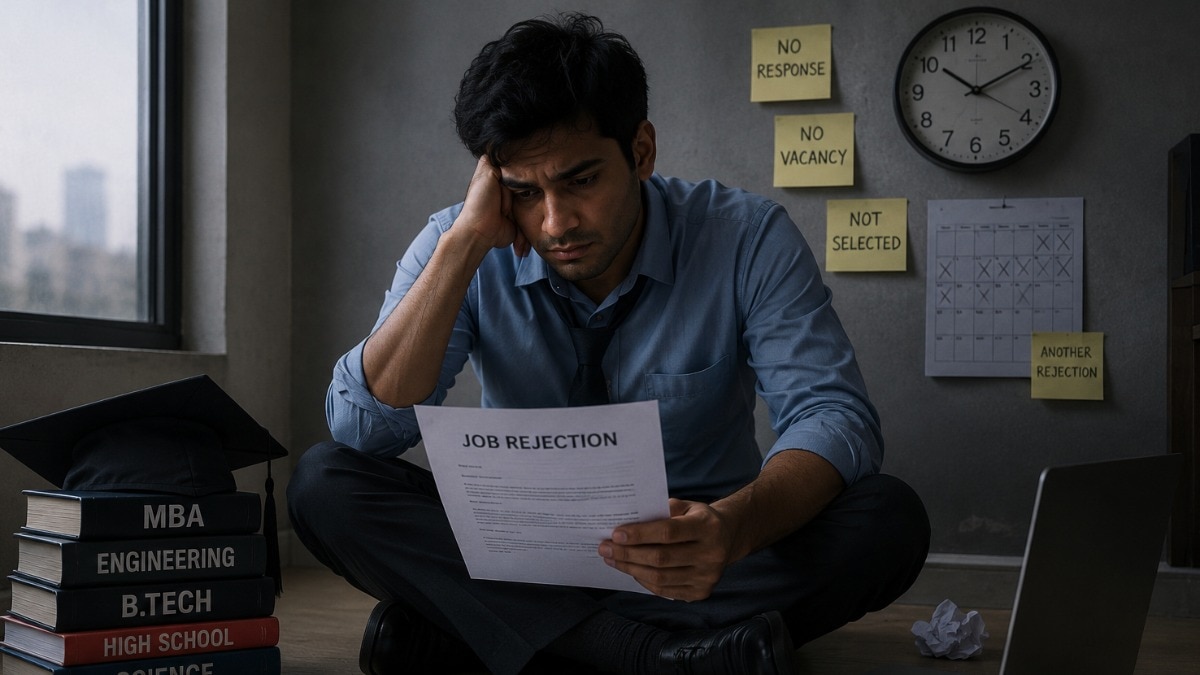
At 34, Ranjan has done almost everything a jobseeker is told to do.He graduated in 2018 hoping to build a career in data analytics and data science. Since then, he has learnt SQL, Python and Power BI, built portfolio projects and dashboards, taken freelance data-analysis assignments, run home tuitions and continued studying.Eight years later, he is still trying to get into the career he trained himself for.The Delhi-based jobseeker says the biggest barrier has not been learning the skills, but convincing recruiters that he deserves a chance to use them. “I graduated back in 2018, eager to break into data analytics and data science. What followed was years of hitting a concrete wall erected by Indian corporate recruiters who value years sitting in a chair over actual problem-solving ability, analytical thinking or tool proficiency,” Ranjan told India Today Digital.“Recruiters copy-paste job requirements asking for eight to 10 years of experience in frameworks, GenAI tools or cloud technologies that were only invented a few years ago,” he said. Ranjan's experience captures an uncomfortable paradox in India's labour market.According to the Periodic Labour Force Survey (PLFS) 2025, cited by the Labour Ministry in a Lok Sabha reply on August 3, unemployment among people who were illiterate stood at 0.3%. It was 0.6% among those educated up to primary level and 1.6% among those with middle-level education. Among people with secondary education and above, it jumped to 6.5% — more than twice the national unemployment rate of 3.1%.Why does having more education not necessarily make it easier to find a job?Part of the answer is that not everyone can afford to wait for the “right” job.“If you are in the lower-income bracket, then you have to take any job that you are getting,” economist Mitali Nikore, founder of Nikore Associates, told India Today Digital.Someone who needs an income immediately may take agricultural work, casual labour or an informal job, even if it has little connection with their education. Someone from a household with greater financial security can afford to wait.“Those with higher education hold out for longer for the right job,” Nikore said.There is another blind spot in the numbers. People who become discouraged and stop looking for work are no longer counted as unemployed.“You may have been looking for a job for six or eight months and then say, ‘No, I am not looking for a job anymore. I am not even in the labour force.’ So you have that category of people as well,” she said.THE FIRST JOB THAT ASKS FOR EXPERIENCEAround 70% of young jobseekers said securing their first job was harder than it had been three to five years earlier, according to Indeed's Fresher Hiring Report 2026. Seventy-two per cent said entry-level roles frequently demanded prior experience, while only 20% reported access to paid internships during their studies.Sashi Kumar, Managing Director of Indeed India, says fresher hiring has softened since 2021, particularly in technology.“Graduate hiring is becoming more selective rather than disappearing,” Kumar told India Today Digital.“As AI and technology reshape entry-level work, employers are looking beyond what a candidate studied to what they can actually do,” he added.That creates a difficult circle: employers want experience to prove capability, but many graduates cannot get that experience without first being hired.Ranjan says he has repeatedly run into that wall.“Having a gap means 90% of automated ATS algorithms reject the resume instantly, completely ignoring GitHub repositories, Kaggle tracks or live Power BI and Python dashboards,” he said.The experience requirement has also created a shadow market, he says.“Because companies refuse to train or hire candidates with gap years or non-traditional backgrounds, an entire shadow industry of 'experience certificate' vendors and fake consultancy backdoors thrives,” Ranjan said.“Honest applicants who refuse to lie on their resumes get penalised, while those who pay for fake experience letters bypass initial HR screens,” he added.Saswata Chakraborty, 33, from Kolkata, sees the desperation behind such stories up close.A cybersecurity analyst, he has been helping unemployed young people get referred to vacancies in IT and business-process services companies, without charging them.“I started doing this based on the bitter experience I faced during my own job-searching days. I feel the despair people go through during the job-search period and the crushing weight of unemployment that bears down on them,” Chakraborty told India Today Digital.What he sees at recruitment drives has stayed with him.“I am on ground zero of this, working in India's IT sector, where I see thousands of youth lining up in 40-degree heat or torrential rain just so they can appear for an interview for a Rs 15,000-in-hand job and then get rejected for being 'overqualified'. It hurts me,” he said.“I use my contacts within the IT and BPS industry to get people referred to vacancies available in their firms, so at least they can start earning something,” Chakraborty added.WHEN THE DEGREE AND THE JOB DON'T MATCHAyan, 37, from Kolkata, graduated in 2012 and completed his postgraduate studies in 2014. From a social science background, he spent years preparing for government jobs and supported himself through private tuitions.He eventually moved into the private sector. After seven years in BPS, he shifted into IT around a year ago.He is satisfied with his employer. The mismatch remains.“I am from a social science background. Currently, I am employed in the IT sector. As a result, my academics and my job role are entirely different, which is challenging for me,” Ayan told India Today Digital.“As the job role is not related to my academics, I have to learn new things every day to cope with my job role,” he said.Krishna (name changed), 36, from Gurugram, has taken a similar detour. His name has been changed because he did not want to be identified.After completing his master's degree, specialising in political studies, conflict and research, he spent years preparing for competitive examinations.“The whole process can take three years or more. That is why I opted for different options and chose to do a different kind of job,” Krishna told India Today Digital.Since 2023, he has worked as an independent contractor for a Switzerland-based company as a data quality reviewer.“My master's specialisation was related to political studies, conflict and research. What I am doing now is totally different,” he said.“For this job, I had to acquire skills that I did not get from my studies. What I was trained for academically is not relevant to the work I am doing now,” he added.“Those kinds of jobs may give you some money, but there is no social security,” Krishna said.He knows one highly qualified person from a village who, after years of trying to find work, is now thinking of moving back to farming.“In economic terms, I am not unemployed, but I am partially underemployed,” he said.WHEN EVEN A PHD DOES NOT GUARANTEE A JOBAniket, 33, from Bengaluru, took the education route much further.He graduated in 2023 with a PhD in Life Sciences and Biotechnology. After an intensive three-month search, he received offers from two biotechnology companies in India. By then, he had also received an offer for a postdoctoral position in the US. He chose the postdoc.Now that it has concluded, he is looking for a permanent role.“Since the postdoc has concluded, I am seeking to transition to a permanent role. I realised that the job market in India for our expertise has actually shrunk,” Aniket told India Today Digital.He is looking for biotechnology R&D roles involving recombinant protein production.“There is also very little scope of work in my field, membrane-based bioprocesses, in India,” he said.“Whatever interviews I have given have mostly been abroad. My job-search journey in India has not been very fruitful,” Aniket added.“I have received interest from professors abroad. It requires an interview and multiple steps before an offer comes, but at least I am talking,” he said.His experience raises a question a pure “skills gap” explanation cannot answer: what happens when someone has the qualification, specialised training and experience, but there are simply too few jobs for that expertise?THE JOBS PROBLEM BEHIND THE SKILLS PROBLEMDivya Srinivasan, economist and researcher, says India's educated unemployment problem has both a supply and demand side.“Educational attainment has expanded much faster than the pool of jobs,” Srinivasan told India Today Digital.India has created strong sectors in IT, finance and modern services, but they are relatively skill-intensive and cannot absorb the country's entire educated workforce.“The result is a missing middle in the labour market: not enough productive, well-paying jobs for people with secondary education, diplomas and ordinary university degrees,” she said.Manufacturing's share of employment remains around 11-12%, while growth within manufacturing has also tilted towards more capital-intensive segments.“I would see this as both a supply-side mismatch and a demand-side shortage,” Srinivasan said.“Training ten people for five jobs still leaves five people without jobs,” she added.At the same time, employers say many graduates arrive without enough practical experience.Arindam Mukherjee, co-founder and CEO of NextLeap, puts it simply. “Having a degree and being fit to do a job are becoming two distinct aspects,” Mukherjee told India Today Digital.A graduate may understand a subject theoretically but struggle to apply it to a business problem, use workplace tools, communicate clearly or work independently.“A degree should be the foundation of employability, not the final proof of it,” he said.NITI Aayog's August report, Reimagining Skilling for Viksit Bharat @2047, found that 80% of learners cited lack of practical experience and industry exposure as a major gap in their education. The report, citing the Economic Survey 2024-25, also found that only 8.25% of graduates were in high-competency occupations.Shantanu Rooj, founder and CEO of TeamLease EdTech, says this has created an experience paradox.“There is also an emerging 'experience paradox': many entry-level roles increasingly expect some prior exposure, while graduates have had limited opportunity to acquire it before joining,” Rooj told India Today Digital.“The deeper issue is that the employer increasingly wants proof of capability, while the education system still primarily provides proof of qualification,” he said.The attraction of government employment adds another layer. Ayan and Krishna both spent years pursuing it.Nikore says the preference is rooted partly in security.“There is no denying the aspiration for a government-sector job and the so-called job security associated with it, the working hours associated with it. There is an over-demand for government-sector jobs,” she said.But years spent preparing for competitive examinations can leave candidates with a career gap when they eventually turn to the private sector.NITI Aayog's report says 1.86 crore applications were received for just 55,000 government posts between November 2024 and July 2025.WHAT NEEDS TO CHANGE?“The first gap is often not knowledge, but the ability to apply knowledge in a workplace setting,” Rooj said.Nikore argues that industry must become much more closely involved in education.“The only way to increase employability is to have industry very closely involved in education,” she said.But education reform alone will not solve the problem. India also needs more productive jobs capable of absorbing people with degrees and diplomas — in manufacturing, healthcare, agriculture, care work, logistics, renewable energy and other sectors.“Children are often not aware that there is a career beyond doctor, lawyer, engineer or teacher,” Nikore said.The government has cited measures including the Pradhan Mantri Kaushal Vikas Yojana, National Apprenticeship Promotion Scheme, Craftsmen Training Scheme and FutureSkills PRIME. The Pradhan Mantri Viksit Bharat Rozgar Yojana, with an outlay of Rs 99,446 crore, aims to incentivise more than 3.5 crore jobs over two years.TeamLease EdTech's Career Outlook Report found that 75% of employers intended to hire freshers during July – December 2026.But the experiences of Ranjan, Ayan, Krishna and Aniket show why the headline unemployment number cannot tell the whole story.One has spent eight years trying to get his first real break. One found employment in a field entirely different from his education. One is working but calls himself partially underemployed. Another has a PhD and postdoctoral experience but is looking abroad for specialised work.And Chakraborty continues to see young people queue for Rs 15,000 jobs, hoping someone will give them a chance.India is educating more of its young people. The harder question is whether the economy is creating enough work worthy of that education.Because a degree can open a door. It cannot help much if there is no job on the other side.- EndsPublished By: Aprameya RaoPublished On: Aug 29, 2026 09:00 IST
Qualified but jobless: Why India's educated youth can't find the right jobs
Full Article
Original Source
Read the full article at Indiatoday →KhanList aggregates and links to publicly available news content. We do not host full articles from third-party sources. Always verify important information with original sources.