
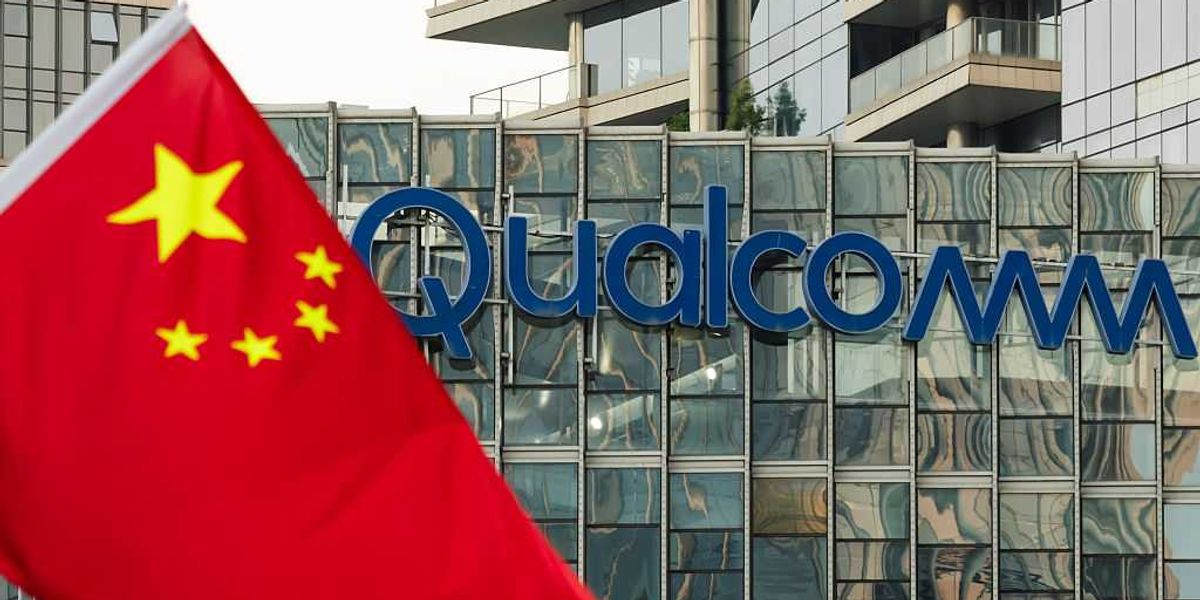
Nvidia’s boardroom scandal has reminded Washington how closely Silicon Valley's fortunes can be tied to China. CEO Jensen Huang resigned last week after revelations of an affair with a woman U.S. officials suspect may be a Chinese spy. At the moment, the espionage allegations remain unproven. But the episode raises a question the tech industry would rather avoid: How much exposure to Beijing is too much?Nvidia is hardly the only U.S. tech company in need of greater scrutiny. Consider Qualcomm.Washington has spent years arguing over which party is tougher on China and which party is tougher on big business. Qualcomm offers a test of whether either side means it.The San Diego semiconductor giant looks like a triumph of American innovation. Yet its latest annual filing attributes $18.1 billion — 42% of its fiscal 2026 revenue — to customers or licensees headquartered in China, including Hong Kong. That accounting figure doesn’t tell us where every device is ultimately sold. It does show how much business Qualcomm conducts with Chinese-headquartered customers.Qualcomm also maintains offices across more than a dozen Chinese cities. In a country where major businesses operate under intense political and legal pressure from the Communist Party, those relationships warrant questions that go well beyond an earnings call.This is no sudden entanglement. In 2014, Qualcomm turned to Chinese chipmaker SMIC to manufacture Snapdragon processors. The United States later placed SMIC on a trade blacklist. In March, U.S. officials accused SMIC of providing chipmaking tools to Iran’s military-industrial complex. Under the circumstances, perhaps the Trump administration should take a harder look at Qualcomm’s supply chains.Then there’s Huawei. In October, Qualcomm and the notorious Chinese tech giant announced a broad patent-licensing agreement covering 5G, artificial intelligence, computing, and networking, along with Qualcomm's planned purchase of certain Huawei U.S. patents. The companies say the transaction is subject to required regulatory approvals.Huawei, meanwhile, faces a federal racketeering and fraud trial in New York involving allegations of intellectual-property theft and other misconduct. U.S. policymakers should ask why sensitive technology partnerships continue to deepen amid serious national-security concerns.The same question extends to AI. Washington has imposed restrictions on advanced technology exports to China, which uses digital tools for surveillance and political control. Yet Qualcomm has continued courting Chinese AI customers. The company even designed a data center chip specially made for China that’s designed to work around the export controls of its home country.RELATED: Nvidia scandal gets crazier — its top chips were apparently illegally sent to China yunping liang/Getty ImagesIf Washington intends to limit China’s access to advanced AI, policymakers should ask whether those limits actually work — and how much influence the companies selling into China have over the rules. An American company can obey the letter of the law while still leaving the country dangerously dependent on its most powerful rival.There’s another reason Washington should examine Qualcomm: its treatment of competitors and customers at home.In 2017, the Federal Trade Commission sued Qualcomm, alleging that its licensing practices unlawfully maintained dominance in cellphone modem chips. Apple also challenged Qualcomm’s royalty demands, before the two companies settled their lawsuits in 2019. Qualcomm’s “no license, no chips” policy became the center of the antitrust fight.Qualcomm won that fight. A federal appeals court rejected the FTC's case in 2020, finding no antitrust violation on the theories presented, and a later private case largely failed. But legal victory is no answer to every question about outsized market power.The company’s enormous patent portfolio gives it leverage throughout the connected-device economy. As wireless technology spreads from phones to automobiles, lawmakers can reasonably ask how that leverage affects prices, innovation, and competition. Losing an antitrust case does not mean Congress has to stop asking questions.RELATED: Cheap Chinese cars: Trojan horse built to undermine US security? Jade Gao/Bettmann/Getty ImagesHere is where divided government could actually work. President Trump wants to limit China's leverage over American industry. Democrats, including Sens. Elizabeth Warren and Bernie Sanders, have made corporate concentration a cause of their own. They don't have to agree on everything to demand serious answers from Qualcomm.Rep. Jamie Raskin (D-Md.) and Sen. Sheldon Whitehouse (D-R.I.) are expected to lead the House and Senate Judiciary committees, respectively, when the new Congress convenes in January. FTC Chairman Andrew Ferguson and Attorney General Todd Blanche have their own responsibilities. Together, Congress and the administration can examine the security consequences of technology partnerships, the adequacy of export controls, and the effects of Qualcomm's licensing practices.Washington has spent years arguing over which party is tougher on China and which party is tougher on big business. Qualcomm offers a test of whether either side means it.American technology companies have every right to compete overseas. They have no right to be exempt from scrutiny at home. If Qualcomm wants Washington to treat it as an American champion, it can start by answering American questions.
Qualcomm has a China problem. America has a Qualcomm problem.
Full Article
Original Source
Read the full article at Theblaze →KhanList aggregates and links to publicly available news content. We do not host full articles from third-party sources. Always verify important information with original sources.