
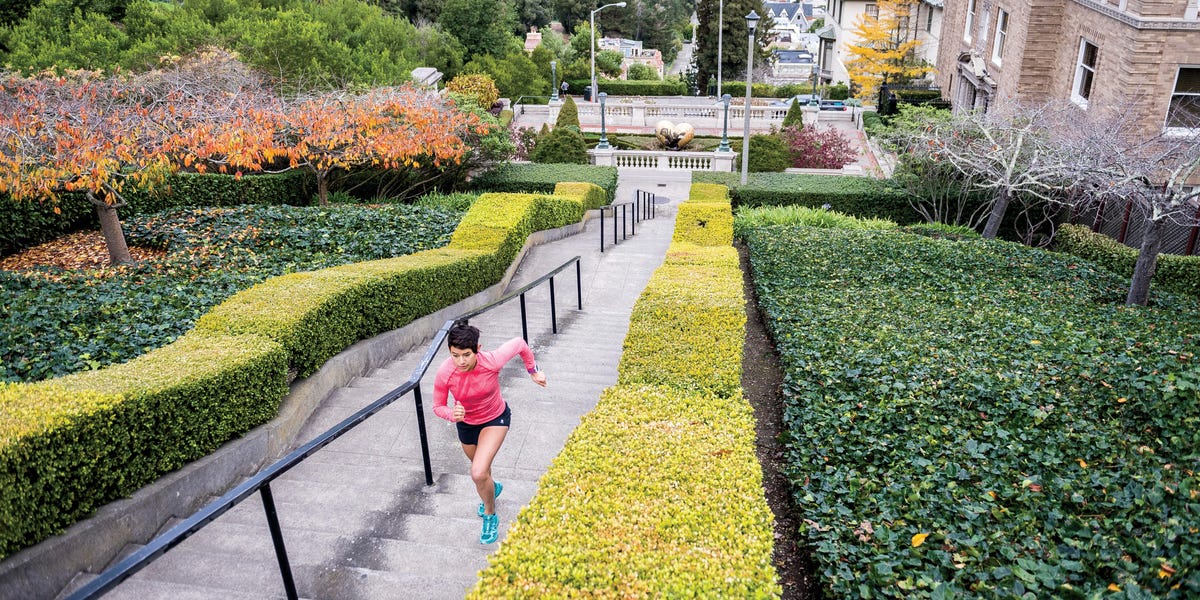
You know you’re working your quads when you’re hit with that sore, burning sensation at the front of the thighs toward the end of a long run, or on steep inclines in a hill workout. Frequently leaning on your quads means they’re doing more than their fair share of the work compared to other muscles, like your glutes and hamstrings.When the quads take on too much as you stride—in other words, when you’re quad dominant—it can lead to tight hamstrings or knee pain, and a lack of glute recruitment alongside it can steal from your power and get in the way of your best run performance.Fear not: The solution isn’t cutting back on your runs; it’s tailoring your fitness routine with specific exercises to help you strengthen the right muscles. But first, take this test to see if you’re really a quad-dominant runner. Then, read on for expert advice on addressing quad dominance so you can run strong, with less pain and fewer injuries.There’s a simple way to tell if you’re quad dominant: Sink down into your best squat position with your eyes closed. Once you get into position, open your eyes. Can you see your big toes? If you can, that likely means your glutes are firing properly, pulling your knees and quads back into a perfect squat position, explains Ellen London-Crane, a running coach at Heartbreak Hill Running Company in Boston.If you can’t see your big toes? “It’s because your knees are settling over your toes and your quads are taking over the balance work your glutes should be doing,” she says. That means you’re likely quad-dominant. If you see the outside of your feet, that could also mean weak glutes, causing the knees to drift inward.“Quad dominance occurs when the anterior muscles (quads and hip flexors) overpower the posterior muscles (glutes and hamstrings) of the leg,” explains AnneAlise Bonistalli, CSCS, a Boston-based strength coach and founder of Boom personal training.Strong quads are never a bad thing, but a strength imbalance could be. Overpowering quads can both hinder performance and up your injury risk.Here are other ways to recognize if you’re quad-dominant—and what you can do to get back in balance.Common Causes of Quad Dominance in RunningQuad dominance is actually pretty common in the running population, especially in speedier and higher-mileage types. That’s because when you go faster and farther, it takes more power to flex the hip and drive forward, which comes from your quads. Beginner runners are also at risk if they ramp up more mileage than their bodies are used to, says London-Crane.These characteristics are often paired with some other behaviors that only compound the problem, like not spending time doing the strength training or hillwork needed to balance out the back side of your body. “It’s likely that without these weight-bearing activities, your glutes and hamstrings are underdeveloped,” she says.So, most of the time, quad dominance can be blamed on weak glutes and hamstrings. “When these power muscles are weak, your quads naturally take over and throw off your front-to-back body balance,” London-Crane says.Quad dominance can also come to light after a hamstring injury, because when this power muscle is weak, your quads naturally take over and throw off your front-to-back body balance; or a back injury, because tight hip flexors may be causing an anterior pelvic tilt (when you arch the lower back). Anytime you experience an injury, remember to ease back into your routine slowly and carefully rebuild your fitness.Another risk factor: Avoiding the great outdoors for treadmill runs, over and over again. That’s because pounding on the treadmill takes some of the hamstring-glute function out of the equation, because the belt is essentially pulling your legs back, explains Angela Rubin, a former studio manager of Precision Running Lab at Equinox Chestnut Hill. As a result, your posterior chain may need even more strengthening.What’s more: “Especially in our day and age where most of us sit at desks for work, it’s really easy to be quad-dominant,” Rubin says. Spending hours at a desk can shorten and tighten both the hip flexors and quadriceps.The Problem With Quad-Dominant RunningAny bodily imbalance potentially ups injury risk and has the ability to hinder performance, Rubin says.Healthy, stable knees, for one, require two oppositional forces, including “strong quads to straighten the knee and help to flex the foot forward, and strong hamstrings to bend the knee and help to pull the leg backward,” London-Crane says. “These two muscles should be working together, and when they’re not, you put your knee at risk.”What’s more, a muscle imbalance in your lower half can mess with your goals on the road. Basically, you can’t quite maximize speed and efficiency if you’re only truly utilizing one half of your body.Look at it this way: If your quads are taking over for your hammies or your glutes, you’re not allowing these important muscles to do their thing.“Your glutes are your powerhouse, and most fatigue-resistant muscle,” Bonistalli says. “Without the glutes and hamstrings strength in helping drive each and every stride you make, you are not reaching your full running potential.”How to Fix Quad-Dominant RunningThe good news: Even if you’ve suffered strength or flexibility imbalances, recurring injuries, or gone your whole life without properly engaging your glutes, you can change things—and it’s worth considering if you’re noticing injuries or feel like your glutes are “sleepy,” and don’t fire during your lower-body exercises.So work on balancing out your body. Balance, in large part, comes in the form of building your posterior chain, Rubin says. “Focus on both the hamstrings and glutes to counterbalance all the quad activation,” she suggests.Glute activation exercises such as deadlifts, rack pulls, donkey kicks, and glute bridges all engage and strengthen glutes and hamstrings. Start with just your bodyweight while you nail form, then introduce weights to build strength and power, London-Crane suggests.FOLLOW OUR GLUTE ACTIVATION GUIDEFoam rolling your quads, hamstrings, and adductors, and active release of your tensor fascia latae (TFL/hip abductor) and iliopsoas (hip flexor) will alleviate any tension in your legs after hitting the road, Bonistalli says. “To get back to a ‘normal state’ you need to release the muscles that are tense and then activate and strengthen the muscles that are weak,” she explains.Keep in mind, though, when it comes to stretching and foam rolling, you need to do these practices concurrently with strength training for them to prove useful. Otherwise, it’s just temporary relief.One final reminder: Any change to your workout habits takes time and practice. And moving too quickly—like adding in 50 deadlifts out of the blue—can be a recipe for injury, London-Crane says. “Be sure to gradually ramp up your glute-activating exercises in the same way you’d gradually ramp up your weekly mileage,” she says.Cassie Shortsleeve is a Boston-based journalist with more than a decade of experience reporting for some of the nation's largest print and digital publications, including Women's Health, Men's Health, Medscape, Parents, Conde Nast Traveler, and others. She also writes the best-selling Substack newsletter Two Truths and is a co-founder of the non-profit Chamber of Mothers. John Vasudevan, M.D. is an associate professor at the University of Pennsylvania. He is board-certified in Physical Medicine & Rehabilitation and Sports Medicine. He is a Team Physician for UPenn Athletics and medical director of the Broad Street Run and Philadelphia Distance Run, and previously for the Rock 'n' Roll Half-Marathon and Tri-Rock Triathlon in Philadelphia. He is a director of the running and endurance Sports Medicine Program at Penn Medicine. Dr. Vasudevan provides non-operative management of musculoskeletal conditions affecting athletes and active individuals of all levels, and combines injury rehabilitation with injury prevention. He utilizes a variety of ultrasound-guided procedures and regenerative approaches such as platelet-rich plasma and percutaneous ultrasonic tenotomy. He sees patients at the Penn Medicine and the Philadelphia Veterans Administration hospital. Dr. Vasudevan attended medical school at the University of Wisconsin School of Medicine and Public Health in Madison. After his Transitional Year in Tucson, Arizona, he went to residency in PM&R at Thomas Jefferson University in Philadelphia and onwards to Stanford University for his fellowship in Sports Medicine. He has been in practice at the University of Pennsylvania since 2012.
Quad-Dominant Running Can Slow You Down. Take This Test to Spot (and Treat) the Imbalance
Full Article
Original Source
Read the full article at Runnersworld →KhanList aggregates and links to publicly available news content. We do not host full articles from third-party sources. Always verify important information with original sources.