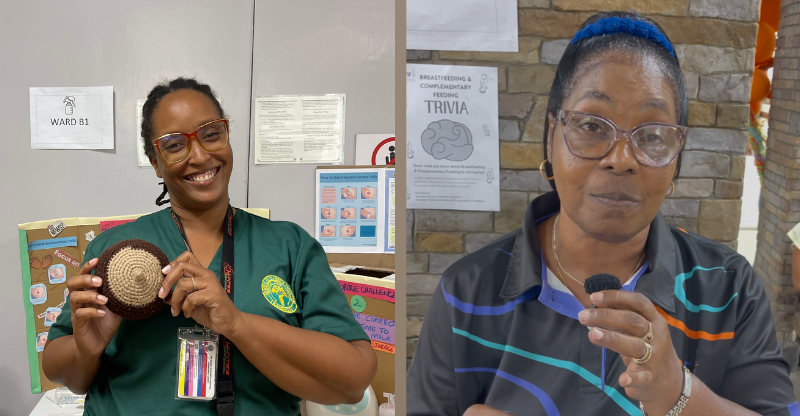
Registered nurse and midwife Shermena Kirton and BCNF representative and retired veteran midwife Betty Reid. (Photo credit: Lauryn Escamilla / Barbados TODAY) Healthcare professionals have renewed the call for employers to provide dedicated spaces where women can express and safely store breast milk as research has found that mothers stop breastfeeding upon returning to work. Registered nurse and midwife Shermena Kirton said workplace support is critical if Barbados is serious about improving breastfeeding rates. She pointed to research on exclusive breastfeeding by Dr Ashley Paris…that women stop breastfeeding and they go back to work. That’s the biggest challenge. Returning to work”. Kirton explained that while some mothers receive maternity leave, financial pressures often force many back to work much sooner. “We got three months. We get extra two weeks home, and that might not be for every mother. Some women gotta go back at six weeks. Some women in their workplaces may not give them the time and they need the money… so they have to go back.” She said the absence of suitable facilities in many workplaces creates another obstacle. You Might Be Interested In “So then if the facility is not providing the space for her to be able to pump… then she resorts to formula.” Kirton stressed that greater support is needed both at work and at home. “So the challenge is back to work, making sure that there’s something that can be done and supportive persons at home… So that’s the main challenge, not good support at home and not the support at work for breastfeeding mothers.” During the Breastfeeding Awareness Month pop-up event, Barbados TODAY was shown two of the hospital’s own breastfeeding rooms, which Kirton said demonstrates that establishing a lactation space does not require expensive infrastructure. Lactation room available at the hospital. (Photo credit: Lauryn Escamilla / Barbados TODAY) “In here… we have a chair for mommy… We have a sink. We have a fridge. Those are the key things that we need… You can shut your door. It’s private.” Kirton argued that employers also benefit from supporting breastfeeding mothers because healthier babies mean fewer days off for parents. “It might look like, ‘Oh no, she’s always out pumping,’ but in the long run, you can get more from her pumping three times in a day than she should be out for three days because she had to stay home with her child.” Registered nurse and midwife Simone Richardson-Small, of the labour ward, said designated breastfeeding areas should become standard in workplaces because they support both mothers’ health and children’s development. “That is crucial,” she said. “There need to be a designated area so that mommy can express milk… to help reduce the risk of mommy breast becoming engorged, which can lead to mastitis.” She added that babies also benefit significantly from receiving expressed breast milk. “It helps baby to gain weight, helps to reduce the risk of infection and it also helps with brain development… Overall it is good for the country.” The Breastfeeding and Child Nutrition Foundation (BCNF) is also advocating for legislative action. Retired veteran midwife and BCNF representative Betty Reid said the organisation wants the government to make workplace lactation spaces mandatory. “We’re one of the ones that advocate towards workplaces having a special area where nursing mothers can go… to either express the milk or even to breastfeed the babies during working time.” “We are trying to advocate now for the government to make it policy that all workplaces have an area like that where moms can go and breastfeed or at least express the milk.” (LE)
QEH breastfeeding advocate calls for workplace support as mums return to work
Full Article
Original Source
Read the full article at Barbadostoday →KhanList aggregates and links to publicly available news content. We do not host full articles from third-party sources. Always verify important information with original sources.