
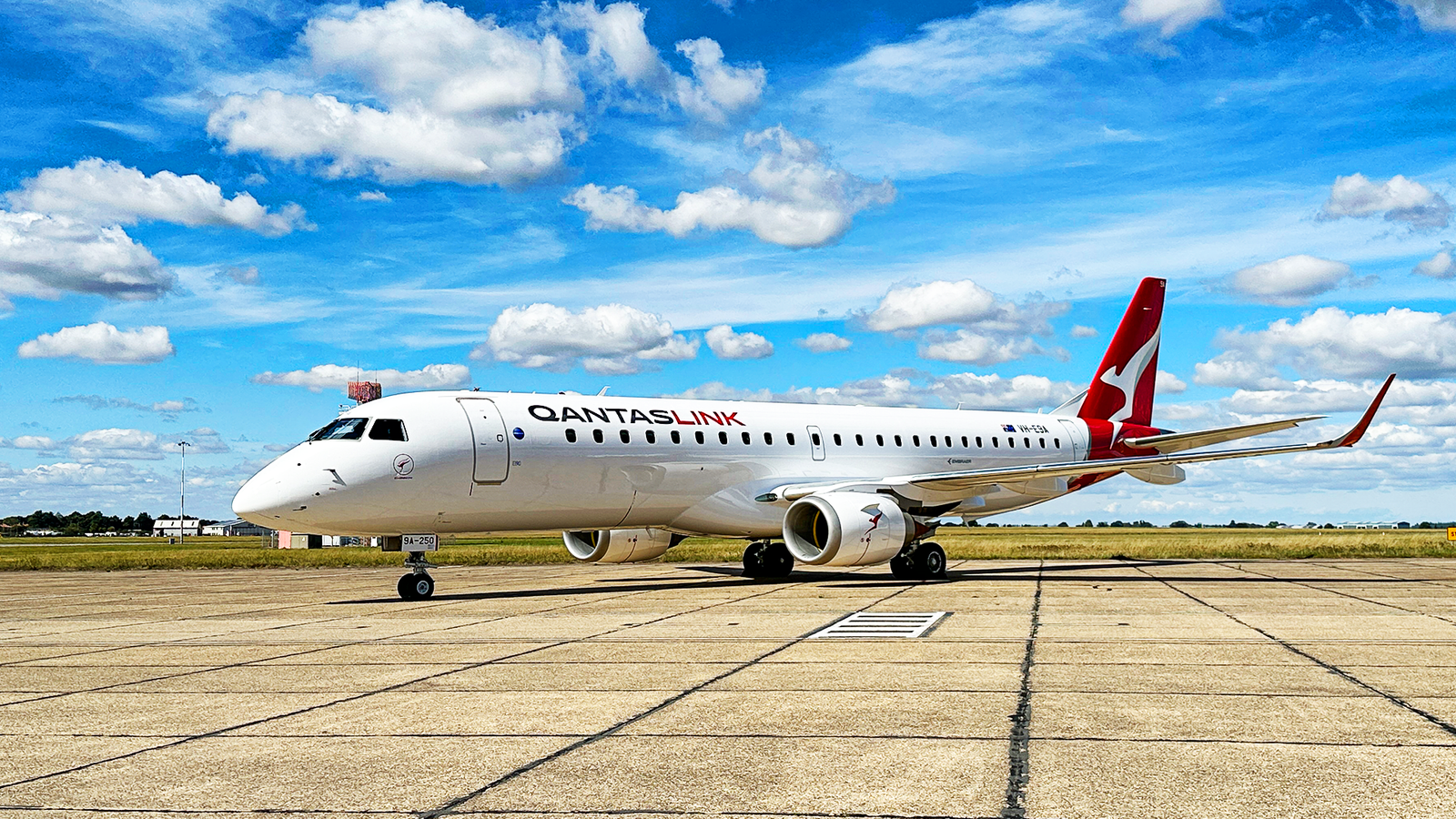
Credit: Qantas | Simple Flying Published Oct 8, 2026, 1:00 PM EDT Experienced ICAO English Language Proficiency Instructor for pilots and ATCOs and conference interpreter who is passionate about facilitating effective communication within aviation-related businesses. Possess a deep understanding of the aviation industry, including aviation regulations, terminology, and industry-specific communication protocols. Has been working at numerous airshows across Europe since 2014. Being an ultralight pilot in her free time, she also promotes safety and efficiency in aviation operations. Based in Italy and Malta Sign in to your Simple Flying account QantasLink’s first Embraer E190 (which is not operated by Alliance Airlines) has already completed one of the more unusual journeys it is ever likely to make for the airline: a 20-hour delivery flight from Norwich in the UK to Perth, crossing Europe, Central Asia, South Asia and Southeast Asia before finally reaching Western Australia. The aircraft, VH-E9A, named “Exmouth”, previously served KLM Cityhopper under PH-EZC tail number. It arrived in Perth on September 7, marking the beginning of a major fleet transition that will eventually see up to 14 E190s replace Network Aviation’s aging Fokker 100s. The question is why a relatively small regional jet needed such an extraordinary route to reach its new home. As the aircraft’s flight history shows, VH-E9A traveled through numerous countries before reaching Perth, with the entire journey taking around 20 hours of flying time. For aviation enthusiasts following the aircraft’s progress, our Live Flight Tracker provides another way of putting the ferry flight into perspective, but the route itself tells the bigger story: QantasLink is preparing an aircraft designed for a very different era of Western Australian regional flying. Why QantasLink’s First E190 Had Such A Long Journey To Perth Credit: Simple Flying The remarkable ferry flight began because VH-E9A was being repositioned from Norwich, where it had been prepared for its new operator, to Network Aviation’s Perth base. Qantas confirmed the aircraft began its 20-hour journey at Norwich International Airport and stopped in Bulgaria, Tajikistan, India, Malaysia and the town of Broome in Western Australia before finally arriving in Perth. Qantas identified VH-E9A as the first of up to 14 mid-life E190s that will progressively replace the Fokker 100 fleet. The route was broken into six flying sectors: Norwich–Sofia, Sofia–Dushanbe, Dushanbe–Kolkata, Kolkata–Johor Bahru, Johor Bahru–Broome and Broome–Perth. Our aircraft tracking records confirm the full route and show the ferry operation took place between September 4 and September 7, with the E190 ultimately parked in Perth on September 7. Delivery sector Airports and countries Approx. distance 1 Norwich (NWI), United Kingdom → Sofia (SOF), Bulgaria 1,231 miles (1,981 km) 2 Sofia (SOF), Bulgaria → Dushanbe (DYU), Tajikistan 2,370 miles (3,815 km) 3 Dushanbe (DYU), Tajikistan → Kolkata (CCU), India 1,595 miles (2,568 km) 4 Kolkata (CCU), India → Johor Bahru (JHB), Malaysia 1,775 miles (2,857 km) 5 Johor Bahru (JHB), Malaysia → Broome (BME), Australia 1,851 miles (2,979 km) 6 Broome (BME), Australia → Perth (PER), Australia 1,043 miles (1,678 km) Total Norwich, United Kingdom → Perth, Australia 9,866 miles (15,878 km) Note: These are approximate great-circle distances between the airports, so the actual distance flown may have differed due to routing, airspace restrictions, weather, and operational requirements. What makes the journey particularly interesting is that it wasn't a long nonstop flight. The E190 was progressively repositioned across several regions, with the intermediate stops allowing the aircraft to cover the enormous distance between Europe and Australia in manageable stages for a regional narrowbody. That route also previews the geographic challenge Network Aviation faces every day: Western Australia has huge distances between population centers, mining operations, and regional airports. The question, then, is what makes the E190 suitable to replace an aircraft that has served this environment for almost two decades? From Fokker 100 To E190: Why QantasLink Is Making The Change Credit: DLeng | Shutterstock The answer begins with the aircraft being replaced. Similarly to Alliance Airlines, Network Aviation also introduced its first Fokker 100 in 2008, before the airline became part of the QantasLink operation in 2011. Today, those F100s remain deeply embedded in Western Australian flying, supporting around 120 charter and passenger services each week to more than 25 destinations across the state. The main reasons for replacement, according to the airline, are improved reliability, fuel efficiency and passenger comfort, as well as lower noise levels and greater range of the E-jet in comparison with the outgoing F100. QantasLink’s wider Western Australian fleet strategy is similarly focused on replacing older aircraft and upgrading cabins, with the airline describing the E190 program as part of a broader investment in its regional operation. The E190 itself is a natural fit for the capacity requirements and routes, as already proven by Alliance Airlines. Embraer describes the E190 as a regional aircraft with mainline capabilities, designed around a relatively low operating weight and a spacious single-aisle cabin. Depending on configuration, the E190 family can accommodate approximately 98–114 passengers, although QantasLink’s aircraft will be configured with 100 seats. The choice is less about finding a modern replacement and more about retaining the basic capacity Network Aviation needs while introducing a newer generation of aircraft. The E190 sits in the same broad 100-seat category as the F100, allowing QantasLink to modernize the fleet without making a dramatic change in aircraft size. But the airframe itself is only one part of the transition; the bigger change will be experienced inside the cabin. What The New E190 Cabin Will Change For Passengers Credit: Aerospace Trek | Shutterstock Passengers will notice the difference. Every E190 will undergo a cabin refresh before entering commercial service, with QantasLink promising new, more spacious seats, adjustable headrests, USB-A and USB-C charging, personal device holders and onboard WiFi. The WiFi installation will allow passengers to stream content on their own devices via the improved Qantas Entertainment App. The aircraft will also introduce Qantas Economy Plus to these Western Australian operations. According to Qantas, the product will provide additional legroom, priority boarding, and priority access to overhead baggage space. This is particularly significant on resource-sector operations, where passengers may spend a considerable amount of time traveling between Perth and remote work locations. QantasLink expects more than three million journeys each year to benefit from the improvements, while Network Aviation is simultaneously investing in training the workforce needed to operate the new type. Around 70 pilots, cabin crew and engineers are expected to receive a combined 18,000 hours of training by the end of 2026 for the initial E190 fleet. The scale of the training requirement also reveals something important about the transition: replacing the aircraft is only the beginning. Network Aviation must build the operational knowledge, maintenance capability, and crew pool around the E190 before the new fleet can take over a significant share of the F100 operation. Why The E190 Makes Sense For Western Australia’s Huge Distances Credit: Vidit Luthra | Shutterstock The E190's value becomes clearer when you consider where it will actually operate. Network Aviation’s Western Australian network is closely tied to the resources industry and regional communities, with aircraft regularly connecting Perth to destinations spread across a vast state. For an operation covering such distances, the E190’s combination of around 100 seats and greater published range than the F100 gives QantasLink additional flexibility without moving into a substantially larger aircraft category. Qantas confirms that its Network Aviation F100s have 100 economy seats, while the new E190s will also be configured with 100 seats, keeping the basic capacity of the operation broadly familiar. QantasLink Embraer E190 vs Fokker F100 Specification QantasLink Embraer E190 QantasLink Fokker F100 QantasLink capacity 100 seats* 100 seats Cabin configuration 2-2 2-3 Economy seat pitch Up to 31 inches (78.7 cm) 31 inches (78.7 cm) Maximum takeoff weight 114,199 lb (51,800 kg) 100,990 lb (45,810 kg) Length 118.0 feet (36.2 meters) 116.7 feet (35.53 meters) Wingspan 94.3 feet (28.7 meters) 92.2 feet (28.08 meters) Cabin width 9.0 feet (2.74 meters) 10.2 feet (3.10 meters) Average cruise speed 515 mph (829 km/h) 525 mph (845 km/h) Range with full payload 2,450 nmi (4,537 km) 1,710 nmi (3,170 km) Maximum fuel capacity 7,554 US gal (28,596 L) 3,531 US gal (13,365 L) Engines 2 × GE CF34-10E 2 × Rolls-Royce Tay Mk 650-15 Maximum thrust 2 × 20,000 lbf (89 kN) 2 × 15,100 lbf (67.2 kN) In-seat power To be added as part of QantasLink's cabin refresh None WiFi Planned as part of cabin refresh No *The 100-seat figure applies to the new Network Aviation E190 program. Qantas currently lists its separately operated E190s in 94- and 97-seat configurations, so the Network Aviation configuration should be considered separately from QantasLink’s existing Alliance-operated E190s. The most significant difference is the aircraft’s published range. Qantas lists the E190 with a full-payload range of 2,450 nautical miles (4,537 km), compared with 1,710 nautical miles (3,170 km) for the F100, giving the E190 roughly 43% greater published range. That does not mean every E190 route will be 43% longer, since real-world range depends on payload, weather, fuel reserves, and routing, but it gives Network Aviation a larger operating envelope for a fleet serving one of Australia’s most geographically expansive states. The passenger experience will also change, despite the similar seating capacity. Both aircraft can offer a 31-inch (78.7 cm) Economy seat pitch, but the E190’s 2-2 configuration eliminates middle seats, whereas the F100 uses a 2-3 arrangement. As mentioned previously, QantasLink also plans to add new seats, chargers, and onboard internet, which is a significant upgrade. But VH-E9A is also a conventional, mid-life E190 rather than a brand-new E190-E2, meaning the fuel-efficiency improvements specific to Embraer’s latest E2 generation should not be attributed to this aircraft. The E190’s capabilities also help put VH-E9A’s extraordinary delivery journey into perspective. The aircraft traveled across the globe, using a series of ferry sectors to bridge the enormous distance between Europe and Western Australia. Ultimately, QantasLink is replacing an aging 100-seat aircraft with a newer platform of broadly similar capacity but greater published range and a substantially updated cabin, leaving the next question of how quickly the E190 fleet can take over the demanding resources and regional flying currently performed by the F100. The E190 Is Only The Beginning Of QantasLink’s WA Fleet Renewal Credit: DLeng | Shutterstock VH-E9A is the first aircraft in a renewal program. QantasLink has described the aircraft as the first of up to 14 mid-life examples that will progressively replace the F100 fleet, with the first E190 expected to enter commercial service from January 2027, subject to regulatory approval. The timing means VH-E9A has several months of work ahead before passengers step aboard. The cabin refurbishment, the installation of connectivity equipment, and the introduction of the Qantas Economy Plus product must all be completed before commercial operations begin. Meanwhile, pilots, cabin crew and engineers are being trained on the type, creating a parallel transition on the ground and in the air. The program also fits into a wider effort to modernize Network Aviation’s Perth-based fleet. Qantas says 19 Perth-based Airbus A320s are receiving WiFi and seat and cabin upgrades, with the first aircraft expected to be completed by the end of October. The E190 program is therefore part of a broader effort to introduce newer cabins and improved onboard technology to an operation that serves some of Australia’s most geographically challenging routes. For the F100, meanwhile, the arrival of VH-E9A represents the beginning of the end of a particularly long chapter. The type has been a backbone of Network Aviation’s Western Australian operation for roughly two decades, carrying workers and other passengers across the state while developing a strong association with QantasLink’s resources-sector flying. The airline has even maintained the naming tradition: the F100s were named after Western Australian destinations, and the first E190 has continued that practice as “Exmouth.” VH-E9A Signals A New Era For Network Aviation Credit: Qantas The arrival of “Exmouth” in Perth is significant because the aircraft will spend much more of its life serving Western Australia than crossing continents on an extraordinary ferry flight. Once the refurbishment and regulatory work are complete, VH-E9A is expected to become the first operational example of a new aircraft family for Network Aviation, with additional E190s following as QantasLink gradually reduces its reliance on the F100. The next major test will be the transition from delivery aircraft to working aircraft. QantasLink has committed to a January 2027 commercial-service target, while the initial training program is already underway. If the airline reaches its planned scale, Qantas says more than 600 pilots, cabin crew and engineers could eventually receive E190 training, turning what is currently a single-aircraft arrival into a much larger operational transformation. For now, VH-E9A’s journey from Norwich to Perth provides an unusually fitting opening chapter. The aircraft crossed multiple regions of the world before reaching the network it was acquired to serve, while the fleet around it is preparing for an equally significant transition. The next aircraft deliveries, the completion of the cabin program, and the first commercial flights from January 2027 will determine how quickly this narrowbody becomes not an arriving aircraft, but the new standard for QantasLink flying across Western Australia.
QantasLink's First Embraer E190 Completed An Epic 20-Hour Delivery Flight
Full Article
Original Source
Read the full article at Simpleflying →KhanList aggregates and links to publicly available news content. We do not host full articles from third-party sources. Always verify important information with original sources.