
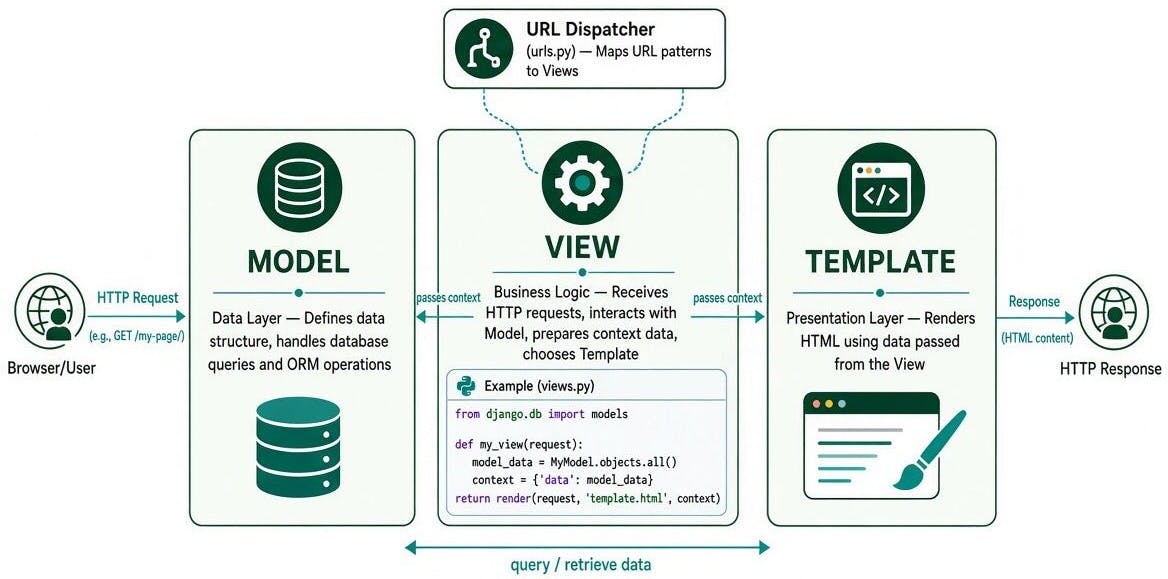
I didn't originally intend to write about this, but after reflecting on some recent architectural gaps, I thought—why not?Coming from the Ruby on Rails ecosystem, the Presenter pattern was a tool I enjoyed immensely. It was my secret weapon for keeping the presentation layer clean and avoiding the dreaded "logic leak" into views. However, when I transitioned to Python and Django, I found myself missing that dedicated layer.I didn't want to adopt a bloated library; I needed a lean, surgical way to manage MVT (Model-View-Template) logic. So, I built Python Presenter.The Problem: The "Inevitable Tangle" As applications scale, we often hit a wall where models become "fat," and templates become "messy." You start seeing logic complexity where a single model handles too many responsibilities, alongside presentation logic creep—where your HTML templates are suddenly doing math or complex string formatting. This tangled web makes testing difficult because presentation logic becomes nearly impossible to isolate from the database or the wider framework.Tests First: Defining the Contract When building this, I followed a rigorous testing pattern to ensure the architecture remained reliable. By looking at the unit tests, you can see exactly how the presenter is intended to behave before even looking at the implementation. For example, the BasePresenter tests ensure that the original object and the view context are correctly encapsulated, and that attributes remain easily accessible:def test_initialization_with_view_context(self, base_presenter): """Test BasePresenter initialization with object and view context.""" assert base_presenter.obj.name == "Test Object" assert base_presenter.view_context == {"context_key": "value"} We also test the "magic" of auto-discovery, ensuring the system can intelligently find the right presenter for a given model without manual mapping. Finally, the Django integration tests verify that our custom template tags can transform a raw model into a "presented" object seamlessly within a template string.Implementation: The Core Engine The architecture is built on three main pillars: 1. The BasePresenter The foundation is the BasePresenter class. It is a lightweight wrapper that holds the original object (self.obj) and an optional view_context. It uses __getattr__ to ensure that if the presenter doesn't explicitly override a property, you can still seamlessly access the original object's underlying data. 2. The present() Function & Auto-Discovery At the heart of the library is the present() function. It operates in two modes: Explicit Mode: You pass the object and the specific presenter class you want to use. Auto-Discovery Mode: You provide only the object. The function uses inspect.getmodule to find where the object lives, searches for a sibling presenter module, and automatically instantiates a class named {ClassName}Presenter. 3. The Bridge to Django To make this useful in a Django environment, I implemented a custom template tag. By using {% present_object model_instance %} in your template, the library intercepts the model and wraps it in its presenter. This creates a powerful "gateway" effect: any data not explicitly defined in your presenter will not appear on the template. This allows for significant transformations—such as uppercase formatting for a property_unit_type or consolidating labels into a single labels property—keeping your HTML purely declarative.High-Level Benefits By introducing this dedicated layer, we achieve the following: Improved Testability: Presentation logic can be unit-tested as pure Python classes without a database. Separation of Concerns: Data retrieval stays in the view/model, while formatting stays in the presenter. Cleaner Templates: Your templates stay logic-free, focusing only on how to display the "prepared" data. An Analogy for Clarification Think of your database model as raw footage from a camera, and your template as the final cinema screen. Without a Presenter, you are trying to edit, color-grade, and add subtitles while the movie is already playing for the audience. The Presenter is the editing suite: it takes the raw footage, processes it, adds the necessary titles, and hands over a polished, "ready-to-watch" file to the screen.Play around with it on https://github.com/afolabiolaoluwa/python-presenter
Python Presenter: Bringing the Magic of Rails to Django
Full Article
Original Source
Read the full article at Hackernoon →KhanList aggregates and links to publicly available news content. We do not host full articles from third-party sources. Always verify important information with original sources.