
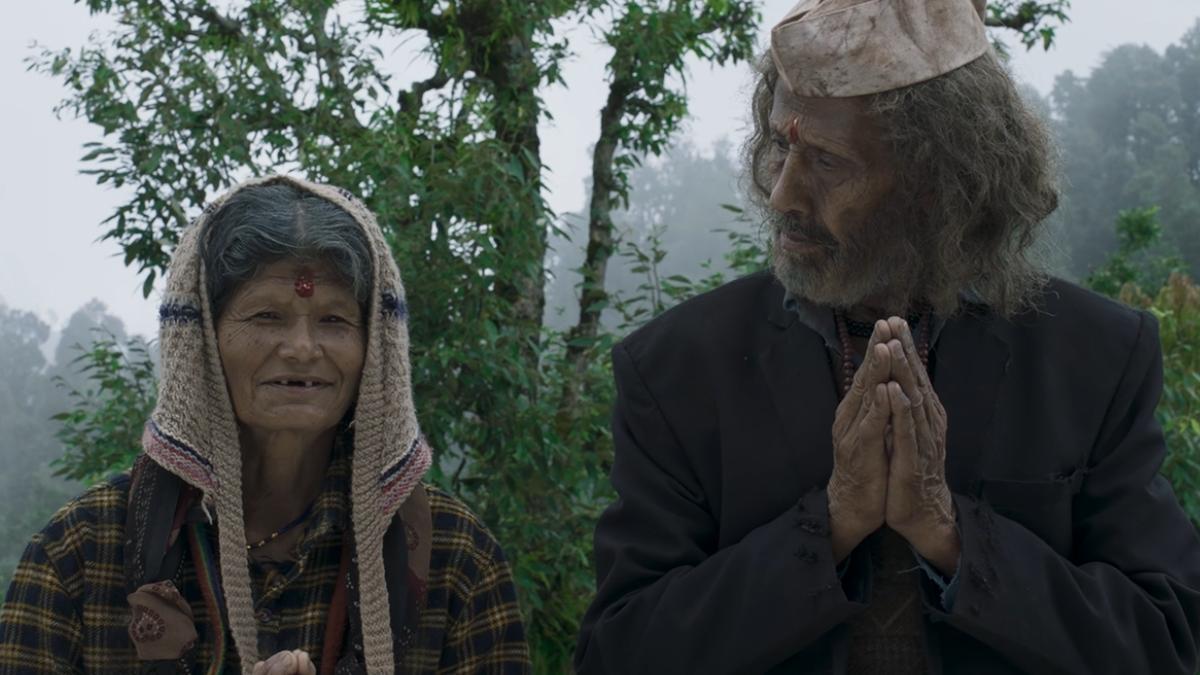
A still from ‘Pyre’ | Photo Credit: Special Arrangement High in the Himalayas, where the wind murmurs through timber and stone, sits a village that time forgot and the world walked away from. This is the stage for Vinod Kapri’s Pyre(Chita), an elegy carved in the lines of timeworn faces and the vast, aching silence of mountains. It is a story born of memories from Uttarakhand’s ghost villages, where the young have shifted to the heartless cities, leaving only the old to watch over a crumbling community.At its heart, Pyre is a poem to the endurance of love. It follows an elderly couple bound by shared devotion and bickering, and the tenuous hope of their son’s return. With the patience of a documentary and the soul of a tragedy, Kapri creates a meditative piece of minimalist cinema where soaring peaks serve as both a majestic sanctuary and an indifferent prison.Padam Singh and Tulsi, an elderly shepherd couple, struggle to survive in a remote Himalayan village that is rapidly emptying out. As helpful young neighbours migrate to greener pastures, their isolated existence and failing health are jolted by a surprise letter from their son, Hariya, who promises to return home after 28 years of absence. However, when his promised arrival repeatedly falls through, their hope and self-esteem start to crumble, driving the couple to build their own physical funeral pyres.Pyre (Hindi)Director: Vinod KapriDuration: 111 minutesCast: Padam Singh, Hira Devi, Subhash Chandra, Shubham ChaudharySynopsis: In a remote Uttarakhand village, an elderly couple faces crushing isolation while waiting for their long-absent son.On the surface, it is a simple story that casual moviegoers, who measure cinema only by how fastor slow it goes, will find tedious. But, gradually, the hurt behind Padam and Tulsi’s sharp-tongued exchanges in Kumaoni-tinged Hindi starts to percolatethrough the screen. Are they tired of each other or their circumstances? Is banter their survival mechanism in a climate that is harsh in more ways than one? Their lives are fractured because the society they grew up in has started to vanish through no fault of their own. The tragedy isn’t just about an old couple, but about an entire culture and lifestyle being erased through no fault of their own. Kapri does not underline the obvious drivers of migration, such as unemployment and a lack of health infrastructure. The self-reliant Padam’s trumpet is a telling metaphor, reminding the world they exist. A still from ‘Pyre’ | Photo Credit: Special Arrangement Played by non-professional actors, Padam Singh and Hira Devi, the bidi-smoking Padam and Tulsi have no artifice in their playful friction and witty repartee. Their desolation and anguish don’t feel manufactured, and the relationship’s implicit tenderness shines through. In contrast, the frames carry a mystical symmetry as cinematographer Manas Bhattacharyya captures stark, expansive mountain landscapes that reflect the couple’s internal struggle.Coming from the language of rapid-fire television journalism that organically informed his debut feature, Miss Tanakpur Haazir Ho, here, Kapri seeks to embrace the stillness of World Cinema, but narrative seams surface in how he handles restraint.Though the narrative rhythm benefits from German editor Patricia Rommel (with Subhajit Singha) and Oscar-winning composer Mychael Danna, their involvement at times suggests a film consciously tailored to navigate the international festival circuit. Consequently, the film walks the edge of a growing trend in which deeply local subjects are manicured to appeal to international sensibilities. If a film truly means to be ‘vocal for local,’ its aesthetic choices may also try to speak the language of the soil. That said, Pyre deserves to be felt.Pyre is currently running in theatres. Published - October 30, 2026 12:02 pm IST
‘Pyre’ movie review: An ode to the resilience of love
Full Article
Original Source
Read the full article at Thehindu →KhanList aggregates and links to publicly available news content. We do not host full articles from third-party sources. Always verify important information with original sources.