
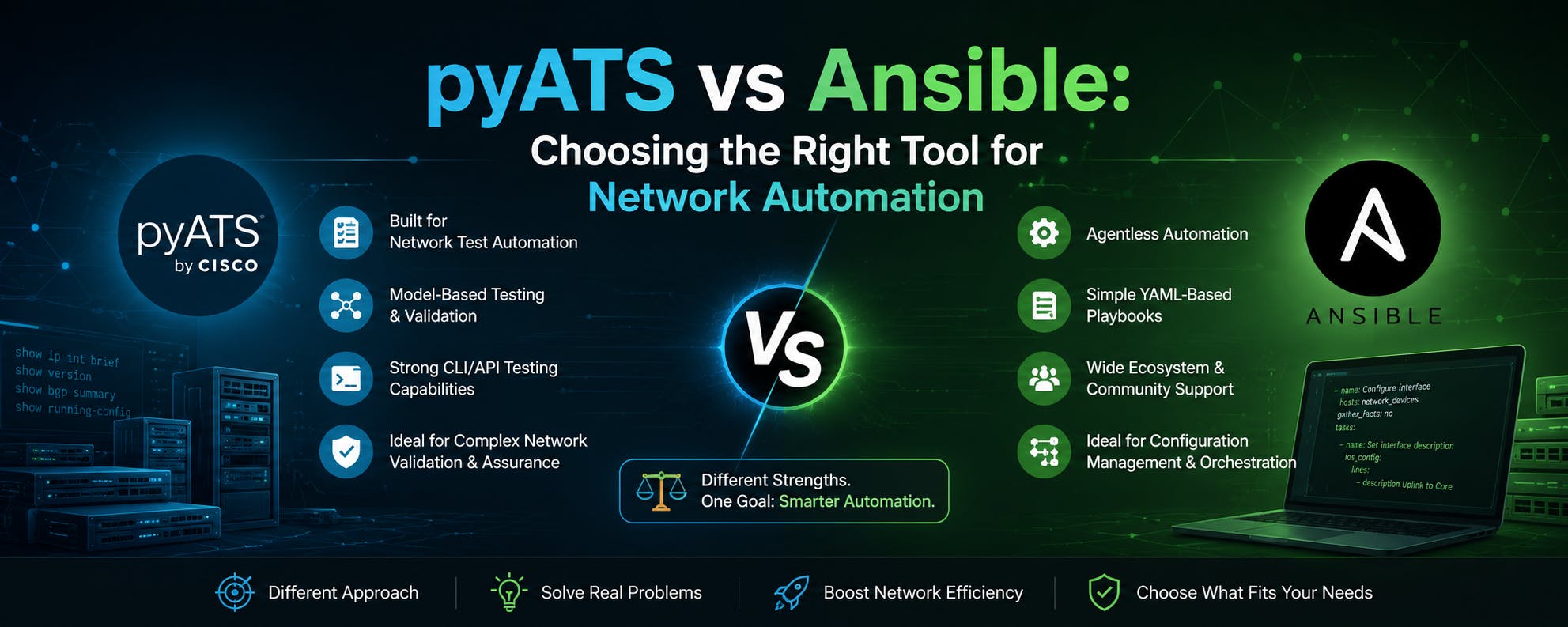
After posting some content on social media platforms about pyATS, I received some questions from different sources: "Should I learn pyATS or Ansible first?"For me, it's the wrong question you are asking, not because it is dumb; it's actually the right intention you should have, because it proves you're trying to pick a lane for a cold start. but you are not. These two tools solve completely different problems, and if you have experience in a live production environment, you will definitely get to know why you need both tools.Let me break down why both the tools are required:Ansible and pyATS play completely different Sports Ansible is an executor, whereas pyATS is a validator. Ansible is responsible for configuration management and deployment. You write a playbook describing that "These VLANs should exist", "This ACL should be modified", "NTP should point to these servers" and Ansible takes responsibility and makes those changes on the real devices.On the other hand, pyATS is not built to make changes on real devices. It's built to look at your network, and it will help you to validate your network and tell you the truth about its current state. pyATS will help to compare the states between pre and post of any changes, and it will flag the differences. In pyATS, there are Genie parsers available which turn raw CLI output into structured Python data; using that, you can write your desired test logic - not "did the command execute properly?" but "is BGP converging the way I expected to be over the whole network?" If you've ever pushed a configuration change and then, for verification, you spent the next thirty minutes manually doing SSH into all the devices one by one, which can be done within a short time using pyATS.One more thing to highlight: pyATS is vendor-agnostic in theory, but in practice it's a Cisco-first tool. Genie's parser coverage for other vendors is limited, so if you're in a heavy multi-vendor shop, you'll likely be writing custom parsers or leaning on Ansible's broader vendor module support instead. At this stage, I believe you will be able to understand the gap between Ansible and pyATS.The learning curve is different Ansible uses YAML, and that's it. If you can write a list or inventory file and if you have some understanding of indentation and modules, then you can write a basic playbook by the next day. The barrier to entry is comparatively low, and that's the reason why it is the tool most network engineers reach for first.However, pyATS requires actual Python. But don't be afraid. Let me clear the picture: "Even I did not complete any Python course"But some basic Python you need to know:Dictionaries and nested Data Structures (reason: Genie parsed output is generally nested JSON-like.)Loops and conditional for test logicsBasic object oriented programming (OOP) concepts while you will start building your own test casesTroubleshooting errors while you need to debug actual tracebacksRecently I went through this journey where I took a 100-days-pyATS challenge, building everything from scratch. I had some prebuilt EVE-NG network lab environments, and based on that, I built some basic OSPF, IS-IS state validation, up through BGP VPNv4/VRF checks and eventually CI/CD pipelines with GitHub Actions. You can build the YAML test file easily. Writing the Python actually parses "Is this route present, is this BGP neighbour up, did this counter increment?" that's where the real learning happens. In my case, I did not have any Python knowledge previously, but after going through this journey, I was able to learn basic Python to build my test cases.If your Python knowledge is at zero, don't be worried but be honest with yourself about the time investment. Ansible will give you wins in week one, but pyATS will humble you for the long run.Blast radius: this is the part people underestimateThis is the most important distinction and the one everyone should consider: how much damage a single action can cause if something goes wrong.In this case, Ansible has a blast radius. When you run a playbook, you are making some changes on production devices. If your playbook contains a logic error, or your inventory group is arranged wrongly, or your variable declaration has a different meaning, you can push undesired config to every device that matches your target group and can make the situation worse. From my network communities, I have heard some horror stories: a mistyped hosts: line turning a "Test on non-prod devices" into "Test on entire devices". Ansible does what you instruct it to do, fast, at scale, and that's the power of Ansible.pyATS has effectively zero blast radius, because by design it doesn't change anything. It connects It captures states It compares, It reports and that's it,you can run a full pyATS validation script against a live production core at 2 pm on a Tuesday, and the worst thing that can happen is a device gets annoyed by an extra SSH session, without doing any production harm. This is exactly the right tool for pre-checks and post-checks around a maintenance window.That's exactly where it gets messy in real deployments: after the playbook ran successfully, teams assume that the network is healthy, or sometimes they check only if the changes took place properly or not, and they skip validation for the entire network. A playbook can execute cleanly and still leave you with a route that was never supposed to come back up, or a BGP session that flapped and did not re-establish. Task success and network health are two different claims, and pyATS or Ansible can tell you one of them eventually.So do they work together? Yes,this is the actual answer.This is the part I wish some had told me earlier instead of framing it as an either/or choice.This should be the pattern that actually works in a production environment:Run pyATS to snapshot the current state (pre-check)Run Ansible to push the changeRun pyATS again to validate the new state (post-check)Diff the two pyATS snapshots if something unexpected changes, you can identify it immediately.I exactly built this workflow into a CI/CD pipeline: testbed file and handful of pyATS scripts, pre-check validations, made some changes, then post-check validation, all wired into GitHub Actions so that config deployment and verification happens as one automated flow instead of two disconnected manual steps. Ansible pushed the static route change, and PyATS confirmed the network actually looked the way it was supposed to be. After this implementation in my lab and I shared it with some experts from leading organizations, they confirmed this combination is really a production-grade change management process, not just a cool automation demo.So which one should you learn first?It depends on where you sit today.Do you have the basics of Python? Start with pyATS. You will move fast, and the payoff will be huge.Zero Python idea? Start with Ansible. Get comfortable pushing the configuration changes safely, build your YAML muscle, and then pick up Python alongside it.On a team doing frequent change windows with production risks? You need both the tools; honestly, the validation is always neglected, so if you're behind, that's probably your gap.Conclusion In the end, I would like to say, don't treat this as a career-defining fork in the road. Consider it as two crucial skills that stack. The engineers I see leveling up fastest right now aren't the ones who picked a side- they're the ones building pipelines where Ansible does the pushing and pyATS does the checking, because that's what the job actually looks like once you're past the lab and into production.
pyATS vs Ansible: Choosing the Right Tool for Network Automation
Full Article
Original Source
Read the full article at Hackernoon →KhanList aggregates and links to publicly available news content. We do not host full articles from third-party sources. Always verify important information with original sources.