
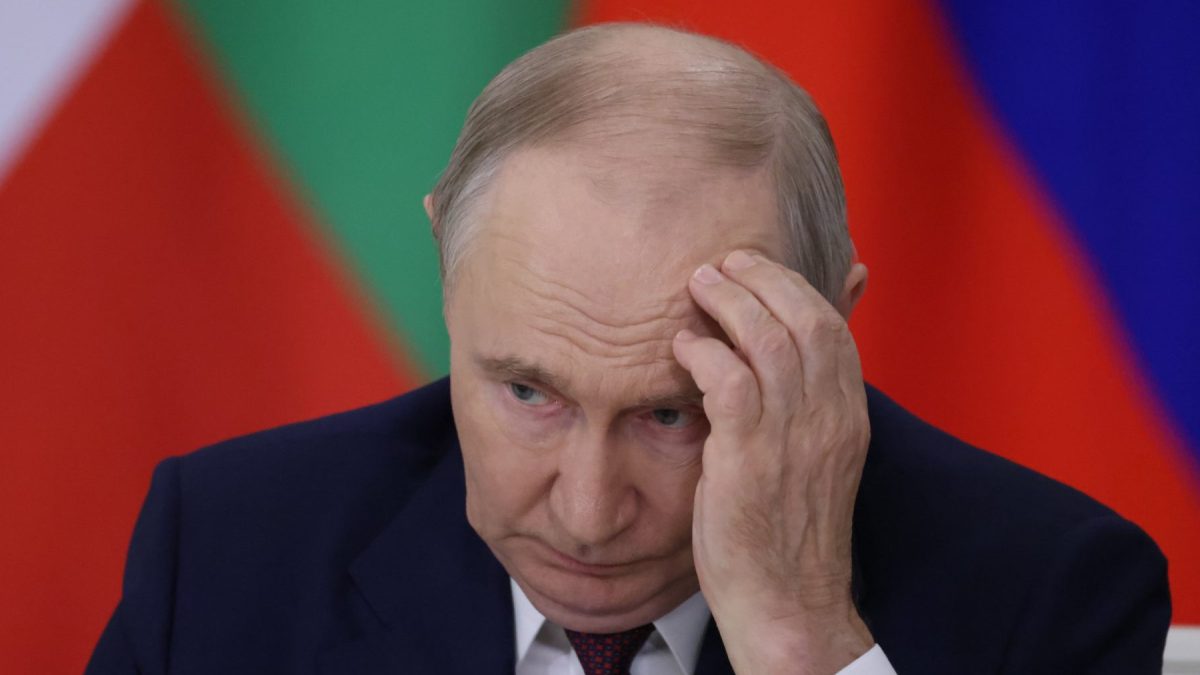
Vladimir Putin’s mind is a bizarre place: a mixture of the paranoia of his KGB spy background, ornate and indulged theories of Russian imperial might and a tendency to resort to folksy metaphors to explain how Russia should be governed – essentially, on a long authoritarian lease by him. As the CIA director John Ratcliffe made an unusual trip to Moscow to meet the heads of Russia’s foreign and domestic intelligence services this week, the aim seems to have been (at least) twofold: to assess at firsthand how Russia’s secret state is thinking about the war in Ukraine, and assess the danger of escalation in “grey zone” hostilities (that is, hostile actions too ambiguous, minor or deniable to cross the threshold into war) between Moscow and Nato. There is inevitably also always a third purpose in such encounters, which is to fill out the psychological profile and assessment of the Kremlin leader’s mental state by talking to people who deal closely with him. Putin gave a clue to his thinking and its oddities this week in conversation with trainee teachers talking about Arctic studies and he cited a familiar internet trope of killer whales killing polar bears: “Orcas hunt these bears devouring them as if they were nothing – they descend in packs and tear them apart.” Children, he said, should learn about this “food chain” so they understand “what kind of world we’re living in and why we are carrying out the special military operation”. (That is, the war in Ukraine.) In other words: it is an orca-eats-bear kind of world, kids. Get real about it. The audience of hand-picked trainee teachers would have been too awed to point out that theoretically, an orca can kill a polar bear in water but that there is no clear evidence it has actually happened. It owes more to fake AI videos than National Geographic. And it lets us know that Putin is consuming a lot of fake news as well as spreading it in a focused propaganda operation about Nato and Ukraine. Foolhardy would be the official to point out that the metaphor really works to Kyiv’s advantage – barrages of Russian ordinance have done immense damage but four years on, the aim of toppling Zelensky, let alone taking control of the Ukrainian capital, has not materialised. Naturally, the conversations and calculations of this visit are shrouded in uncertainty. There was a lot of speculation about a warning of an imminent attack on a Nato state, but other motivations seem just as likely – for instance, that Donald Trump, who faces awkward midterm elections in November, wants to assess possible routes to a peace deal between Russia and Ukraine. Ratcliffe, who is a trusted pro-Trump official and has negotiated successfully with Moscow on prisoner releases, is in a position to bring back useful information on how realistic that is. Putin’s concept of the war has widened into regarding it as proxy for a wider clash of values and security with Nato – and indeed, he is waging constant cyber war, submarine-led aggression and other hostilities which edge toward – but do not cross – the threshold of Nato’s retaliatory Article 5. That, as one former UK defence attaché suggests, indicates a degree of realism beneath all of the noise – the now regular rhetorical attacks on the UK via the Kremlin’s media channels are in the end repackages of the same messages and dire threats. There are, however, many more active operations: sabotage in the UK and across Europe and attacking a Leipzig military airport in order to show that support for Ukraine has consequences at home. Following Putin’s house journal of the Kremlin website shows that he has become notably more locked in internal memes and obsessed by orcas since getting involved in a domestic spat about a “whale prison” of the creatures being held in poor conditions in the far east of Russia. No such concern extends to the thousands of political prisoners condemned to appalling conditions or major opponents like Alexei Navalny, poisoned on his orders in grim captivity. Like a lot of dictators, he prefers the animal kingdom to obstinate fellow humans. The other aspect Ratcliffe and the CIA’s (very good) Russia analysis centre will be probing is the extent to which raw power is still with Putin or seeping away, or at least creaking. It’s always a mistake to predict that the end is just around the corner. Often, there are just more corners ahead. Putin has consolidated power and fear to a remarkable extent; recall the ruthless assassination of his military challenger Yevgeny Prigozhin three years ago this month. But there are also signs of weakness. For one, Alexander Lukashenko, the Belarussian leader who has at times been slapped down by Russia, has also pursued its own interests as a neighbour of Ukraine – including sending congratulations on Ukraine’s recent Independence Day anniversary. Pressures are also building up inside a Russian economy now geared towards supporting the war, which strains an inadequate health system, causes shortfalls in pensions and has led to alarmed signals about financial instability. Savers took out large amounts of funds in recent weeks, evidently fearing that the state would begin to limit withdrawals as money is siphoned into technological upgrades for the military and AI. At the same time, the day-to-day focus of Putin is often on relatively minor things, from anti-Western moves to the return of official and commercial signage to the Cyrillic script – or trying to keep restive Siloviki (his network of top investors and entrepreneurs) convinced that plans like the Siberian economic expansion remain on track. An awful lot of his job is performative. Absolute power in the Kremlin can prove fragile when the intelligence services start to harbour quiet doubts about the way forward. Gradually, they influenced the succession of Mikhail Gorbachev, when Yuri Andropov, the KGB boss, let loose the Soviet grip on Eastern Europe. It happened again when the foreign intelligence chief Yevgeny Primakov attempted to unseat Boris Yeltsin, first to try and insert himself into the role – and ultimately to the benefit of Putin, who took the crown. There is still political manoeuvring in the Motherland, however mighty the Kremlin may be, and what goes around tends comes around as power ebbs and flows. No doubt, as the war grinds on and an uneasy Russian public also wonders how it will end, that thought has occurred to the curious CIA visitors too. Anne McElvoy is executive editor of POLITICO, co-host of “Politics at Sam and Anne’s” podcast and a former Moscow correspondent for The Times
Putin’s story about killer whales is a window into his warped mind
Full Article
Original Source
Read the full article at Inews →KhanList aggregates and links to publicly available news content. We do not host full articles from third-party sources. Always verify important information with original sources.