
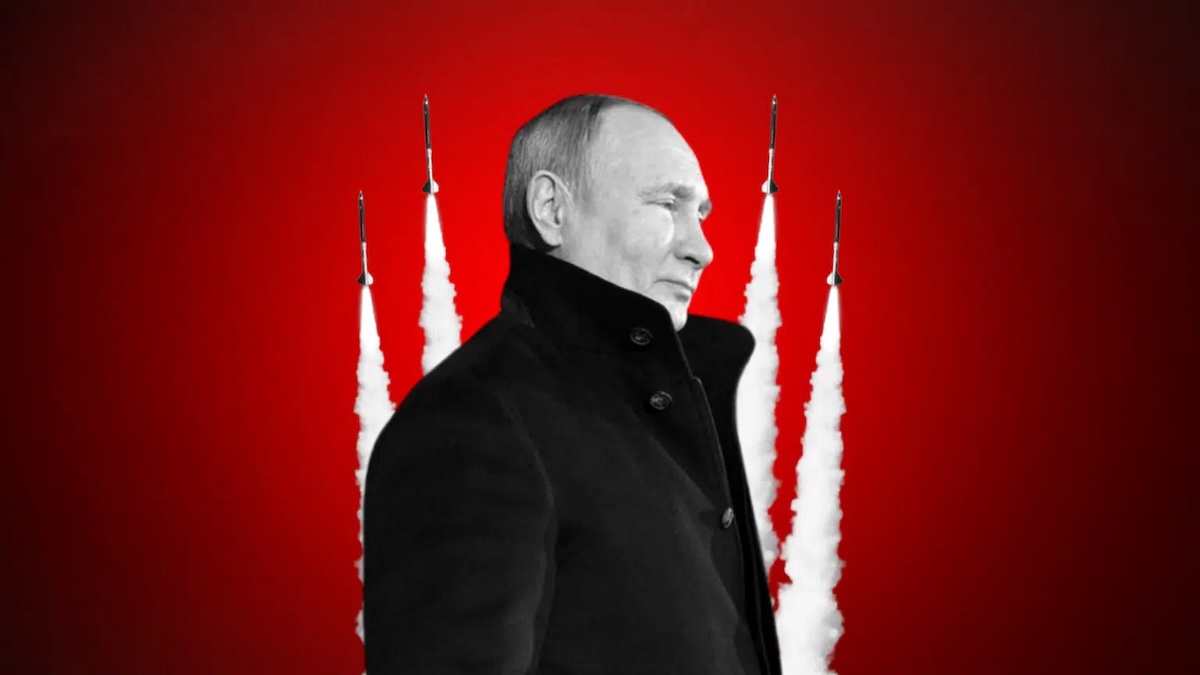
During a quarter-century in power, Vladimir Putin has led Russia into three wars, in part aimed at restoring his country’s status as a world power via violent conquest . Each war began in a blitzkrieg-style display of fearsome power meant to climax in a swift victory. Instead, each conflict, whether the 1999-2009 war on the Russian province of Chechnya, or the 2015-2024 air campaign in Syria to help dictator Bashar al-Assad fight Islamic rebels or now the Ukraine war, descended into a single strategy: bludgeoning use of air power against cities in tactics reminiscent of World War II. Because Grozny, the Chechen capital, was the first victim of such battering, military experts have dubbed the strategy the “Grozny Model” or, sarcastically, “Peace Through Obliteration.” “I hate to use this term, but I think the ‘Grozny-fication’ of Kyiv has begun,” Max Hess, a fellow at the Foreign Policy Research Institute, told an American television interviewer. “And that is something I thought was unimaginable.” The latest chapter began last Tuesday, when Russian sent scores of drones and ballistic missiles to bombard civilian neighborhoods in Kyiv, the Ukrainian capital, and killed 21 residents, including some children. The next three days saw bombardments of least three other cities. More than 100 people. died Emergency workers in the south-central town of Pryluky dug up 22 bodies from the ruins of an apartment building, Ukrainian television showed. On Saturday, glide-bombers, which are winged projectiles launched from aircraft, killed 15 civilians in Zaporizhia, site of a nuclear power plant. “Its counter-city campaign may aim to drive out remaining civilians and collapse the capacity and will of Ukrainian defenders to resist any military occupation,” predicted Colin P. Clarke, a researcher at The Soufan Center, a security analysis and research center based in New York. James Hughs, a professor at the London School of Economics and Political Science, offers a similar assessment and a pessimistic prediction: “What has occurred in Ukraine so far, tactically, is an iteration of Russia’s Chechen conflict but on an even more immense scale. The strategic outcome, however, is likely to be similar – a costly Russian victory at the expense of massive opposition losses, destroyed infrastructure and depopulation.” Putin’s goals are largely consistent, but tactics have evolved since the Chechen war. I covered the assault on Grozny in late 1999 and into 2000. Russian jet bombers freely roamed the skies and tanks and artillery pummeled the city. The fusillade started in October, prompting masses of civilians flee. Into December, it became clear that bombs and shells had failed to dislodged Chechen forces. Neither the conventional troops under the command of Aslan Maskhadov, a former Soviet army officer, nor Islamic terrorists and guerrillas led by Shamil Basayev had been vanquished. At the New Year, Russian soldiers crammed together behind earthen barricades at the edge of Grozny ducked rifle fire and called out for artillery salvos on houses where they imagined snipers hid. In response, fearsome aerial bombing and cannon fire forced Maskhadov’s troops to filter out of the city. On the night of January 31, Basayev and his followers fled , through a treacherous minefield into the nearby town of Alkhan-Kala. During the exodus, Basayev stepped on a mine. A doctor amputated his left foot and he escaped by truck to the mountains. (In a prelude to the now-popular tactic among US and Israeli leaders known as decapitation, Russia claimed to have killed Maskhadov during a raid north of Grozny and Basayev, by a truck bomb placed next to his car. The Chechens said both died in accidents.) In late 2016, Putin moved on to Syria and ordered up the razing of not just one locale but several to terrorize the population into fleeing and so isolate enemy fighters. In response to a plea from al-Assad, whose forces were unable to make inroads into the northern city of Aleppo, he sent jets to bomb the historic anncient center of the city. The Russians felt they had a free hand to play: The intervention coincided with US President Barack Obama’s decision not to support Syrian rebels with arms. The old quarter of Aleppo had become a fortress for a guerrilla group known of Jaish al-Fatah, the “Army of Conquest,” an Islamic group trying to overthrow Assad. Before the war, the district had been thoroughly restored with German money, under the patronage of Asma al-Assad, the Syrian president’s wife. The Russians turned the old city into rubble. Without international outrage over the carnage, the Russians bombed other towns with impunity. But in 2024, Putin turned his attention to Ukraine, where his lightning invasion had turned into a quagmire. He returned his jets to Russia. Islamist rebels attacked Aleppo in November, retook it by early December and the Assads, husband and wife, fled to Moscow. In 2022, the Russians had already ordered up the Grozny Solution for Mariupol, a coastal (Azov Sea) Ukrainian city, via a four month bombardment. Relentless fire emptied the port of civilians, leaving armed resisters behind in an iron and steel factory complex. They eventually surrendered. The tactic reached Kyiv in emphatic fashion last Tuesday. In a full-bore effort to terrorize residents, Russia launched its heaviest drone and rocket attack yet on the capital. A total of 130 drones, 48 cruise missiles and an unspecified number of ballistic rockets blasted residential areas. Other cities were hit during the rest of the week, with around 100 killed in four towns. In the northern city of Pryluky, emergency workers sifted through debris from a shattered apartment building and found 22 dead residents. Rescuers climbed up teetering upper floor looking for survivors, Ukrainian television reported. Such bombardments are not simply an effort to soften up the capital and other towns in advance of a ground assault. Rather, as in Aleppo and the rest of Syria, they are substitutes for entry on the ground. Russian troops bogged down for months and taking heavy casualties along Ukraine’s Dniepro River are unlikely to make a breakthrough westward soon. Bombing Kyiv is a replacement strategy. “If the Russian military cannot take Kyiv through rapid maneuvers, they are highly likely to besiege the city and rely heavily on the kind of devastating artillery and rocket bombardments used against Grozny and Aleppo to break Ukrainian resolve,” says the Institute for the Study of War, a Washington think-tank that focuses on current tensions and/or combat in Ukraine, the Middle East and East Asia. Putin seems intent on persisting. The hostility of United States President Donald Trump toward Ukraine and its President Volodymyr Zelensky might provide an incentive to continue. Last week, Trump launched a tirade agains the Ukrainian leader. He said it is time for Ukraine to “get a new president” and warned Zelensky “better damn well stop” targeting Russian oil refineries.” Drone attacks on Russia’s oil industry are draining Russia’s biggest source of income to finance the war. Hitting them, however, gets in the way of Trump’s politically self-serving decision to buy diesel fuel from Russia. Trump wants the fuel to reduce fuel prices in advance of legislative elections next month. Trump’s decision undercuts Western sanctions against the Putin regime and has outraged the European Union, which is supplying Ukrainian defense equipment. But domestic political analysts note that, if the November elections go against Trump’s Republican Party, it will be easier to blame Zelensky than take responsibility for two political disasters of Trump’s own making: persistent inflation and the war in Iran, both of which are unpopular among potential voters.
Putin’s scorched-city policy hits Ukraine hard
Full Article
Original Source
Read the full article at Asiatimes →KhanList aggregates and links to publicly available news content. We do not host full articles from third-party sources. Always verify important information with original sources.