
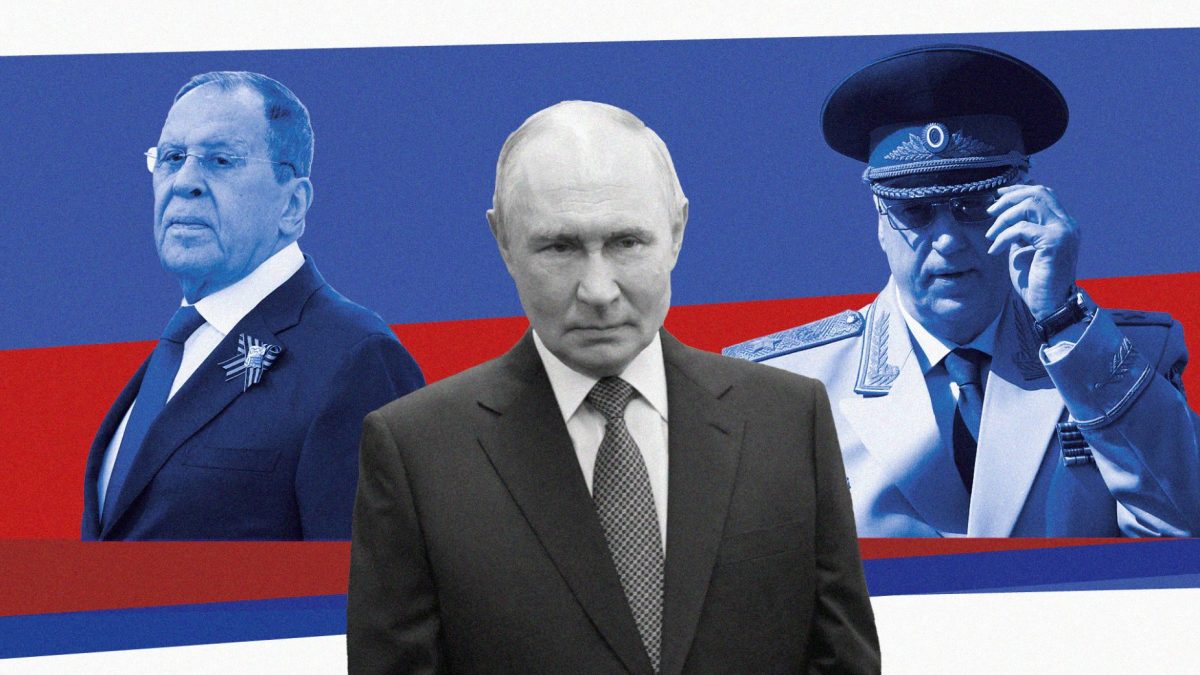
On Monday, Vladimir Putin signed a presidential decree that was little remarked upon outside Russia. Yet the move encapsulated the reality of Putin’s rule today. In a Kremlin he has built on insecurity and paranoia, it pointed to what could prove to be one of the ageing dictator’s most serious weaknesses. The decree allowed Alexander Bastrykin, head of the powerful Investigative Committee, to stay in office one more year. Bastrykin, like Putin, is 73, and is part of the ageing collection of cronies with which the Russian president has surrounded himself, isolating himself from fresh voices and rising officials more attuned to the modern world. Under Russian law, state officials face mandatory retirement at 70. To serve beyond then requires a specific presidential decree to be issued, every year. These days, Putin is frequently having to issue them, as he clings to the ageing circle of “securocrats” (politically influential security officials) whose loyalty is more important to him than their health or even their competence. The Investigative Committee is one of the most feared institutions in today’s Russia, leading many of the cases that end up with Putin’s critics imprisoned and intimidated. That is why it is so important for Putin to have someone he trusts in charge, and he knows that Bastrykin, a university classmate of his at Leningrad State University in the 1970s, owes his prominence to the president’s favour. He will do whatever it takes to retain it. Alexander Bastrykin, 73, who heads the powerful Investigative Committee, can now stay in office one more year after Putin issued another extension (Photo: Mikhail Svetlov/Getty) Meanwhile the other main domestic security agency on which Putin relies, the Federal Security Service (FSB), is run by the 74-year-old Alexander Bortnikov. He is not just old, but known to be ill, and often has to attend meetings by video call, as well as not being able to put in a full week in the FSB’s headquarters in central Moscow. He has reportedly asked to be allowed to retire, but Putin is not letting him go. The rest of the security apparatus leadership is no more youthful. Sergei Naryshkin, the head of the Foreign Intelligence Service (SVR), is 71 and known to be hoping for a seat in the senate as a comfortable semi-retirement. The commander of the National Guard, Viktor Zolotov, is 72. General Valery Gerasimov, Chief of the General Staff and the architect of Putin’s brutal war in Ukraine, is 70, and seems likely to remain in post for the duration of the campaign. Foreign Minister Sergei Lavrov – who has also for years asked for permission to retire – is 76. This is a reflection of Putin’s insecurity. Over his 26 years in direct or indirect rule over Russia, he has increasingly withdrawn not just from his own people, but even his elite. He doesn’t really know the younger generation of officials, with the exception of his personal aides and bodyguards, and so he doesn’t necessarily trust them, either. Putin with Bortnikov, the FSB boss, in the West Sayan Mountains in Tyva Republic, Siberia, in 2018. The Russian leader doesn’t seem to trust the younger generation of security officials (Photo: Russian Presidential Press and Information Office /Getty) He has tried elevating several of the latter into political roles, but only one of them, Alexei Dyumin, has been able to make the jump from bullet-catcher to politician. Even so, Putin seems to have decided he can’t do without him, and although he has served as deputy defence minister and then governor of Tula region, he is now back in the Kremlin as a presidential aide. There are able understudies waiting in the wings, impatient for their time on stage. Bortnikov’s 64-year-old deputy, General Sergei Korolev, is ruthless, able and ambitious. But while Putin has known Bortnikov since they were in the KGB together in the 1970s, he doesn’t know Korolev (who, in any case, also has some powerful detractors) and has for years delayed a handover that was anticipated in 2022. Likewise, Gerasimov is widely despised for his mishandling of the war, and Colonel-General Andrei Mordvichev, commander of the Ground Forces, is the current favourite as a successor. Tough, competent and well-regarded by his troops, at only 50, Mordvichev has not only been made a Hero of the Russian Federation, but is also a recipient of the Order of Military Merit, which is a typical mark of a “fighting general”. Foreign minister Sergei Lavrov, 76, has for years asked for permission to retire (Photo: Alexander Zemlianichenko/Reuters) By clinging on to his ageing cronies out of fear of elevating a younger generation of securocrats whom he doesn’t know, Putin is ironically causing growing tensions. Consequently, the 60-somethings, fearing they will lose their chance at the top, come to resent him, while they themselves try to keep down the hungry 50-somethings below them. It also means that Putin has surrounded himself with fellow veterans of the Soviet era, men whose advice echoes his prejudices and whose experiences are increasingly out of time. These are men steeped in imperial assumptions dating back to Cold War times, when Moscow was the capital of a global superpower. Contrast that with Ukraine, where 48-year-old President Volodymyr Zelensky has a 39-year-old defence minister, a 43-year-old military commander, a 52-year-old security chief, and a 51-year-old foreign minister. In an age of rapidly changing geopolitics, of drone and cyber warfare, and where online memes and soundbites can be as powerful as traditional diplomacy, Putin’s determination to cling on to his septuagenarian securocrats may be one of his greatest weaknesses.
Putin’s ill and ageing loyalists could prove to be his greatest weakness
Full Article
Original Source
Read the full article at Inews →KhanList aggregates and links to publicly available news content. We do not host full articles from third-party sources. Always verify important information with original sources.