
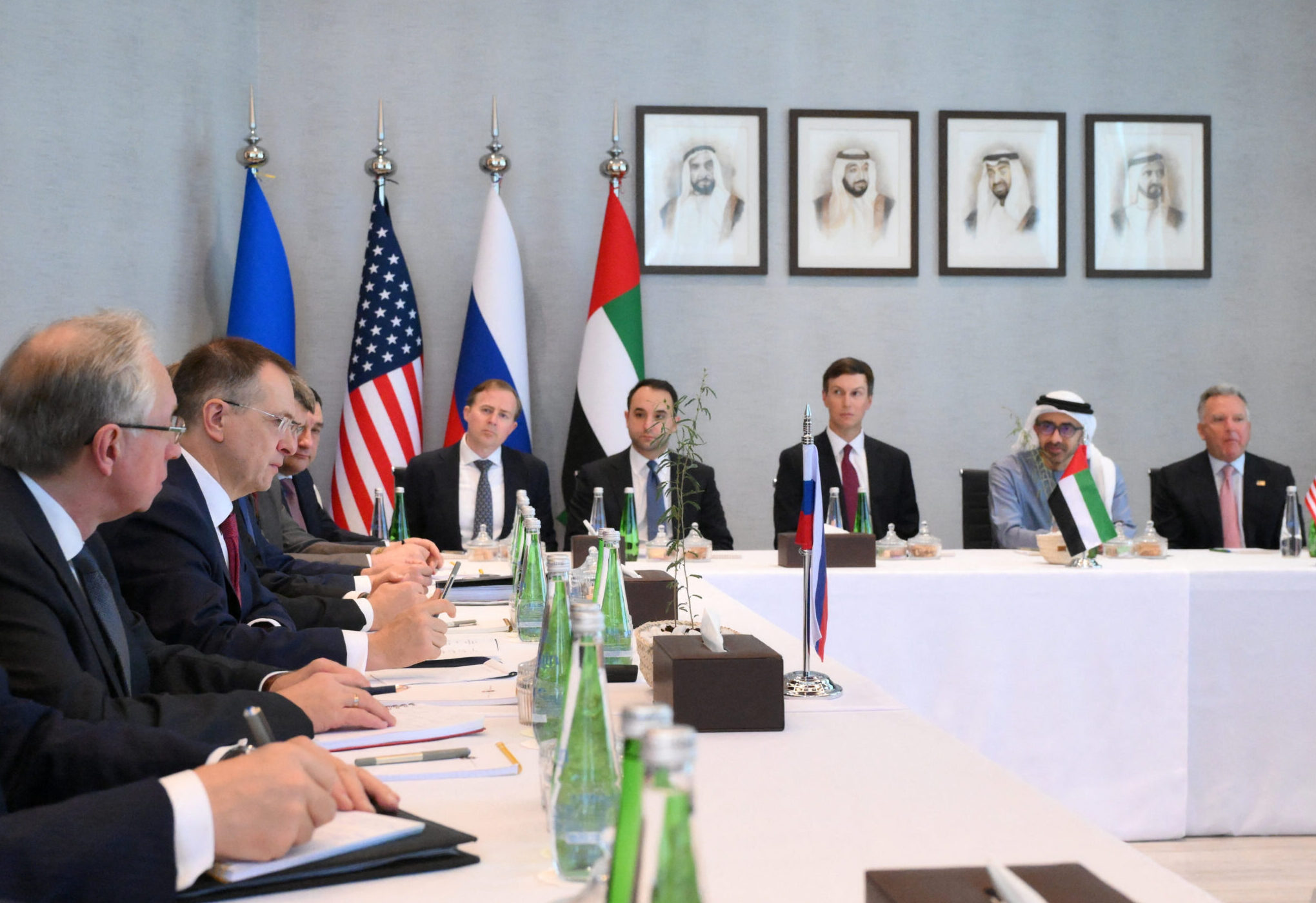
The first direct negotiations between Russia and Ukraine in nearly a year ended on Wednesday without producing any breakthroughs. The US-brokered peace talks in Abu Dhabi lasted two days, with both countries tentatively agreeing on a major prisoner exchange. However, there was no sign of progress on key issues including the Kremlin’s territorial demands and postwar security guarantees for Ukraine. Ukrainian and Russian representatives both offered fairly upbeat assessments of the talks. Kremlin officials said the meetings had brought the prospect of a peace deal closer, while Ukrainian negotiator David Arakhamia commented that the renewed dialog provided “good momentum” and suggested that it may be possible to reach a solution by the end of the year. At this stage, there is little evidence to support such optimistic assessments. On the contrary, the two sides appear to be as far apart as ever. Crucially, while Ukraine proposes using the current front lines of the war as the basis for a territorial settlement, Russia continues to demand that Ukraine also withdraw from the remaining 10 percent of the Donbas region that is still under Kyiv’s control. Ukraine’s reluctance to retreat from the Donbas is grounded in harsh military realities. The territory that Russia insists on receiving before agreeing to a ceasefire includes a fortress belt of cities which is considered absolutely critical for Ukraine’s national defense. Handing this region over to the Kremlin without a fight would leave the rest of the country dangerously exposed and extremely vulnerable to further Russian advances. Nevertheless, Moscow refuses to moderate its position. Stay updated As the world watches the Russian invasion of Ukraine unfold, UkraineAlert delivers the best Atlantic Council expert insight and analysis on Ukraine twice a week directly to your inbox. The Kremlin’s uncompromising approach to negotiations with Ukraine was summed up by Russian delegation head Vladimir Medinsky. “Every inch of Russian land will be returned to Russia, one way or another,” Medinsky commented on the sidelines of this week’s talks in the United Arab Emirates. Medinsky’s rhetoric closely echoes Russian President Vladimir Putin’s own framing of the Ukraine invasion as a crusade to return what he frequently refers to as “historically Russian lands.” In late October, Putin declared that Ukrainians have no right to the occupied regions of their own country. “I think it is not their territory, but the historical territory of Russia,” he commented. Putin’s oft-stated insistence that Ukrainian land rightfully belongs to Russia leaves little room for any meaningful concessions and creates obvious obstacles to a lasting settlement capable of safeguarding the continued existence of an independent Ukraine. It also raises serious questions about the true extent of his territorial ambitions. While US officials have sought to focus peace talks on the Donbas issue, it seems self-evident that Putin has much bigger goals in mind. Critics of a land-for-peace deal have argued that Putin seeks to seize the whole of Ukraine and sees the conquest of the Donbas region as a mere stepping stone toward this far grander objective. Many have noted that the Kremlin dictator’s historical claims are clearly not limited to eastern Ukraine’s Donbas. By his own twisted logic, Putin can hardly claim his place in Russian history if he captures the rust belt towns of the Donbas but leaves Kyiv, which he revers as “the mother of all Russian cities,” in enemy hands. Eurasia Center events There are many red flags signaling Russia’s lack of interest in a genuine peace deal. For example, Putin’s vocal objections to the deployment of European troops in postwar Ukraine, along with his efforts to limit the size and capabilities of the Ukrainian military, do not suggest a man who is planning to live in peaceful coexistence with his Ukrainian neighbors. Instead, everything seems designed to create favorable conditions for the next stage of Russia’s invasion. Likewise, regular Russian statements emphasizing the need to address the “root causes” of the war indicate aspirations that go far beyond the capture of the Donbas. While no definitive version of these root causes exists, the list of demands presented by Kremlin officials during previous bilateral talks reads like a playbook to undermine Ukrainian sovereignty and reestablish Russian dominance over the country. This has led many to conclude that as far as Vladimir Putin is concerned, the root cause of the war is the existence of Ukraine. These factors help to explain the lack of progress toward peace, but the brightest red flag of all is Putin’s claim that Ukrainian land is historically Russian. The Kremlin ruler’s Ukraine obsession reflects his conviction that the emergence of an independent Ukrainian state after 1991 was a grave injustice that left historical Russia divided. In order to reclaim his country’s great power status, Putin believes he must extinguish Ukrainian independence. This belief is not Putin’s alone. Indeed, generations of Russian imperialists have struggled to suppress Ukraine’s statehood aspirations. But Putin has brought this toxic anti-Ukrainian ideology into the contemporary mainstream and made it a central pillar of modern Russia’s national discourse. His rants about returning historically Russian lands sound utterly unhinged to international audiences, but they are regarded as routine by the Russian public. Anyone who wants to broker a peace deal with Putin must first grasp the sheer scale of his imperial delusions. He believes he is on a sacred mission to revive the Russian Empire and will not be swayed by the promise of limited territorial gains or economic incentives. Peace is still possible in such circumstances, but it must be peace through strength. Peter Dickinson is editor of the Atlantic Council’s UkraineAlert service. Further reading The views expressed in UkraineAlert are solely those of the authors and do not necessarily reflect the views of the Atlantic Council, its staff, or its supporters. The Eurasia Center’s mission is to enhance transatlantic cooperation in promoting stability, democratic values, and prosperity in Eurasia, from Eastern Europe and Turkey in the West to the Caucasus, Russia, and Central Asia in the East. Follow us on social media and support our work Image: Participants, including US officials, led by envoys Steve Witkoff and Jared Kushner, and members of the Russian delegation, led by Vladimir Medinsky, attend US-led trilateral peace talks with the Ukrainian delegation in Abu Dhabi, United Arab Emirates, November 10, 2026. Sputnik/Grigory Sysoyev/Pool via REUTERS
Putin’s chief negotiator vows to return ‘every inch of Russian land’ in Ukraine
Full Article
Original Source
Read the full article at Atlanticcouncil →KhanList aggregates and links to publicly available news content. We do not host full articles from third-party sources. Always verify important information with original sources.