
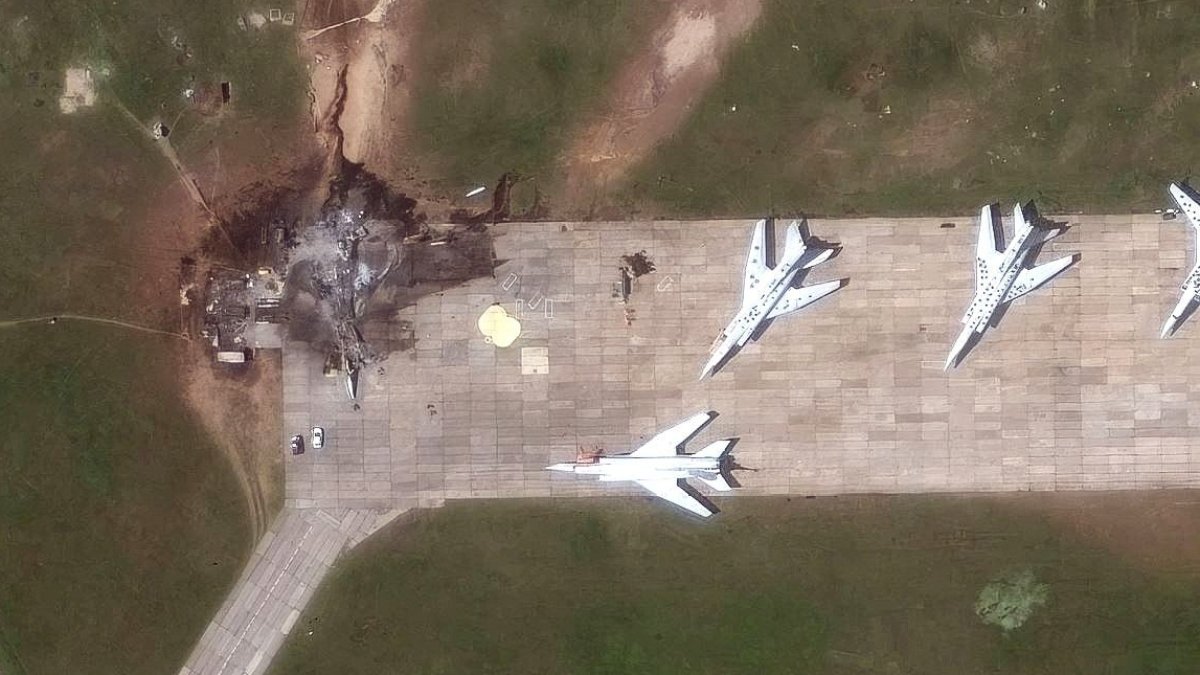
Among the great surprises of the war in Ukraine is that Russia’s air force – the second largest in the world – has been unable to establish dominance of the skies over a modest, largely Soviet-era Ukrainian fleet. More than four years into the conflict, that goal seems further away than ever as Russia continues to suffer losses of its most advanced and valuable warplanes, and Ukraine steadily builds up a patchwork of Western combat aircraft. Kyiv is launching ever more audacious strikes deep inside Russia against key airfields that house its strategic bombers and other military aircraft. Last weekend, the Ukrainian military said a drone hit the Engels military airbase in the Saratov region, around 373 miles (600km) from the border. Shorts The airfield is one of the main bases for Russia’s strategic aviation, housing Tu-95MS and Tu-160 bombers, which Moscow regularly uses to launch missile attacks against Ukraine. Russia failed on day one Yet Russia’s air force has struggled from the start of the war. Since 2022 it has suffered heavy hits to its 4,000-strong air force, with at least 380 aircraft lost, according to one open-source tracker. A new report on the state of the air war from the UK defence think-tank the Royal United Services Institute traces Russia’s problems to a failure to “complete a suppression and destruction of enemy air defences” in the first days of the war, as Nato doctrine calls for. That failure continues to haunt Moscow, which is “no closer to being able to actually establish air superiority with a co-ordinated offensive air campaign than in 2022”, the report’s author, Justin Bronk, told The i Paper. A Tupolev Tu-22M3 bomber during a military exercise in 2016. Such strategic bombers are part of Russia’s nuclear deterrent (Photo: Maxim Shemetov/Reuters) As a result, Russia has been forced to adopt a conservative strategy, typically using warplanes to launch heavy glide bombs at frontline targets from ranges of more than 60 miles (96km). This approach has delivered some local successes. Ukrainian soldiers have vividly described the trauma of facing saturation bombing with munitions weighing up to three tonnes, a tactic that has allowed Vladimir Putin’s forces to devastate and then capture cities such as Avdiivka in the eastern Donbas region. Mykola Bielieskov, a military analyst at the government-run National Institute for Strategic Studies think-tank in Kyiv, said Russia’s glide bombs “level buildings” and were “important in urban warfare”. Ukraine now a major threat to Russian planes But Ukraine is finding innovative ways to turn the tables with its – on paper at least – far inferior air power. Ukraine has sought to use long-range strikes into Russian territory to force enemy pilots to defend rather than attack. “Hopefully, Ukraine can impose a dilemma on Russia as to how to use piloted aviation – either to deliver glide bombs, or intercept Ukraine’s drones and cruise missiles,” said Bielieskov. Russian forces have been using glide bombs on Ukraine to devastating effect (Photo: Russian defence ministry/AP) Kyiv has also developed new ways to threaten and limit Russian fighter jets, says Thomas Newdick, an aviation specialist at military news outlet The War Zone. “It’s only becoming more difficult [for Russia] because Ukraine is being increasingly innovative in the way it’s moving air defence assets around the country, and the way it’s operating jets from highway strips and secondary airfields,” he said. Ukrainian operators of ground-based defences have refined their tactics to carry out effective ambushes of enemy warplanes, said Newdick. Kyiv is also making use of a growing fleet of Western aircraft supplied by allies to defend the skies, including US-made F-16s and French Mirages. Ukraine’s F-16s are being “pushed hard” in a variety of roles, said Newdick, from “chasing drones and cruise missiles” to keeping Russian aircraft from pushing deep into Ukrainian territory – a work rate reflected in several losses. While dogfights in the skies have been rare during the war, a Ukrainian F-16 pilot shot down a Russian fighter jet for the first time last month, according to General Dan Caine, chairman of the US Joint Chiefs of Staff, who did not specify the aircraft targeted. Vasyl Malyuk, then head of Ukraine’s Security Service, looking at a map showing Belaya air base, in eastern Siberia. The aftermath of the attack is pictured on the right (Photo: Security Service of Ukraine/AFP; Planet Labs PBC/Reuters) Meanwhile, deals are also in place for more aircraft provided by allies, including Swedish Gripen fighters to join next year and French Rafales in 2028. The Gripen, capable of firing its Meteor missile more than 100 miles (160km), will increase Ukraine’s aerial threat. “It will push the envelope further with the potential to shoot down Russian jets at longer range,” said Newdick. The formation of a “Frankenfleet” of aircraft from different countries has presented challenges, said Marina Miron, a military analyst at the War Studies Department of King’s College London. “Ukrainian pilots have to learn systems they are not familiar with… an F-16 can be a year and a half of basic training,” she said, adding that the air force also required ground crews with the equipment and knowledge of how to maintain and sustain Western aircraft. But the new fighter jets have allowed Ukraine to develop an “integrated air defence system” that is effectively denying Russia control in the skies, Miron added. A Sukhoi Su-57 performs during a Victory Day parade in Moscow (Photo: Sefa Karacan/Getty) ‘Losses are a big deal for Moscow’ Russia is also losing aircraft in murky circumstances. A stealth fighter jet, reported to be a fifth-generation Su-57, crashed last week deep inside Russian territory in what Moscow authorities described as a training accident due to a technical malfunction – the latest in a series of such incidents. Ukrainian sources suggested the crash could have been the work of hackers interfering with Russian air defences, without providing evidence for the claim. Miron noted that shortages of key components have led to “technical problems” for the Russian air force. Bielieskov said Russia has long-standing issues in co-ordination between its air defence units and aircraft. The loss of a jet with an estimated price tag above £50m is a problem for the Kremlin, said Newdick. But he suggested that the greater concern is Ukraine’s successful attacks on strategic bombers that are part of Russia’s nuclear deterrent but have been used to bombard Ukrainian cities with missiles far from the front line. Russia has lost an estimated 21 of its strategic bombers during the war, several of them in Ukraine’s Operation Spiderweb in June 2025, according to the Oryx open-source defence analysis website. The most recent reported loss occurred last month as a result of a long-range drone strike on Engels. “They really are irreplaceable; there is no production line for them,” said Newdick of strategic bombers. “This is a big deal for Moscow, both in terms of its prestige but also its seriousness as a military power.”
Putin’s 4,000-strong air force is crashing and burning
Full Article
Original Source
Read the full article at Inews →KhanList aggregates and links to publicly available news content. We do not host full articles from third-party sources. Always verify important information with original sources.