
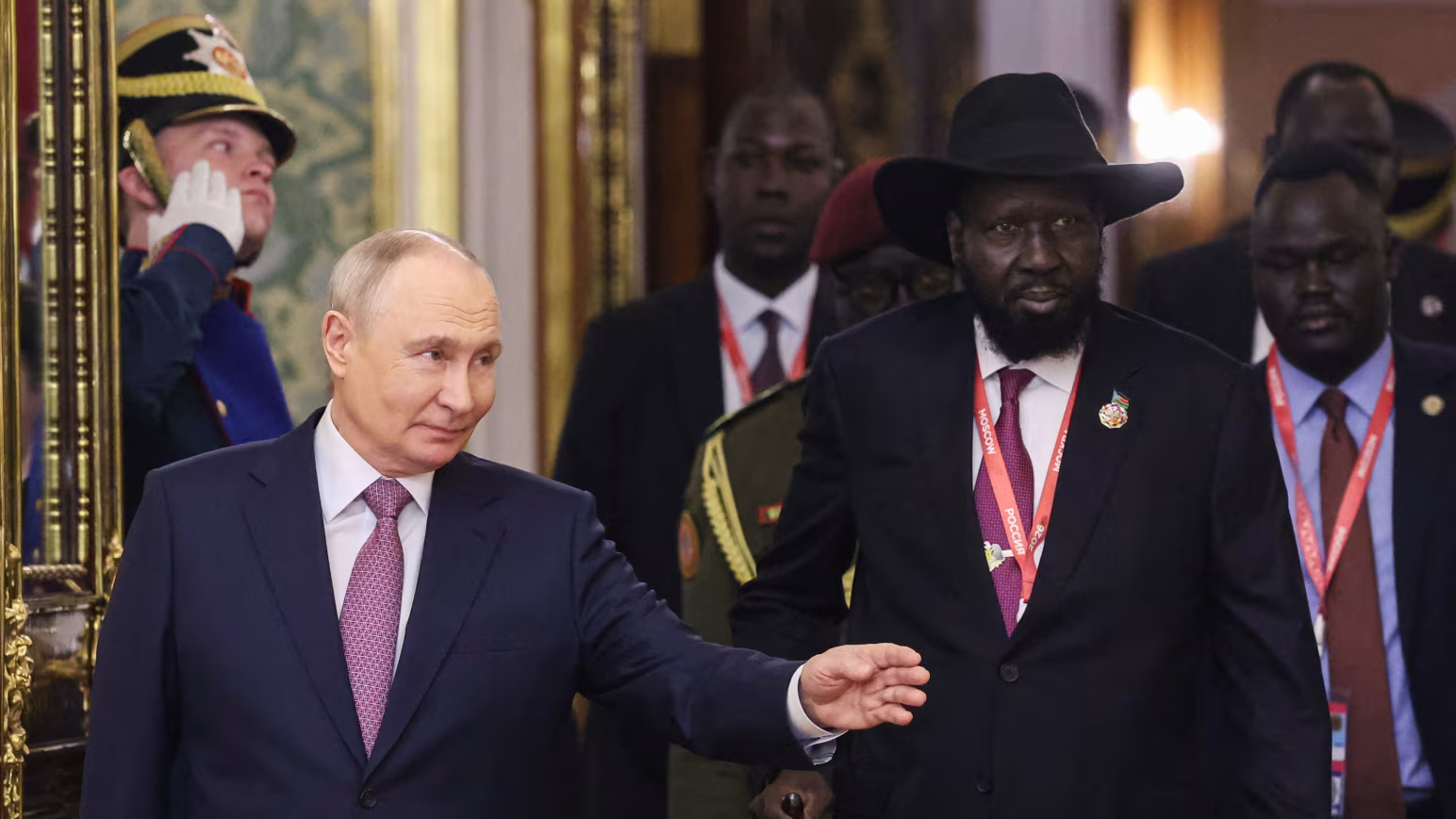
Russia is seeking allies and expanding its influence abroad as its war in Ukraine drags on. African governments, meanwhile, are cozying up to the Kremlin for reasons of their own. As he hosted the third Russia-Africa Summit in Moscow this week, President Vladimir Putin portrayed Russia as a better partner for Africa than the West, which he accused of exploiting the continent’s resources, maintaining a colonial approach and using debt to hold back development. Russia, he argued, offered a different model of cooperation, one which allowed both parties to prosper through closer ties in trade and technology. “Our business does not engage in the predatory, neo-colonial exploitation of natural and human resources,” Putin said, adding that Russian companies supported local job creation and tax revenues. Delegations from 48 of Africa’s 54 countries attended the two-day gathering. Twenty-two were represented by heads of state, according to Kremlin aide Yury Ushakov, compared with 17 at the 2023 summit and 43 at the first meeting in 2019. Such visibility helps Moscow counter its growing international isolation as it grapples with punitive Western sanctions. Will Brown, an Africa policy specialist at the European Council on Foreign Relations, says images of Putin alongside African leaders may matter more than what was agreed at the summit, since they can be reused by Russian influence networks to shape perceptions across Africa and the wider Global South. “The ‘story’ of the summit is the most important thing,” Brown told CNN. African governments, however, are not simply choosing between Moscow and the West. Tighisti Amare, director of the Africa Program at Chatham House, calls their approach “diversified non-alignment”: keeping ties with several partners rather than committing to one camp. Their reasons differ, she said. Some seek security support, others want agricultural supplies, energy investment, or diplomatic backing. Brown says many governments also use international competition to hedge their bets and secure better offers from Western partners. Russia has gained ground in Mali, Burkina Faso and Niger, where military-led governments turned to Moscow for military support after breaking with Western partners. Russia’s military role has grown through the Africa Corps, a paramilitary organization that assumed much of Wagner’s work after the mercenary group’s 2023 mutiny against the Kremlin. The Sahel, the semi-arid belt south of the Sahara, is a key focus. Anna Ida Rock, a researcher at the Swedish Defense Research Agency, says Africa Corps has a reported presence in Burkina Faso, the Central African Republic (CAR), Equatorial Guinea, Libya, Mali and Niger. Russian military instructors have also been reported in the Republic of Congo, Madagascar and Togo, though claims about Togo are disputed. Moscow is also seeking a naval foothold on the Red Sea through a proposed naval facility in Sudan. The shift from Wagner to Africa Corps was more than a name change. The new force operates openly under Russia’s Defense Ministry and military intelligence. Many personnel are former Wagner fighters, but Africa Corps focuses more on training, advising and protecting strategic sites. Wagner remains active in CAR, whose government has resisted the transition. Results vary. In Mali, Russian forces helped the government retake the north-eastern city of Kidal, but insecurity has worsened and the Africa Corps has suffered significant losses. In Burkina Faso, Russian personnel have focused on protecting the government during political instability. Their role in Niger has been more limited. In CAR, Russian forces helped keep the government in power, but insecurity persists. The arrangement has helped the government secure its position, but many civilians do not feel safer. Russia’s political and security presence in Africa is not matched by its trade with the continent. Trade was estimated at $27 billion in 2025, below the $40 billion target Moscow set in 2019. Putin has now set a new goal of more than $50 billion. China and the European Union are far larger trading partners for Africa. China-Africa trade reached about $348 billion in 2025, while trade between the EU and Africa stood at about $395 billion. Agriculture is one area where Russia has established stronger commercial ties. Putin said Russia exported 13 million metric tons of agricultural products to Africa in the first nine months of 2026 and highlighted fertilizer supplies. Energy is another area of cooperation, though projects remain at different stages. Russia’s state nuclear company, Rosatom, is building Egypt’s El Dabaa nuclear power plant, while talks about floating nuclear plants elsewhere have not reached construction. At the summit, Putin also promoted digital cooperation and local production of medicines and vaccines. But Amare says turning these proposals into tangible results will require investment, production facilities and skills. Arms and recruitment Ethiopia illustrates what Russia can still offer militarily. Prime Minister Abiy Ahmed said at the summit that his country had received Russian Su-35 fighter jets and would acquire four S-400 long-range air-defense systems. The deal comes as tensions and renewed fighting in northern Ethiopia raise concerns about a possible return to wider conflict. The agreement covers 12 aircraft. Russia’s state arms exporter told Reuters that it had delivered two. The deal’s value and the delivery schedule for the S-400s have not been disclosed. The deal shows that Moscow can supply advanced weapons despite Western sanctions, Rock told CNN, but noted it could concern Egypt, given tensions between Cairo and Addis Ababa over the Nile. Russia’s arms exports overall continue to decline. The Stockholm International Peace Research Institute reports that Russian exports dropped 64 percent between 2016–2020 and 2021–2025, while the United States and China remained among the world’s largest suppliers. Closer military ties also carry risks. Amnesty International documented cases of Africans allegedly recruited into Russia’s military through deception, coercion and economic hardship. Amnesty said the circumstances in many cases amounted to trafficking. CNN interviewed African men who said they were misled or forced into Russian military service and sent to fight in Ukraine. Russia has denied involvement in the unlawful recruitment of Africans. In February, its embassy in Kenya said Russian authorities had never engaged in the illegal recruitment of Kenyan citizens while maintaining that foreign nationals could voluntarily enlist in its armed forces. Moscow’s promises and Africa’s calculations The summit produced a joint declaration, an agreement on civilian artificial intelligence and a 2027–2029 Russia-Africa action plan. The African Union Commission and Russia also signed a cooperation plan covering security, trade, energy, agriculture, health, education and technology. The Commission says it is a framework, not a legally binding agreement. Amare says progress will depend on whether the commitments receive funding, clear institutional responsibility and deadlines. Brown says African governments are navigating a harsher international environment but are finding ways to use it to their advantage, widening their options and pressing established partners to improve their offers. “They also see the increasingly nasty world we live in and the cards they have to play,” he says. Putin may be courting Africa, but Brown says many governments are “playing their hand very skillfully.”
Putin wants Africa on his side. African leaders are playing their own game
Full Article
Original Source
Read the full article at Egyptindependent →KhanList aggregates and links to publicly available news content. We do not host full articles from third-party sources. Always verify important information with original sources.