
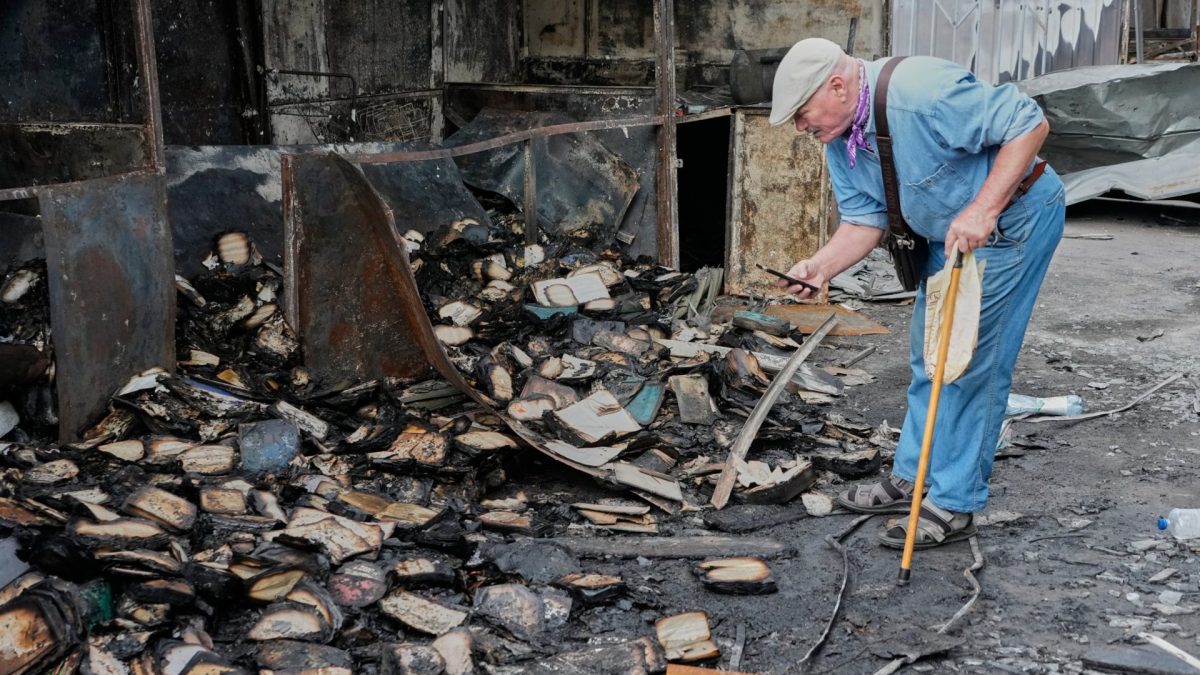
The latest casualty of Russia’s four-year war in Ukraine might not show up on in lists of the dead and wounded, but the loss is nonetheless felt heavily within the country. Vladimir Putin is now attempting to destroy Ukrainian morale through strikes on publishing warehouses, book markets and distribution centres. The strategy, which has seen more than 10 million books destroyed in the last two months, is part of Russia’s wider campaign to eliminate Ukrainian culture. Just like during the Soviet era in Eastern Europe, Ukrainians in occupied territories are banned from speaking their native language, and Russian passports are a requirement for access to public services. But analysts say the attempt to erase Ukrainian identity has the opposite of its intended effect, with civilians more determined than ever to resist in the face of “cultural genocide”. Shorts Books under attack A missile strike on Konvi publishing house in Kyiv on Sunday night destroyed more than 1.3 million schoolbooks, 10 per cent of those required nationwide, just two days before schools reopen on 1 September. This marked the second attack on the publisher in six weeks, after a strike on 19 July destroyed more than 250,000 school books and the materials for 350,000 more. 📖💔 One of Ukraine’s largest printing houses, Konvi, was destroyed by a Russian S-400 strike overnight on July 18–19. The attack damaged equipment, destroyed books and threatened the production of school textbooks🎥 Watch more in the NV video pic.twitter.com/qZxnUxA6Jg— The New Voice of Ukraine (@NewVoiceUkraine) July 26, 2026 According to estimates by the culture ministry, more than 10 million copies of books were destroyed in Ukraine in July and August 2026. This accounts for a third of the annual book production. A fire broke out Ukraine’s largest second-hand book market in Kyiv after strikes overnight on 16 August, with hundreds of stalls damaged. These attacks come amid a dramatic increase on long-range strikes in Ukraine, with 437 civilians killed across the country and 2,610 injured in July according to the UN – the highest number recorded killed since May 2022. Attacks on booksellers’ infrastructure date back to the very beginning of the war, according to Yuri Marchenko, head of analytics at the Ukrainian Book Institute, but the scale has increased dramatically as strikes have ramped up. Marchenko told The i Paper: “Since the summer of 2026, the book industry’s losses have increased tenfold, as the enemy shifted to the tactic of destroying logistical infrastructure – publishers’ warehouses, distribution centres, and fulfillment services. “Over 50 publishers and about 10 bookstore chains and independent bookstores have reported losses.” Cultural genocide The destruction of books is not a standalone campaign, but “makes perfect sense” as part of Russia’s wider war objective “to erase Ukraine as a country and Ukrainians as a nation”, according to Keir Giles, associate fellow of the Russia and Eurasia programme at Chatham House. “Cultural genocide is an aim of the Russian campaign,” Giles said. “The whole reason why Russia went to war in the first place was the deluded belief that Ukraine does not exist.” The Nazis burned tens of millions of books in an effort to extinguish Jewish culture and heritage. In the occupied parts of Ukraine, where Russia can exert control over the civilian population, Ukrainian books have been removed from the shelves and people caught reading them can be punished by up to five years in prison. Giles said: “Russia has a free hand to impose ‘Russianness’ on the victims there. That is where speaking Ukrainian is public punished… you don’t have access to healthcare or public services, such as they are, if you don’t accept a Russian passport. That’s where the erasure of the existence of Ukraine is proceeding rapidly while the war continues.” Destroyed and burned books the day after the attack at a city book market in Kyiv (Photo: Francisco Seco/AP) This isn’t the first time the Ukrainian language has come under attack from Russia. Books in Ukrainian were banned by Russian leaders as far back as 1720, and the language was banned entirely in 1863. Whilst Ukraine was part of the Soviet Union, Ukrainian dictionaries were banned and teachers of Russian received higher salaries to promote the language. “Russia is reaching back into the grimmest parts of its past for how to expand its empire and recolonise places that it thinks should still be governed from Moscow,” Giles said. “Moscow and [St] Petersburg have routinely banned Ukrainian books altogether, so it’s really just a continuation of the same attitude to the existence of Ukrainians.” Resistance ‘getting stronger’ Rather than bringing about Ukrainian surrender by grinding down morale, however, this tactic seems to be increasing domestic support for the war. “The most keen to support Ukraine in its struggle to remain free [are those who] within living memory know what it means to be overrun by Russia and what suffering that inflicts on their populations,” Giles said. 1/2 More than 60,000 books were destroyed in a Russian strike on a warehouse in Kyiv region overnight on August 28.The warehouse held books belonging to Ukrainian bookstores Readеat and https://t.co/w3F91pQy2f, publishers Vivat, Osnovy, Uroboros, Khto Tse?, Krapky and others. pic.twitter.com/RhbRqixcdS— PEN Ukraine (@PenUkraine) August 28, 2026 A poll from early August showed 61 per cent of Ukrainians are prepared to support the war for as long as necessary. “Their theories of victory appear to have come unstuck,” Giles said. Outside of occupied territories, the use of the Ukrainian language has increased since the war began, with 87 per cent of Ukrainians considering it there native language a year into the war compared to 77 per cent the year before. Free Ukrainian courses are offered to both military personnel and civilians as part of the government’s “Switch to Ukrainian” initiative. After the attack on 20 July, Konvi’s commercial director, Viktoriia Haidai, said in a statement: “The enemy’s goal is obvious — to treacherously disrupt the educational process in Ukraine and leave schoolchildren without books on the eve of September 1. They are fighting against the knowledge of our children and Ukrainian culture. “But they cannot break us. We will endure and rebuild the printing house to continue providing children with everything necessary for learning.”
Putin has a chilling new target in his plot to break Ukraine’s spirit
Full Article
Original Source
Read the full article at Inews →KhanList aggregates and links to publicly available news content. We do not host full articles from third-party sources. Always verify important information with original sources.