
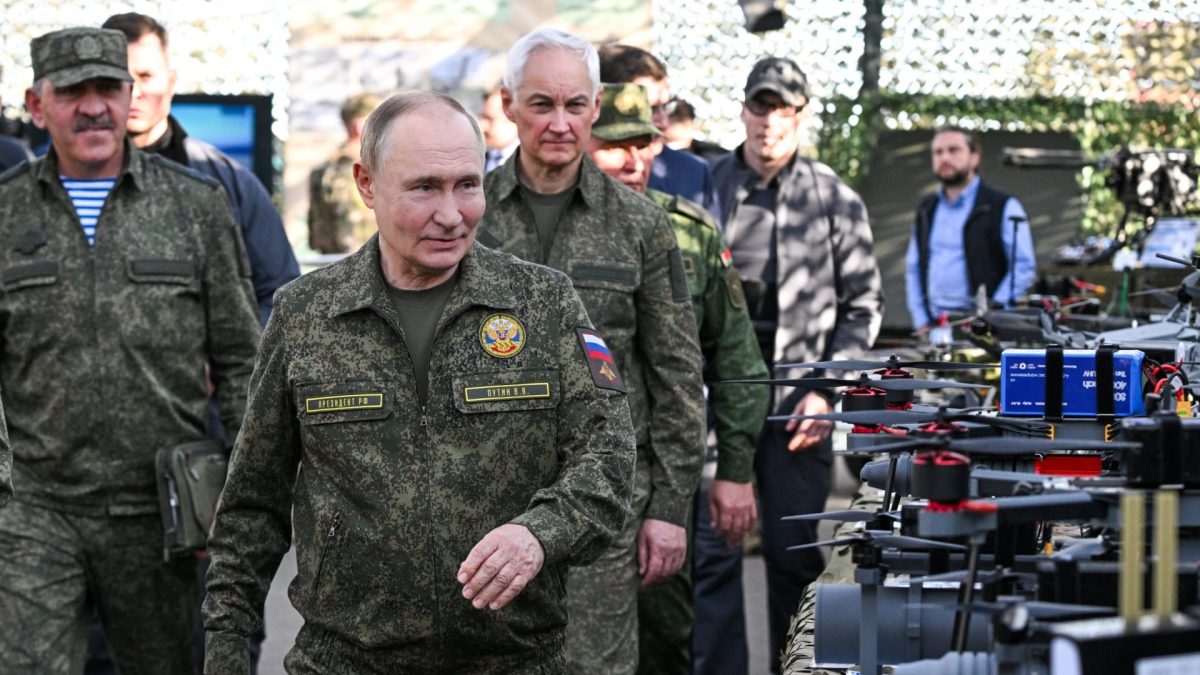
Vladimir Putin is growing more reckless as his inner circle shrinks, UK security insiders believe, prompting fears that he might “lash out” against Britain or another Nato state. The Russian leader’s smaller, more radical group of advisers is fuelling his unpredictable actions, sources have told The i Paper. Concerns over Putin’s brinkmanship have been heightened by the attempted drone attack on Leipzig airport last month, which this week Germany blamed directly on Russia. Shorts European and British diplomatic insiders believe the plot – which involved military grade explosives – marked a new phase in Moscow’s grey zone warfare against the West, as it tested the limits of what is normally deemed the threshold of military action, going beyond typical hybrid activity of cyber attacks, signal jamming and sabotage. ‘None of the sensible voices are there’ A Western security source said: “One of the concerns is that Putin is speaking to an increasingly small inner circle of people and none of the more sensible voices are still there.” The suggestion has fuelled fears that the Russian president is “paranoid” and may “not be thinking rationally”. The assessment is shared by military experts and former generals, who said it should serve as a warning to Andy Burnham and Chancellor John Healey to go faster on defence spending. The i Paper has learned that a number of Labour MPs are concerned that Burnham and Healey are refusing to commit immediately to a timetable of 3 per cent by 2030, and are instead waiting until next year’s spending review to announce it. It follows the broadside by Tan Dhesi, the Labour chairman of the Commons Defence Committee, at PMQs on Wednesday that “vibes alone” were not enough to address funding of the Armed Forces. It was a significant challenge to Burnham from one of his own senior MPs on his first day in Parliament as Prime Minister. The Kremlin has denied playing a part in the Leipzig attack plot. ‘Internal enemies are starting to circle’ With Putin said to be increasingly reliant on his tight-knit circle of advisers, the president is facing internal pressure from others over the progress of the war in Ukraine and the dire state of the Russian economy. Lord Dannatt, former head of the British Army, said: “The internal enemies are starting to encircle the Kremlin wagons. “The old guard of Putin’s supporters are becoming more concerned that popular opinion is turning against Putin, despite his control of the media. “You cannot hide rising prices, interest rates and inflation, nor the long queues at petrol stations. “The danger for us is that he might lash out. What about the drone at Leipzig? And his smirk when asked if the UK should be worried about an attack. “Meanwhile, our Government refuses to commit to 3 per cent of GDP on defence by 2030. ‘Vibes will not defend us’ says the chair of the Defence Select Committee.” Gen Sir Richard Barrons, a former UK forces commander and co-author of the latest Strategic Defence Review, said: “It is clear that Putin is calibrating his sub (military) threshold attacks on the UK and Europe at a higher level of risk and consequence than has been the case of the past two years or so.” Barrons said he believed the rising tensions were closely connected to the progress of the war in Ukraine as Putin was “not making the hoped-for significant breakthroughs on the battlefield”. Russian action against Europe ‘likely to be ramped up’ The continued deterioration of the Russian economy “raises big questions – not yet critical – about the long-term sustainability of the Russian war effort”, he said. Barrons added: “Putin must be considering whether to make a bigger effort in Ukraine, which is likely to require another very unpopular compulsory mobilisation of people, and as part of this escalation he will continue to increase the pressure on European countries supporting Ukraine. “The failed drone attack on a Ukrainian cargo aircraft in Leipzig was a major increase in the threat – this shouldn’t be lost sight of even though it failed. Imagine what would’ve happened if that large cargo aircraft had been damaged on takeoff and fallen on a populated area.” He added: “In all these circumstances, we must assume that Russian sub-threshold activity against Europe is much more likely to be ramped up than diminished and that the UK will be a high priority target.” The visit to Moscow last week by CIA director John Ratcliffe, who reportedly warned Putin’s aides not to attack Nato, “shows how high the stakes are”, Barrons said. Labour MPs concerned about defence spending Labour MPs echoed Dhesi’s call for an announcement on 3 per cent defence spending. One Labour MP said they thought Dhesi was “right to keep applying the pressure on this”, adding: “I would like the 3 per cent target announced as soon as possible and actually think we’ll end up needing more than that anyway. “Alongside that we need to increase public awareness of the threat to the UK and what it means to people here in terms of costs to them of cyber attacks, etc. So we create that upward pressure for more government action.” Another MP said: “I think it’s always good to keep up the pressure and show there is backbench support for [a] firm date on 3 per cent.” Although they acknowledged it was made clear at the time of the Defence Investment Plan in July that the next steps would be taken in next year’s spending review. Asked whether or not Burnham had committed to a 3 per cent defence spending target by 2030, the Prime Minister’s official spokesman said: “As the Prime Minister made clear in the House, we remain unwavering in our commitments to international defence spending targets, and the first duty of government is to keep its country safe. “And the Prime Minister and Chancellor remain fully committed to funding the Defence Investment Plan and meeting our Nato commitment of 3.5 per cent of GDP on defence by 2035. “On 3 per cent the Chancellor, as he has said, will set that out at the spending review next year. So I’m not going to get ahead of that.” Who is in Putin’s close circle of advisers? Sergei Naryshkin, the head of Russia’s foreign intelligence service, SVR, who has made threats against the West Nikolai Patrushev, former secretary of Russia’s security council but said to be still influential Sergei Kiriyenko, the hardline deputy chief of staff of the presidential administration Alexander Bortnikov, the head of domestic intelligence service, FSB Valeri Gerasimov, the head of the armed forces
Putin growing more reckless as inner circle shrinks, UK security insiders fear
Full Article
Original Source
Read the full article at Inews →KhanList aggregates and links to publicly available news content. We do not host full articles from third-party sources. Always verify important information with original sources.