
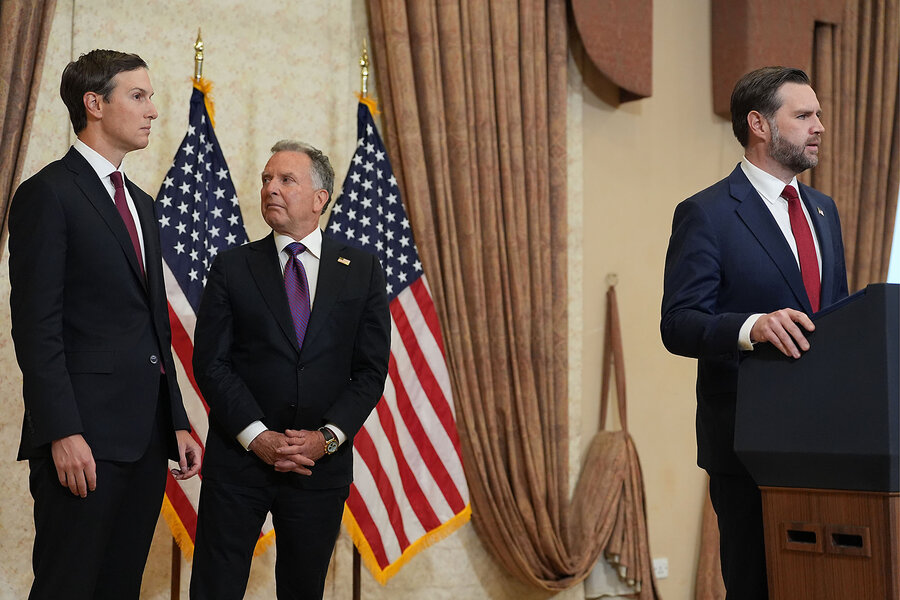
President Donald Trump has been looking for months for a way to end the unpopular and costly Iran war.Now, Democrats, who have gained the power of the purse by winning control of both houses of Congress in midterm elections this week, are likely to be more than willing to play a part in bringing the war to an end.Exercising their newfound power to force an end to the Iran war – by cutting appropriations, for example, or by trading action on the war for something the Trump administration wants – is just one way Democrats are expected to influence foreign policy in the final two years of the Trump presidency. Once in control of the powerful House Foreign Affairs and Senate Foreign Relations committees, as well as the appropriations processes in each chamber, Democrats will have a key hand in budgets for the military, foreign aid, and foreign operations.Beyond that, they have indicated they will take up a list of issues that played some role in their electoral triumph, experts on Congress and foreign policy say. Expect oversight hearings, probes, and initiatives on topics ranging from Ukraine and relations with allies to corruption, artificial intelligence, and Mr. Trump’s particular manner of conducting diplomacy.Taking control of Congress “gives the Democrats unprecedented leverage, particularly with budgetary tools,” says Ryan Crocker, a retired career diplomat who served in wartime Iraq and Afghanistan. He expects a Defense Department request for additional funding for the Iran war, anticipated before the end of the year, “will be the first battleground of this newfound power” – even though the new Congress won’t take office until January. Jacquelyn Martin/APDefense Secretary Pete Hegseth testifies at a Senate Appropriations Committee hearing in Washington, July 21, 2026. But Mr. Crocker, who served as U.S. ambassador in a number of Middle Eastern countries, says he hopes the Democrats use their new influence in foreign policy matters more broadly to steer the United States to a reinvigorated traditional diplomacy.Diplomatic postsPresident Trump has left dozens of embassies without ambassadors, and has preferred friends and family members over seasoned diplomats to negotiate conflicts, including the Iran and Ukraine wars, he notes. “You can’t have credible diplomacy without diplomats,” says Mr. Crocker, now a distinguished diplomatic fellow at the Middle East Institute in Washington.On the Iran war, Democrats lost no time in drawing a direct line between their victory Tuesday and the conflict’s termination.“We are going to end the war,” Senate Minority Leader Chuck Schumer of New York said at a news conference in Washington on Wednesday.But the former ambassador and other experts say the Democrats should be realistic about their ability to force a president’s hand on military engagement.The Democrats could use the annual authorization of the Defense Department budget to pressure the president on Iran, notes Shoon Murray, associate professor emerita of foreign policy and global security at American University in Washington. But she cites a similar situation two decades ago when Democrats, newly in control of Congress in 2007, attempted to use purse strings to end President George W. Bush’s Iraq War. Elizabeth Frantz/ReutersSenate Minority Leader Chuck Schumer of New York speaks about his party reclaiming the Senate majority in Tuesday's elections, at a press conference in Washington, Nov. 4, 2026. “They tried and failed,” Dr. Murray says. The Democrats passed legislation demanding a timetable for ending the war, she adds, but President Bush “vetoed it and surged troops into Iraq instead.”Power of oversightAs important as the power of the purse might be, Dr. Murray says the oversight role the Democrats will gain with leadership of key congressional committees could be more consequential.In addition to a focus on the cost and strategy of the Iran war, she says she expects hearings on everything from tariffs to the legality of lethal strikes on boats in the Caribbean and Western Pacific, and “on the enrichment of Trump family members in deals with Gulf states.”Indeed, Sen. Chris Murphy of Connecticut says he wants fellow Democrats to use new oversight powers to investigate the president’s reliance on personal friends and family members to conduct diplomacy.“The White House and Jared Kushner and Steve Witkoff want to keep diplomacy with the Gulf to themselves because it’s a grift,” Senator Murphy told reporters last month, referring to Mr. Trump’s son-in-law and his close personal friend. “They don’t want powerful ambassadors to ring alarm bells about their corruption.”Others expect a Democratic-led Congress to set a new, friendlier tone on Ukraine that translates to more reliable and faster-paced military assistance. Democratic control “means that aid packages move not in nine months but in nine days or nine weeks on the outside,” Rep. Jim Himes of Connecticut, the likely incoming chair of the House Intelligence Committee, said last week in Poland. Allison Robbert/APDemocratic Sen. Chris Murphy of Connecticut speaks with reporters following votes at the Capitol, March 5, 2026. Democrats might find that they have more influence in forcing the end of the Iran war because they have more than themselves to count on to oppose the war’s continuation. Vice President JD Vance, who opposed initiating a war with Iran from the outset, was quick to blame the war for the Republicans’ midterm losses in a lengthy social media post Wednesday. Already, during the midterm campaign, a number of Republican congressional candidates had come out in favor of ending the war. Former GOP Rep. Mike Rogers, who campaigned unsuccessfully for a U.S. Senate seat in Michigan, ran an ad in which he declared, “The war with Iran needs to end and end quickly. When it does,” he promised, “energy costs will plummet.”Iranian leverageSome Iran experts caution that it’s not just U.S. politicians who are gauging what this week’s elections say about the war’s future course.“With the midterms, the Islamic Republic believes it has more leverage rather than less,” says Behnam Ben Taleblu, senior fellow in Iranian security and political issues at the Foundation for Defense of Democracies in Washington.Given Tehran’s sense that it is winning the “narrative war,” he says, any mounting pressure on the president to end the war will only yield the opposite of what the war’s opponents seek.Invoking the adage that the enemy has a vote in how a war plays out, Mr. Taleblu says, “Any submission now would be escalatory.” Deepen your worldviewwith Monitor Highlights.Politics with respectGet political stories with respectful analysis.There‘s a world of new ideas in everyBooks newsletter.There‘s more to life, enrich yours withCulture & Learning weekly.Follow humanity‘s discoveries withScience & Nature stories in your inbox.Gain a spiritual perspectivefrom the stories in your inbox.Want to understand the deeper impact of critical events? Learn the Monitor‘s insight.Already a subscriber? Log in to hide ads. Others express some concern that Mr. Trump, who has toggled between seeing himself as a peace president and a triumphant war president, could feel unleashed by the midterm results and the coming lame-duck period and decide to go for Iran’s military defeat.“This is Donald Trump’s war, and he will decide what he does about it,” Mr. Crocker, the former ambassador, says. “I would hope the midterm results would reinforce the president’s instinct for caution in military conflict.” ALREADY A SUBSCRIBER? LoginReal news can be honest, hopeful, credible, constructive.The Christian Science Monitor was founded in 1908 to lift the standard of journalism and uplift humanity. We aim to “speak the truth in love.” Our goal is not to tell you what to think, but to give you the essential knowledge and understanding to come to your own intelligent conclusions. Join us in this mission by subscribing.
Purse strings and oversight: How Democrats can influence Trump’s foreign policy
Full Article
Original Source
Read the full article at Csmonitor →KhanList aggregates and links to publicly available news content. We do not host full articles from third-party sources. Always verify important information with original sources.