
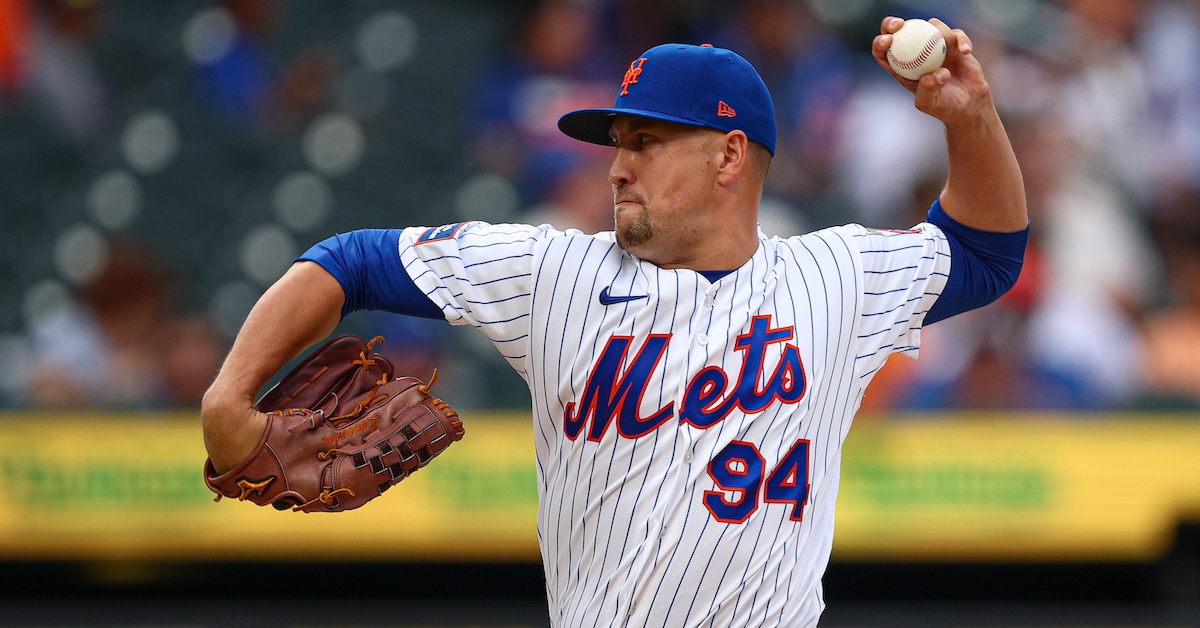
Vincent Carchietta-Imagn Images I’m going to give you a little cheat sheet for writing about deadline moves. If you’re talking about a seller who traded a player for a minimal return and you’re looking for silver linings, you can mention “opportunity.” It has two big advantages. First, it’s nebulous and hard to disprove. If you make a claim about a specific player, it might be wrong. If you say that a roster spot is an opportunity, how will someone counter that? But more importantly, roster spots really are opportunities, so your analysis will have the advantage of being correct. Case in point: Nate Lavender. If you’re wondering who that is, that’s exactly what I’m getting at. Lavender debuted on August 4, the day after the Mets sent half the team out of town at the trade deadline. He was one of five Mets pitchers called up that day, a hockey-style line shift in the bullpen. Not all of them panned out. Xzavion Curry and Chayce McDermott are back in the minors. Jefry Yan has a fun strikeout celebration and a 5.18 FIP. But Lavender has been good enough that he’s worked his way from his big league debut into a setup role in three weeks. Opportunity, indeed. A quick recap of Lavender’s minor league career: He was the Mets’ 14th-round draft pick in 2021, climbed the minor league ladder despite below-average velocity and stuff, and then blew out his elbow early in the 2024 season. He had an internal brace surgery that summer, and then the Rays plucked him away in the Rule 5 draft that December. They parked him on the 60-day injured list for the entirety of the 2025 season, as a bone spur in his elbow delayed his rehab. When the year ended and the 60-day IL disappeared, the Rays returned him to the Mets rather than place him on their 40-man roster. That banked Lavender a year of major league service time, itself a coup for such a late draft pick. In 2026, the Mets put him back in Triple-A after a few early-season appearances in A-ball to shake off the rust, but he was just way too good for the batters he faced in the minors; he struck out 40% of his opponents in Syracuse, and by the time the Mets were looking for bullpen reinforcements, he was an obvious choice. “Acquired by the Rays” is one of the best things I could imagine saying about a funky reliever. And oh man, is Lavender funky. Here’s how Eric Longenhagen described his delivery after that Rule 5 draft: “…he has one of the more deceptive deliveries in the minors… Lavender’s head whack… prevents him from seeing his target at release. He gets way, way, way down the mound… His arm action is also super whippy, and the line on his fastball is incredibly difficult for hitters to get on top of.” Yeah, you should probably just see it: You Aren't a FanGraphs Member It looks like you aren't yet a FanGraphs Member (or aren't logged in). We aren't mad, just disappointed. We get it. You want to read this article. But before we let you get back to it, we'd like to point out a few of the good reasons why you should become a Member. 1. Ad Free viewing! We won't bug you with this ad, or any other. 2. Unlimited articles! Non-Members only get to read 10 free articles a month. Members never get cut off. 3. Dark mode and Classic mode! 4. Custom player page dashboards! Choose the player cards you want, in the order you want them. 5. One-click data exports! Export our projections and leaderboards for your personal projects. 6. Remove the photos on the home page! (Honestly, this doesn't sound so great to us, but some people wanted it, and we like to give our Members what they want.) 7. Even more Steamer projections! We have handedness, percentile, and context neutral projections available for Members only. 8. Get FanGraphs Walk-Off, a customized year end review! Find out exactly how you used FanGraphs this year, and how that compares to other Members. Don't be a victim of FOMO. 9. A weekly mailbag column, exclusively for Members. 10. Help support FanGraphs and our entire staff! Our Members provide us with critical resources to improve the site and deliver new features! We hope you'll consider a Membership today, for yourself or as a gift! And we realize this has been an awfully long sales pitch, so we've also removed all the other ads in this article. We didn't want to overdo it. That’s 93 right down Broadway, and Jackson Merrill looked like he was seeing ghosts after the pitch. The camera angle isn’t conducive to seeing extension, but the scouting report wasn’t wrong. Lavender gets 7.2 feet closer to home before releasing the ball, which is in the 95th percentile for extension. His delivery obscures the ball twice, first behind his stride leg and then behind his plant leg. His short arm swing means that the ball stays hidden behind his torso even as he starts driving towards the plate. Hitters see a whole lot of nothing for most of his delivery, and then he steps seven feet towards them; it’s a very unsettling at-bat. In fact, if you expand that GIF and pause it, you can step through frame-by-frame and marvel at how little of the ball Lavender shows; it’s almost like a magic trick, a sequence of body parts and hand positions combining to prevent hitters from keeping their eye on the ball. Lavender has only thrown 70 four-seamers since being called up, but he’s running a gaudy 18.6% swinging strike rate on them. That’s one of the best marks in baseball, even with tiny minimums. It’s in the 97th percentile, to be precise, fractionally behind Cam Schlittler’s own excellent fastball. If you’re now perusing Lavender’s statistics, I bet that you’ve noticed that our pitch models think his fastball is unremarkable stuff-wise. PitchingBot gives it a 53, Stuff+ a 96. That’s not some quirk of our models relative to other pitch models, either; pretty much every publicly available one agrees on that front. To that I have two things to say. First, the models at least like the pitch’s location. Second, who cares? To be clear, I don’t mean that you shouldn’t care about pitch models. I mean that when you have an absolute oddball like Lavender, a guy who’s been posting big strikeout rates with mop-up man velo and a funky delivery, you should be skeptical that the models are getting him right. They operate by using some fancy math to figure out what pitches with the same general characteristics tend to do, and there are very few pitchers who pitch like Nate Lavender. Even after that, they don’t account for deception. That’s on purpose, more or less; it’s just not a feature that we’ve figured out how to capture yet. When weird-pitch relievers come up and start succeeding right away, I’m inclined to look for reasons why they’re making it work, instead of deferring to the model. If Lavender were throwing 97 mph with decent ride using a more normal delivery, I’d be a lot more willing to listen to the machines. One thing the models don’t need context for is location — a funky delivery doesn’t change the physical location of the strike zone — and they’ve loved Lavender’s fastball command so far. We’ll see how long that lasts; before his elbow injury, he posted ugly walk rates down on the farm. But in encouraging news, he had already slashed his walk rate to single digits in the minors this year, and he’s pushed it even lower in his 10 big league appearances. Command is often one of the last things to return after elbow surgery, but that’s more of a guideline than a rule, and I love to see a pitcher setting career-best marks against the toughest competition he’s faced. Oh, right, I should probably give you his stats. They’re outrageous! For one thing, Lavender has a 0.00 ERA. That’s a caricature of his skill, of course; he hasn’t given up a home run, and he’s allowing a silly .143 BABIP. But advanced ERA estimators also think he’s been excellent. He’s striking out 34.3% of opponents, walking only 5.7%, and he’s not giving up much loud contact even when he does let someone put the ball in play. He sports a 1.34 FIP (ninth among relievers in the last month), 1.80 xERA (12th), 2.26 SIERA (16th), and 2.94 xFIP (25th). When one indicator is flashing bright green, it might be a coincidence. When they all are, call me Fox Mulder, because I want to believe. His arsenal isn’t all fastballs – but it’s kind of all fastballs. Lavender throws his heater 60% of the time, a slider 20% of the time, and then mixes in sweepers against lefties and changeups against righties. None of them jump off the page; our latest prospect report on him had the slider and changeup as fringe-average, which looks right to me. The sweeper is new, and I do like it more than the other two, but it’s probably only for use against lefties given its shape. Like his fastball, though, his secondaries’ success is due at least as much to how he throws them as it is to what they do after he lets them go. The secondaries also have the added benefit of batters trying their hardest to figure out the fastball; if you’re expecting an invisiball in the low 90s and get a different, bending pitch, how much it bends is less important. To the Mets’ credit, they’ve basically tossed Lavender into the forge and let him cook. In keeping with my theme of comparing Lavender to all big league relievers in the past month, only five have entered in higher-leverage situations on average. Those five: Dodgers closer Tanner Scott, Rays closer Bryan Baker, Yankees closer David Bednar, Mariners closer Andrés Muñoz, and Reds closer Emilio Pagán. That’s not your normal August call-up reliever workload, which makes sense, because Lavender is not your normal August call-up reliever. Our in-season projection systems now give Lavender the second-best projection among Mets relievers the rest of this season, and the 58th-best mark out of the 496 relievers we project to pitch the rest of the year. That’s kind of wild for a 26-year-old rookie who tops out below 95 mph, but maybe it’s not so wild for a guy who has faced 209 batters this season and struck 82 of them out. It’s a good reminder that there are a lot of good relievers in the minors waiting for one tweak or one opportunity to burst onto the big stage. For me, it’s also a good reminder to enjoy things while they’re happening. Part of Lavender’s effectiveness surely comes down to his novelty. I’m not saying he won’t continue to baffle hitters down the road, but they probably won’t look quite so bamboozled as the guys facing him now do. Can he keep commanding the ball this well? History would suggest not. How will his arm hold up to a bigger workload? Who knows! But for now, Lavender is one of the best relievers in the major leagues, full stop. The numbers don’t lie. Those swinging strikes aren’t subjective; he’s turning big league hitters into uncoordinated pretzels at a spectacular rate. Post-deadline opportunity is a real thing, and there’s no better example this year than Lavender.
Purple Reign: Nate Lavender Is Unhittable
Full Article
Original Source
Read the full article at Blogs →KhanList aggregates and links to publicly available news content. We do not host full articles from third-party sources. Always verify important information with original sources.