
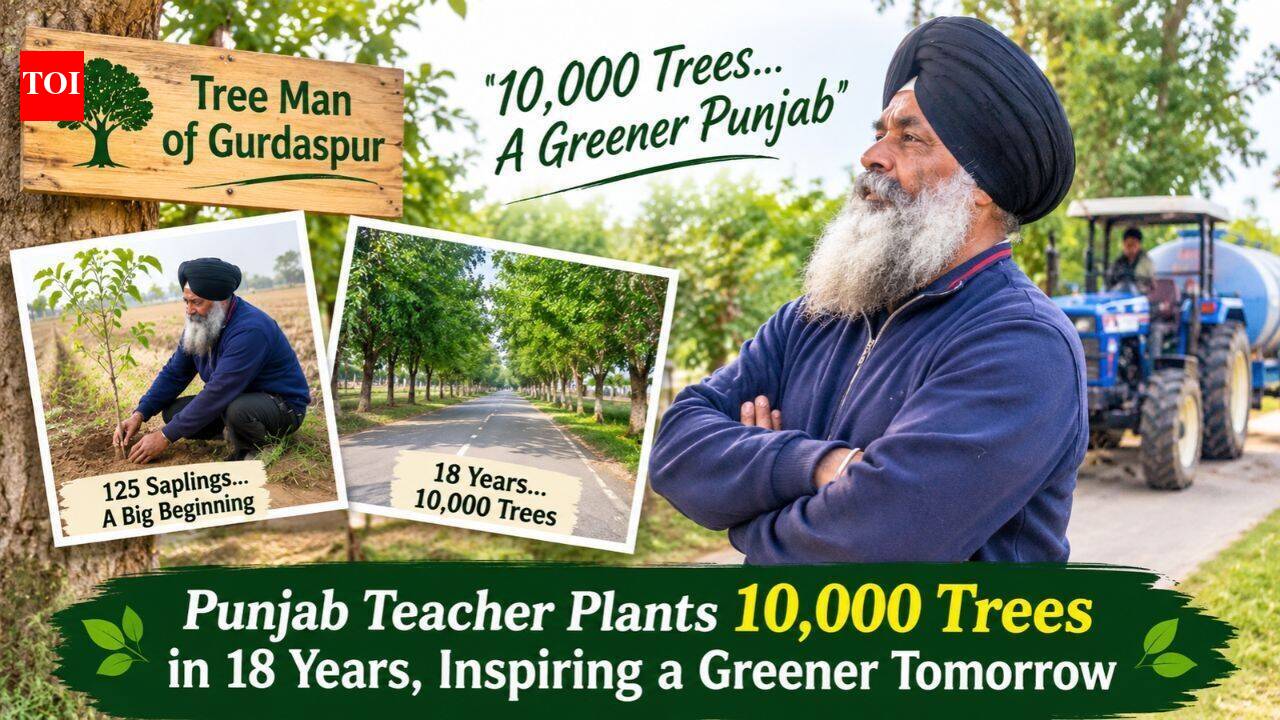
What began with 125 saplings, a bucket of water and a simple concern for children walking under the scorching summer sun has grown into an extraordinary 18-year mission. At 56, Ranjit Singh Chinna, a government schoolteacher from Punjab's Gurdaspur district, has planted and nurtured around 10,000 fruit-bearing and medicinal trees across highways, village roads and public spaces.Popularly known as the 'Tree Man of Gurdaspur', Chinna has spent nearly two decades making roads greener, creating shaded spaces and improving his surroundings. His journey has not been driven by a large organisation or an elaborate environmental campaign. Instead, it has been powered by personal commitment, his own resources and the belief that even small efforts can make a difference.Today, his plantation work extends across several parts of the border district, while his contribution to society goes beyond planting trees. From cleaning public spaces to respectfully burying dead animals and birds found along roads, he has made community service an important part of his life.A road without trees gave birth to a green missionChinna's journey began in 2007 when he noticed something missing along the road connecting his native village, Chinna Railwala, with Naushera Magha Singh. The approximately one-kilometre stretch had no trees, leaving children returning from school and college exposed to the harsh summer heat. Rather than waiting for someone else to address the problem, he decided to do something himself.He planted 125 saplings along the road over three months. However, planting them was only the beginning. With no proper water supply available, he carried water in a bucket and watered each sapling himself. Recalling those early days, Chinna told The New Indian Express, “This road is around one kilometre, so I planted 125 trees in the span of three months and then used to water them with my own bucket, as I had no source to water them otherwise.”The modest beginning gradually developed into a much larger environmental effort. What started as an attempt to provide shade to children became a lifelong commitment to improving the district's green cover.From a bucket to a tractor, the work kept growingAs the number of saplings increased, manually carrying water became increasingly difficult. Chinna came up with a practical solution by installing a 500-litre water tank on his motorcycle, using a tyre as its base. This allowed him to transport water and irrigate more plants. However, a back problem eventually made it difficult for him to continue using the motorcycle for the task. He then shifted the water tank to his tractor trolley, which he now uses to water the trees.Explaining the change, he said, “After that, due to my back problem, I have installed that tank in my tractor trolley and thus now irrigate the plants.” Over the years, his plantation efforts expanded beyond national highways to village link roads and public spaces. He has planted trees around railway stations, schools, cremation grounds and bus stands.He particularly focuses on planting saplings between June and August. Whenever he identifies suitable land for plantation, he raises around 400 to 500 saplings. The effort requires considerable personal investment, with Chinna spending approximately Rs 60,000 to Rs 65,000 every year on his green mission.His idea of service extends beyond planting treesFor Chinna, environmental responsibility does not end with making an area greener. He has also taken up several tasks that many people might overlook, including clearing unwanted vegetation and ensuring that dead animals and birds found along roads are properly buried. For the past 15 years, he has been involved in collecting and burying animal and bird carcasses. He considers this an important responsibility because decomposing bodies can create public health concerns and attract harmful bacteria and other pathogens.He also believes that leaving dead animals exposed or throwing them into garbage dumps is disrespectful. In his view, animals deserve dignity even after death. Explaining why he undertakes this work, Chinna said that removing carcasses also helps prevent accidents, as motorists sometimes make sudden manoeuvres to avoid bodies lying on busy roads. During the rainy season, he additionally clears congress grass along village link roads. His efforts also include cleaning stretches used by devotees after religious processions.His commitment to public service was visible even before his tree-planting initiative began. According to The Tribune, between 2005 and 2012, he served drinking water to passengers at Chhina railway station every day, without missing a single day. During the Covid-19 pandemic, he also offered to transport infected patients to hospitals using his vehicle.The 'Tree Man of Gurdaspur' believes small efforts matterChinna's dedication has earned him recognition from several social and voluntary organisations. He has also received the Bhai Kanhaiya Award for excellence in social service. Despite the appreciation, he believes the real reward lies in helping others rather than receiving awards. His guiding thought is a simple question: “What are you doing for others?”He also recognises that one individual cannot transform an entire district's environment alone. According to The Tribune, Gurdaspur has limited forest cover, and Chinna believes greater participation from NGOs and social organisations could help expand the district's green spaces. For now, he continues his work with the resources available to him, identifying suitable locations, raising saplings, watering them and ensuring that they survive.At 56, his journey offers a refreshing perspective on environmental activism. It does not always require a massive campaign, expensive machinery or institutional backing to begin making a difference. Sometimes, it starts with noticing a problem on a familiar road, planting a few saplings and returning every day with a bucket of water. Nearly 10,000 trees later, Chinna's efforts have turned that small act of concern into a mission that continues to benefit people, animals and the environment.
Punjab teacher plants 10,000 trees over 18 years, keeps mission alive
Full Article
Original Source
Read the full article at Timesofindia →KhanList aggregates and links to publicly available news content. We do not host full articles from third-party sources. Always verify important information with original sources.