
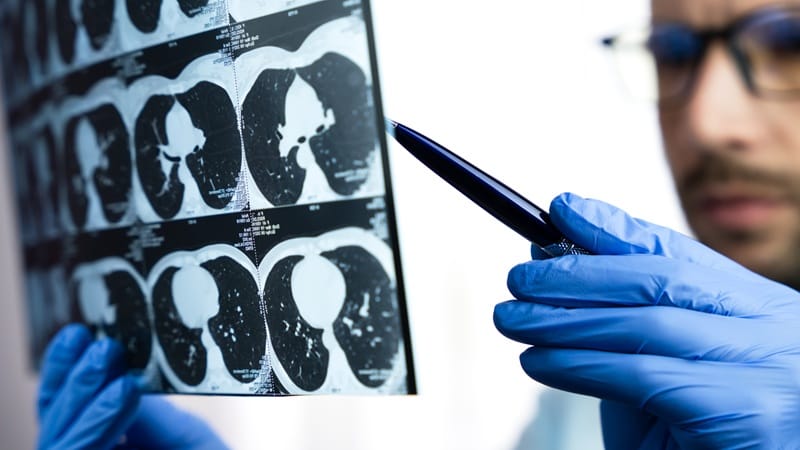
Chest CT is commonly performed in older adults to investigate symptoms such as persistent cough, chest pain, shortness of breath, and fever. It can also aid in the evaluation of aortic aneurysms and chronic diseases. Other indications include assessing coronary artery calcium levels, monitoring patients after thoracic surgery, detecting and staging lung cancer (LC), characterizing pulmonary nodules, and evaluating metastases.Low-dose CT (LDCT) is used to screen for LC in asymptomatic high-risk individuals. Eligibility criteria include age 50-80 years, current smoking or smoking cessation within the past 15 years, and a smoking history of ≥ 20 pack-years.LC screening reduces mortality and the number of diagnoses at advanced stages. However, it also carries risks, including false-positive results, additional testing, and patient anxiety. Clinicians, therefore, need to understand the interpretation of radiologic findings and subsequent management.Epidemiologic DataMost pulmonary nodules are discovered incidentally rather than during investigations for suspected cancer. The prevalence of nodules detected through screening is similar in older and younger adults, at approximately 20%-25%. However, the proportion of malignant nodules increases with age, from less than 5% in younger adults to 6%-10% in older adults. Most benign nodules are associated with infectious granulomas, scarring, hamartomas, intrapulmonary lymph nodes, or vascular malformations.Risk StratificationSeveral multivariable prediction models can help clinicians estimate the probability of a pulmonary nodule being malignant. The Brock model, originally developed using data from a population undergoing LDCT screening, has proven applicable in both the screening and evaluation of incidental nodules.Nodule morphology is a key factor in assessing malignancy risk and in determining its management.Risk prediction models are primarily used to assess solid nodules, although studies suggest that experienced physicians can also accurately estimate the risk for malignancy.Subsolid nodules: Subsolid nodules carry a higher risk for malignancy than solid nodules. Approximately 63% of part-solid nodules and 18% of pure ground-glass nodules are malignant. These nodules generally need to remain stable for ≥ 4 years before they can be considered benign.Risk prediction models are primarily used to assess solid nodules, although studies suggest that experienced physicians can also accurately estimate the risk for malignancy.Management Based on Risk StratificationThe goal is to promptly identify malignant nodules while avoiding unnecessary invasive procedures. Management is guided by the estimated probability of malignancy.Low-risk: Low-risk nodules are monitored using follow-up CT scans.Intermediate risk: Intermediate-risk nodules may require PET-CT, biopsy, or both. PET-CT is useful for assessing solid nodules ≥ 8 mm when the probability of malignancy is intermediate. It has a sensitivity of approximately 89% and a specificity of approximately 75%. However, its accuracy is lower for tumors with low metabolic activity and in regions where infections are endemic.High-risk: High-risk nodules may warrant surgical resection, sometimes without preoperative biopsy.Additional factors can increase the probability of malignancy, including older age, current or former smoking, family history of LC, emphysema, larger nodule size, spiculated margins, upper lobe location, and growth on serial imaging.AI may further improve nodule assessment. Deep learning combined with radiomics and radiogenomics shows potential for noninvasively predicting nodule growth and estimating malignancy risk.In clinical practice, I value radiologists’ opinions. If I have even the slightest doubt, I refer the patient to the pulmonologist I trust. There is no room for error.This story was translated from Medscape’s Portuguese edition.
Pulmonary Nodules: Who Needs PET-CT or a Biopsy?
Full Article
Original Source
Read the full article at Medscape →KhanList aggregates and links to publicly available news content. We do not host full articles from third-party sources. Always verify important information with original sources.