
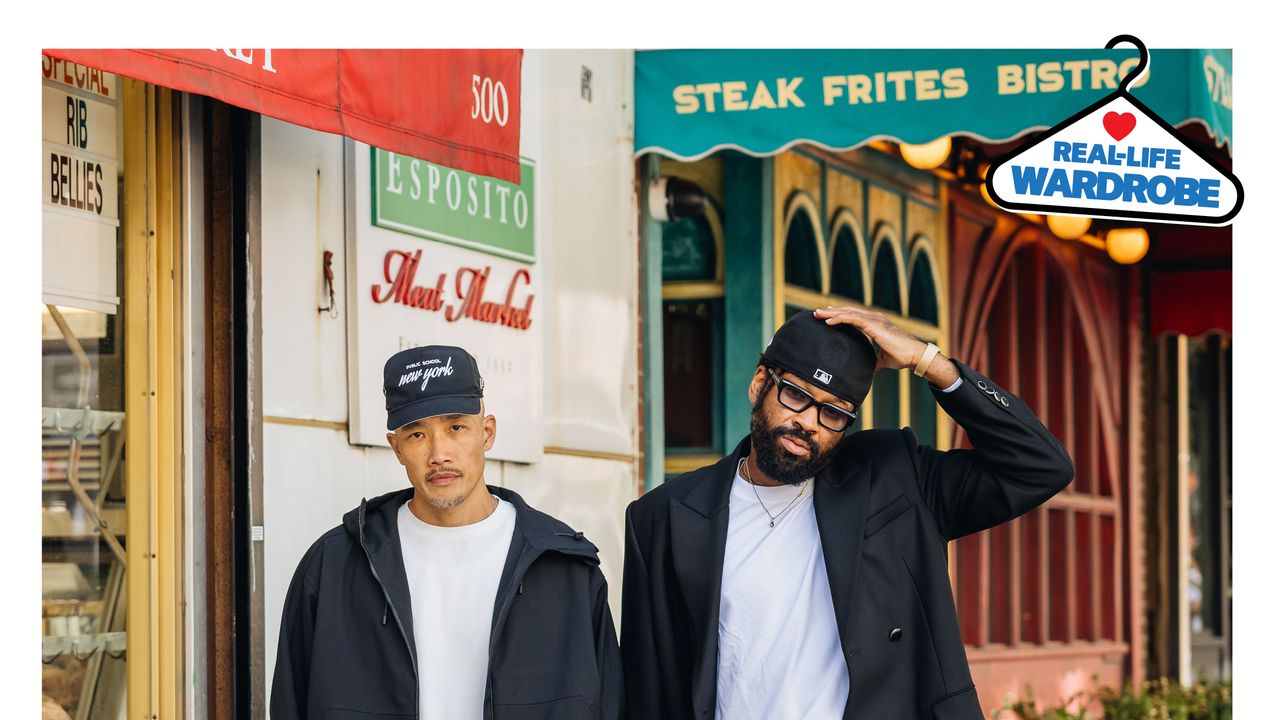
The veteran design duo takes GQ columnist Christopher Fenimore behind the scenes of their latest runway spectacle.When I walk into Public School New York’s Garment District office, Maxwell Osborne greets me with a dap so familiar it leads a nearby PR person to ask if we already knew each other. “Nah,” we say in unison. There’s simply an inherent understanding between native New Yorkers like us.Osborne and his co-designer Dao-Yi Chow’s shared reverence for New York City has always been vital to the DNA of their brand. The pair founded Public School in 2008 and quickly became staples of the local fashion scene, earning a handful of CFDA honors in the early 2010s and eventually becoming creative directors of DKNY. During the pandemic, however, the duo decided to shutter their label, before reemerging with a triumphant comeback show at New York Fashion Week this February.A few weeks before their sophomore effort, last night’s spring-summer 2027 runway show, I was given the opportunity to browse through racks filled with the still-in-progress collection. I was thoroughly impressed with what I saw—a proposal for a complete modern wardrobe, full of familiar silhouettes tweaked just enough to feel genuinely fresh. There were boxy dress shirts, made in New York with luxurious Japanese cotton-silk blends, with large French cuffs finished with a single mother-of-pearl button in lieu of a cufflink. I spied wide-leg barrel leg jeans constructed in a patchwork of subtly different blue washes. My favorite piece was a pair of very long cargo shorts cut in tropical wool, with functional buttons that travel from the hems all the way up to just below the waistband. Most of the collection was made in New York, with some cut-and-sew done in Los Angeles and a few knits made in Italy.I chatted with Osborne and Chow about how Public School’s yearslong hiatus helped reset the brand, their wild new Nike ACG collab, and why they believe producing runway shows in New York is more important than ever.GQ: When did each of you first become interested in style?Osborne: I don’t know if it was a specific moment. I was always into fashion. Growing up around the people I did and going to school, we always cared about what we wore, trying to be first on the scene with certain things. To really hone in on designing, that came when I was working retail and watching seasons come through the store. When it was quiet, I found myself doodling. That was the moment where I found out, like, “Oh yeah, it’s actually real that you can be a designer.”Chow: I really discovered fashion and style through music. Growing up in New York City in the early ’90s, hip hop was such a big part of my life, and through the music I discovered the ideas and the power of style—not necessarily brands or clothing, even though that was part of it too. But it was such a big part of your identity and how you were viewed by your peers and kids throughout the city that it was ingrained from an early time in my life. From there, I developed an aesthetic and learned what things look good to me. Establishing that early on, I think, was a big key to now having a career in fashion.Do you remember your first significant purchase?Osborne: It was a pair of Jordans. Jordans at the time were probably the most expensive sneaker, and I was able to get a pair with some money that somebody gave me for my birthday. I had to fight my mother to get a pair.Chow: I was also going to say a pair of Jordans.It’s a New York rite of passage.Chow: The Olympic 6s in ’92. That was the first pair that I ever bought with my own money. But I’d say the first piece of fashion was a pair of Prada [sneakers] in ’99.How old were you at that time?Chow: I was 25. The America’s Cup, silver, gray on white. It was like a group of us and we just went down to the Prada store when they came out.Walk me through how Public School came to be.Chow: Max and I used to work together at Sean John. That’s where we met and that’s where we established our friendship. It really instilled this aspiration of going further than people would allow you to or further than people think that you could, and combining that with growing up in New York City, having essentially the world in your backyard. That was a powerful time for us. We were able to travel the world at a really early age, and have a level of access that most people probably didn’t have at the time. Being able to go to Japan on research and development trips.Osborne: We went to India. It was crazy. When I was at Sean John, I started as an intern and became an assistant designer at about 19, 20, and then taking development trips to India or Asia at 21, 22. The whole design team also took me under their wing and taught me different things. You’re seeing the world—New York is always its own world, but then to actually get to see it and be there firsthand, your eyes really open up.Why take the hiatus and why bring the brand back now?Chow: The hiatus was a necessary reset. We had been revving on all cylinders for five, six straight years of doing eight collections a season with the DKNY appointment. I think that we lost focus and lost purpose. The pandemic hit, and it was like, “Cool, let’s just take a season off.” The season turned into a year, and the year turned into fucking six. It really flew by, but we always knew that we would get back to it, and it was like, “Hey, let’s just take the time that we need to really get back to it in a meaningful and thoughtful way.”Osborne: The reset was definitely needed. I think there is such a personal approach to what we do for Public School that when we’re doing all these collections and you come back to your own studio and you look at the rack, and you don’t recognize the collection on the rack because you’re too busy and you appointed a head of design... The company goes forward and you’re like, “Yeah, you have a business, but what is this?” Especially when we care so much about what we do. So that led to a slow down, to the hiatus, to now coming back.How has the menswear landscape changed since you took the hiatus?Osborne: Fashion has changed.Chow: More men care about clothes than they ever have. It’s not even about clothes, it’s about anything that’s personal to them, anything that’s part of their identity. I think people nowadays have discovered how powerful fashion is as a tool to be able to align yourself with your tribe, or your group, or your set of morals, or how you want people to portray you. Naturally, the more attention, the more opportunity there is for new brands that come into the landscape.I think with the rise of the athlete as sort of the muse, at least in menswear, you have a lot more cohorts [for men] to look at and aspire to or relate to. There are more access points and people are seeing it and incorporating it into their lives more than they ever have before.As native New Yorkers, how do you feel about the way New York City has changed over the last decade or so?Chow: The pandemic certainly reset the city. Obviously, a terrible time for a lot of people, but then you also had the real New Yorkers who stayed or didn’t have a choice to leave. All the economic recovery that happened afterwards certainly changed the landscape, accelerating all this new money and growth in the city, which definitely accelerated the gentrification of a lot of different neighborhoods. You had this push and pull of people who were born here, who built their businesses and families here, who had no choice to leave—and this new influx of money and private equity coming in, then adding their layer of what they think New York City should be.Now, I think we’re going through a renaissance after Mamdani’s mayoral election. I’m a fan of his, and I think that he has really captured the spirit of what New York City is about, really helping all New Yorkers. Everyone lends a hand, everyone is part of a rebuild or helping each other get back on their feet. New York City is looking up.Osborne: Ten years ago, the Knicks didn’t have a championship, so it feels like a whole different New York right now. It feels more united through joy and not through pain. Maybe it’s just us being lifelong Knicks fans, but it feels like New York is in a happy place.How about style in New York?Chow: New York City is a city of reinvention. That goes for everything: for your career, your family, your home life, and certainly your style. Most of our inspiration comes from walking, running, and Citi biking around the city and seeing people. So that constant reinvention—especially from the younger kids, looking back and making it new—will never stop. That’s what New York is. You have all these different influences that are hitting you at one time. So it’s like, how do you pull apart those different pieces and put it together and make it your own? And the great thing about New York City is everyone is doing that. That’s part of being a New Yorker.What are some newer brands you guys are into at the moment?Osborne: Some up-and-comers we’re paying attention to: Bryan Jimenez, Greg Laboratory and Zane Li.Talk to me about the new collection. What inspired it? What are you trying to say with it?Osborne: This new collection, “Living Proof,” is based on what’s happening in New York and the climate. We talk about what the new New York is and what the new uniform is going to be in the future.Chow: It’s a discussion on modularity. The first show was the homecoming—looking backwards with all the codes for being introduced to Public School. Spring ’27 is more about looking forward and projecting out the uniform that New Yorkers and people who live in big cities need to wear. And all of that is dictated by the ever-changing extreme climates. Every time it rains now, there’s a flood watch. So you’ll see a lot of consideration to the elements and how extreme it has gotten, and really being prepared for anything that comes your way. Because that’s what New York is and that’s what it always will be: all these different elements that you have to deal with. How prepared are you to meet that moment when it comes?Why do a runway show, when most brands are moving to presentations or showroom appointments?Osborne: There’s something about the community that our runway shows bring together. It’s really nice for people to be in the same room. When we watch backstage and watch the people mingle on the screen, it’s some of the best feelings. We’re like, “Oh shit, our mother’s talking to so-and-so.” You can’t replicate that feeling when you do a lookbook. Those moments are very special to us and there is a sense of gratitude. We want to show face to people. We’re just locked up in the studio a lot, so it’s a chance for everybody to come together and to see the product move.Chow: Also, it’s just keeping tradition alive. A lot of people here in New York have moved to show in Paris. So we feel a responsibility—especially when we were not showing for the past six, seven, eight years—that we, at least for the first few seasons, wanted to put on for the city. There is nothing quite like doing a show. A presentation or showroom appointments can never duplicate that feeling. It’s the energy that you’re capturing at the time, the people who come, the venue, and that feeling during Fashion Week. It was important for us to make sure that we came back and showed during New York Fashion Week.These sneakers just arrived in the middle of this interview. What’s up with them?Chow: These are the Nike ACG Air Max Goadome boots. I’d say probably second to the Air Force 1 Lows, they’re the quintessential winter shoe for New Yorkers. They came out in 2007 and were built for the mountain, but anything that’s sort of multi-purpose and functional and technical, kids from New York City have always co-opted that and made part of their uniform.We wrote a whole Substack about this: If you were going out in the 2000s, you would see this boot because it was the unofficial boot of all the security guards at the clubs. Hopefully you didn’t get a close-up view of this boot in your face—that would probably mean you were not in a good place. But it’s really a staple of New York City street style. When you see this shoe, you think about nightlife.When we relaunched, Nike was also relaunching the boots, so we brought them back on the runway. It’s so cyclical. The timing was perfect. We had pitched them this idea of trying to do a double monk strap on the boot, because we wanted something as an alternative to the sneakers that we were wearing at the time. We had all these really beautifully constructed tailored pants, so we wanted something that was chunky enough to ground those pants, and this was the perfect option for us. We’re super excited for these to come out. They weren’t even meant to be a commercial release, but the reaction to them when we debuted them on the runway was so great that the Nike team was like, “Yo, let’s commercialize these.” They drop on September 11th.In an ideal world, where do you guys see Public School in five years?Chow: We see Public School with a bunch of our own stores—certainly a flagship or a few here in New York, and overseas as well. We see a new crop of men who are really passionate about what they wear and care about the craftsmanship and the make of the garments. And a group of men who don’t want a bunch of logos and want to have a sophisticated wardrobe without looking like they’re trying too hard.Osborne: All that.Sign up for Show Notes to get news on the latest runway shows, parties, and insider events on the international fashion circuit.Christopher Fenimore writes and photographs GQ’s Real-Life Wardrobe column. He currently splits time between Cutchogue and Brooklyn, NY. ... Read More
Public School’s Maxwell Osborne and Dao-Yi Chow on Their Epic Comeback, Nike ACG Collab, and Why NYFW Still Matters
Full Article
Original Source
Read the full article at Gq →KhanList aggregates and links to publicly available news content. We do not host full articles from third-party sources. Always verify important information with original sources.