
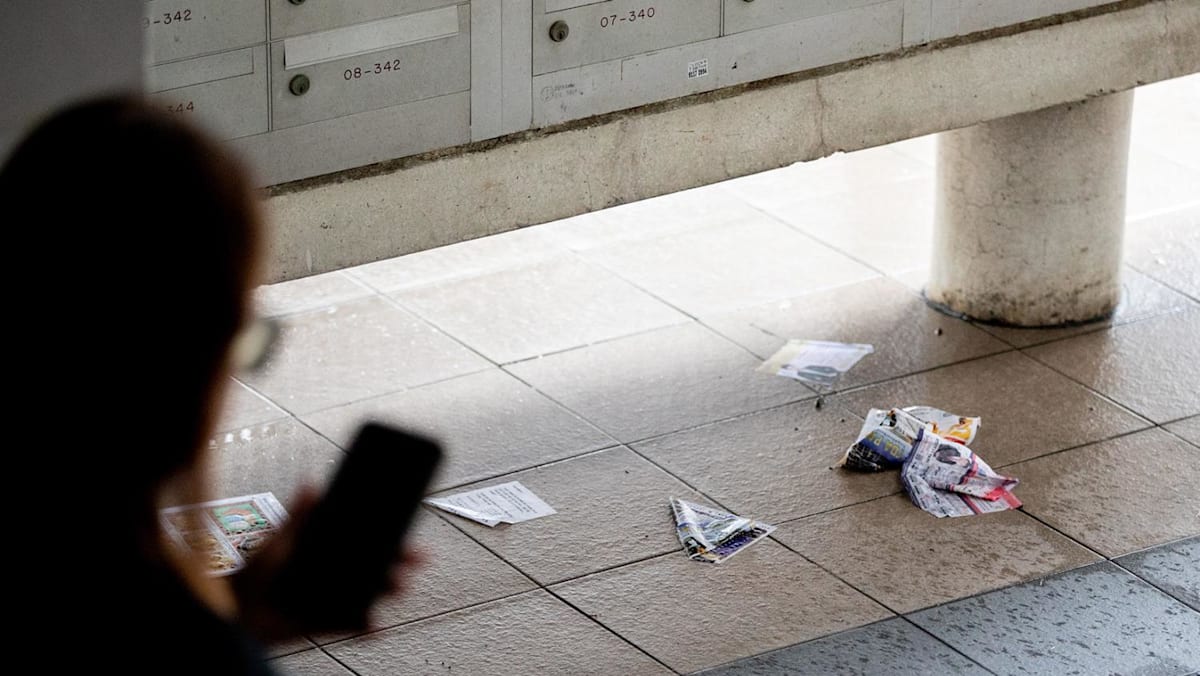
Singapore More residents say they feel personally responsible for keeping shared spaces clean, even as satisfaction with public cleanliness fell across the areas surveyed. Litter seen on the floor of a housing block's void deck in Toa Payoh, on Mar 5, 2024. New: You can now listen to articles. This audio is generated by an AI tool. SINGAPORE: Satisfaction with public cleanliness fell to 91 per cent in 2025 from 94 per cent in 2023, with neighbourhood spaces recording the biggest decline among six domains surveyed, a study released on Friday (Sep 4) found.Satisfaction with public toilets also fell sharply.The study's researchers said the decline could partly reflect rising expectations, as Singaporeans have become accustomed to higher standards of cleanliness over the years.The latest figure still marks a significant rise from 2017, when overall satisfaction stood at 82 per cent in the survey's first edition. The 2025 Public Cleanliness Satisfaction Survey, conducted by the Singapore Management University (SMU), is the seventh edition of the study, led by Professor of Sociology (Practice) Paulin Tay Straughan and Dr Mathew Mathews, principal research fellow at the Institute of Policy Studies.It surveyed 2,007 Singapore citizens and permanent residents aged 21 and above between December 2025 and April 2026. The findings come as the National Environment Agency (NEA) reported fewer fines and corrective work orders in the first half of this year compared with the same period last year, a decline it attributed to continued efforts to clean up targeted littering hotspots.NEIGHBOURHOOD SPACES SEE SHARPEST FALLAll six domains measured – transportation nodes, leisure venues, commuter paths, spaces after public events, neighbourhood spaces and food outlets – recorded lower satisfaction than in 2023.Transportation nodes and leisure venues remained the highest-rated, though satisfaction slipped in both: from 98.3 per cent to 97.2 per cent for transportation spaces such as roads, bus stops and MRT and LRT stations, and from 96.8 per cent to 95.1 per cent for leisure spaces such as parks, malls and playgrounds.Neighbourhood spaces recorded the steepest dip of the six, falling from 93.3 per cent to 87.4 per cent, their lowest level since 2018. The decline was sharpest at void decks, corridors and lift lobbies, where satisfaction fell 8.8 percentage points to 80.9 per cent, the largest drop among all 20 public spaces surveyed.Asked about the decline in neighbourhood satisfaction, the researchers said several factors could be at play, including higher expectations, more waste from increased deliveries and whether cleaning services have kept pace amid higher manpower costs.Food outlets remained the lowest-rated of the six domains, as they have been since 2021, with satisfaction falling 2.8 percentage points to 82.4 per cent. Hawker centres and coffee shops continued to be among the weakest performers, falling 5.5 percentage points to 76.4 per cent and 3.6 points to 76.8 per cent respectively.Prof Straughan suggested that temperature could also shape perceptions of cleanliness, with patrons potentially less tolerant of non-air-conditioned hawker centres and coffee shops than of air-conditioned food courts."When it's hot, there's this perception that there's this level of grime ... everybody is so grumpy, so that also affects how we perceive cleanliness of the spaces shared," she said. PUBLIC TOILET SATISFACTION DECLINESSeparately from the six domains, the survey also tracked public toilets, where satisfaction fell 8.2 percentage points, from 83.7 per cent to 75.5 per cent. Coffee shop toilets fared worst, dropping 12 points to 48.3 per cent, while hawker centre toilets fell 10 points to 60 per cent. Toilets in downtown and central business district malls remained the best-rated, at 93.6 per cent.The fall in toilet satisfaction comes even as the Public Toilets Taskforce, set up in 2024, has recommended measures including grants for coffee shop operators to renovate and deep-clean their toilets. The study suggested these efforts may have raised public expectations, adding: "The full benefits of these efforts may take time to be felt, particularly in high-footfall dining environments where maintaining cleanliness presents greater operational challenges, and where continued focus is expected to yield meaningful improvements over time."Respondents were also less likely than before to see individual users as primarily responsible for toilet cleanliness, with more attributing responsibility to operators and premises owners instead. "This may suggest that public toilet cleanliness is perceived differently from other public cleanliness issues and highlights the continued need to reinforce individual responsibility for maintaining clean public toilets," the study said.Dr Mathews said people may expect more of themselves in places where they feel they have greater power and agency."But in areas like the toilet, for instance, people may not feel that they have the same level of ability to do something. But nonetheless, it's something that needs to continue to be highlighted - that everybody can play a part in (making) things better, even in bathrooms." PERSONAL RESPONSIBILITY ON THE RISEDespite the overall decline, 98.6 per cent of respondents agreed that keeping Singapore clean is the responsibility of every individual.Among those who disposed of rubbish properly, 71.3 per cent cited a sense of personal responsibility, up from 65.2 per cent in 2023, while 53.6 per cent cited caring for the environment, up from 48.1 per cent. Fewer respondents cited external motivations such as the risk of fines or embarrassment.A similar pattern held for tray return: 95.5 per cent said they always returned their trays and crockery, edging up from 95 per cent in 2023, while the proportion who viewed individual patrons as primarily responsible for the practice rose from 79.9 per cent to 83.3 per cent. Social responsibility remained the most common reason cited, at 77.7 per cent.The study said the findings were observed despite slight declines in awareness, support and perceived effectiveness of anti-littering enforcement measures."This may suggest that behaviours such as tray return and proper disposal of litter are increasingly becoming socially expected behaviours rather than actions motivated primarily by fear of enforcement," the study said, adding that campaigns and enforcement over the years may have helped such norms take hold.Enforcement of tray and crockery return began in phases from September 2021 and was stepped up in June 2023, when first-time offenders were issued written warnings while repeat offenders could be fined or charged in court.Prof Straughan said the results suggested that the messaging around the tray-return law had worked."Rather than a punitive measure, the rationale for the law was articulated well. So I think many social agencies helped to make sure that the narrative was directed at the right centre, so we're seeing the fruits of that labour now."The proportion who said they would look for another rubbish bin when faced with an overflowing one fell from 80.8 per cent to 76.9 per cent. About 19 per cent of respondents felt there were not enough bins, nearly double the 10.4 per cent in 2023. Wet markets, hawker centres and coffee shops were most often flagged as short on bins.Prof Straughan said one thing that stood out clearly in the survey results was a shift towards people taking greater ownership of the cleanliness of shared spaces."Taking ownership can mean many things. You know, you don't blame others. That's one, right? So we are blaming, you know, cleaners less. We try not to dirty it ourselves, and clearly that is reflected in you know some of the things that we try to do: Not litter, clean up after ourselves in hawker centres".However, she said more people could be encouraged to give feedback. describing this as one area where a sense of disempowerment was reflected in the survey results.Only 71.8 per cent of respondents said they knew how to provide feedback on the quality of cleaning services in 2025, down from 81.5 per cent in 2023."The mechanism for receiving feedback must be perceived of as being effective. Otherwise, why waste time, right? So that's one area perhaps we could work on."Prof Straughan said the next step – and one that people may still be some way from – is taking proactive action beyond their own behaviour, such as picking up other people's litter."This is one step that I think we have not been able to cross over. So how do we encourage that? There has to be a way. So this is an area that I think we need to work on." An overflowing recycling bin at a housing block in Punggol. (File photo: Veron Wong) FEWER WILLING TO PAY MORE OR VOLUNTEERWhile most respondents felt residents should be encouraged to help maintain the cleanliness of the neighbourhood, this did not necessarily translate into a willingness to take part in broader community efforts.Support for residents helping maintain neighbourhood cleanliness remained high, at 96.7 per cent, and 96.5 per cent agreed residents and cleaners should work together. But less than half, 49.6 per cent, said they would volunteer with a neighbourhood cleanliness group, down from 63.5 per cent.Support for organised initiatives also weakened – backing for pausing public cleaning once every three months fell from 80.9 per cent to 75.4 per cent, while support for quarterly mass litter-picking exercises fell from 83.7 per cent to 76 per cent. Willingness to personally join such exercises nonetheless rose slightly, from 56 per cent to 57.8 per cent.Prof Straughan suggested that people do not necessarily know how to participate, adding that community involvement would need to become a regular, normalised activity rather than an occasional campaign.Appetite to pay for more cleaning also fell. The proportion who felt more should be spent on cleaning services dropped from 74.8 per cent to 58.1 per cent, while the proportion willing to pay more through higher service and conservancy charges fell from 45.5 per cent to 32 per cent.The study concluded that the norms and behaviours promoted through public cleanliness campaigns and enforcement measures in recent years "have become increasingly embedded in everyday life"."Nevertheless, with such increasingly embedded norms, expectations of cleanliness standards among the population may have increased, which inevitably decreases satisfaction levels at least slightly."Prof Straughan said it was important to empower communities to take greater ownership of shared spaces, suggesting that neighbourhood hawker centres and coffee shops could be seen as "community kitchens" that residents have a role in looking after."Community spaces are very, very important. So that's where we hope, we can agitate some social activism in communities for them to just take ownership. So stop complaining about the hawker centres and coffee shops, but take action. "Because we also don't want to pay more. That's very clear. So if you don't want to pay more, then you have to take action. You have to demonstrate agency and collectively in a nice way, in a positive way."
Public cleanliness satisfaction falls to 91%; toilets and neighbourhood spaces see biggest declines: SMU survey
Full Article
Original Source
Read the full article at Channelnewsasia →KhanList aggregates and links to publicly available news content. We do not host full articles from third-party sources. Always verify important information with original sources.