
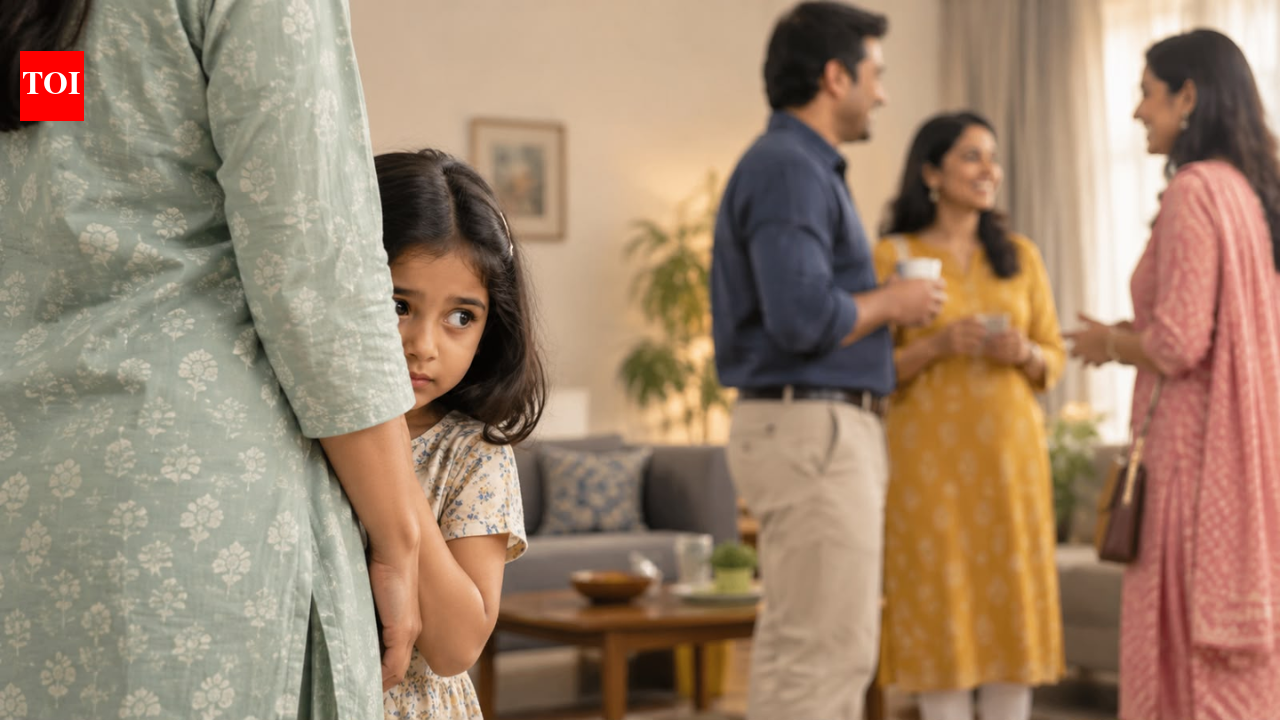
AI representation/ChatGPTA child who refuses to greet relatives, buries their face in their mother's shoulder or stands behind their father when guests arrive may be communicating something different from shyness. Here's what parents need to know about children's social behaviour, unfamiliar people and the pressure to interact.When a child hides behind a parent, what are they really saying?28 Jul 2026 | 16:26Which parenting tip from elders actually worked for you?For a young child, the parent is often the person who knows what is happening, who the guests are and whether the situation is safe.It happens in many Indian homes. A relative arrives, an uncle bends down to say hello, or a family friend asks a child their name. Instead of answering, the child moves behind their mother, holds on to their father's leg or turns their face away. The adults may laugh. Someone says, “Why are you so shy?” Another asks, “Don't you know how to greet guests?” The child is encouraged to say namaste, shake hands or answer a few questions. But a child who does not speak to guests is not necessarily a shy child.Sometimes the child is simply taking time to understand an unfamiliar person. Sometimes they feel uncomfortable being the centre of attention. At other times, they may be worried about saying the wrong thing or being asked questions they do not know how to answer.Psychology research on children's temperament, attachment and social anxiety helps explain why similar behaviour can have different causes. The important part is not just that a child hides. It is what the child is feeling, how often it happens and whether it interferes with everyday life.The child may need time to feel comfortableFor some children, meeting guests is a sudden change in their surroundings. They may be playing with toys, watching television or sitting quietly with a parent when the doorbell rings. Within seconds, an unfamiliar adult is standing in front of them, looking at them and asking questions. A 2013 study published in the Journal of Clinical Child & Adolescent Psychology found that children who showed a pattern of poorly regulated fear at age two were more likely to show social wariness and anxiety symptoms later. However, the study also makes an exception. Not every fearful child develops an anxiety disorder.So when a child stays behind a parent during a family gathering, the first question should not be, “Why is this child so shy?” It should be, “Does this child need a little more time?”Hiding can be a way of seeking safetyA familiar parent can make an unfamiliar situation easier to manage. For a young child, the parent is often the person who knows what is happening, who the guests are and whether the situation is safe. Staying close to that person can help the child regulate their emotions. Children can be confident in one setting and cautious in another. A child may speak freely at home, play happily with familiar cousins and still avoid an unfamiliar guest.A 2008 study by Laura E. Brumariu and Kathryn A. Kerns examined the relationship between mother-child attachment and social anxiety symptoms in middle childhood. The researchers studied 74 children and found that some attachment patterns were associated with higher social anxiety.Some children dislike being put on the spotImagine a guest asking a four-year-old: “What is your name?” “Which school do you go to?” “Can you sing a poem?” “Why are you not talking?” The questions may seem harmless to an adult. But several questions in quick succession can feel overwhelming to a child who is still getting comfortable. The child may know the answers. They may even speak confidently at home. Yet they do not want to answer in front of someone unfamiliar.Some children also need more time to organise their thoughts. Others dislike being watched while they speak. A child who is comfortable talking to one person may become quiet when several adults turn their attention towards them. This is particularly relevant in family gatherings, where children may be expected to greet several relatives, answer questions and perform something for guests.Fear of being judged can make social situations harderAs children grow, they become more aware of how other people see them. A young child may simply avoid a stranger. An older child may worry about what the stranger thinks. These worries can be especially relevant in Indian homes, where children may be asked to greet relatives, recite poems, answer questions about school or speak in a particular language. Social anxiety involves fear or distress in social situations, including concerns about being judged or negatively evaluated. But ordinary nervousness is not the same as social anxiety disorder.Children can behave differently with familiar and unfamiliar peopleParents sometimes say, “My child talks nonstop at home. Why does he become silent when guests arrive?” This difference is not unusual. Children behave differently depending on how familiar they are with the people around them, how comfortable they feel and what is expected of them. A child may be expressive with parents and grandparents but quiet with distant relatives. They may talk freely with classmates but struggle to speak to adults they do not know well. This is one reason it is unhelpful to describe a child as simply “shy” without looking at the situation.Does parental anxiety affect children's social behaviour?Children often look to their caregivers when they encounter something unfamiliar. Research on social referencing has examined how young children use adults' emotional reactions to understand new situations. A review of research on childhood social anxiety describes studies in which children observed their parents interacting with unfamiliar people. Some findings suggest that children's reactions can be influenced by the emotional information they receive from their caregivers.A 2017 study examined parental anxiety, children's temperament and avoidance of unfamiliar people and a robot. The findings did not show that more parental anxiety at age 4.5 was significantly linked to more fear or avoidance at that same age.What parents can do when a child hides behind themLet the child stay close: If a child wants to stand beside their mother when guests arrive, there is no need to immediately pull them forward. The parent can say, “You can stay with me.” This gives the child time to observe the guest and understand the situation.Avoid forced greetings: Greeting people is a useful social skill, but forcing a child to hug, shake hands or speak on demand can make the interaction uncomfortable.Prepare the child before guests arrive: A simple explanation can help: “Your aunt is coming today. She may ask you about school. You can answer when you feel comfortable.” This is different from warning the child that they must behave perfectly.Introduce people slowly: Instead of bringing a child into a room full of adults and asking them to greet everyone, start with one familiar person. The child may find it easier to interact when there is less attention on them.When should parents look beyond ordinary shyness?Hiding behind a parent is not enough to diagnose an anxiety disorder. Parents should look at the wider pattern. Some signs that may deserve closer attention include:The child regularly avoids school activities, birthday parties or playing with other children because of fear.They become very distressed when expected to speak to unfamiliar people.They worry repeatedly about being judged or making mistakes.Their social discomfort interferes with friendships, learning or daily activities.
Psychology says children who hide behind parents around guests aren’t always shy
Full Article
Original Source
Read the full article at Timesofindia →KhanList aggregates and links to publicly available news content. We do not host full articles from third-party sources. Always verify important information with original sources.