
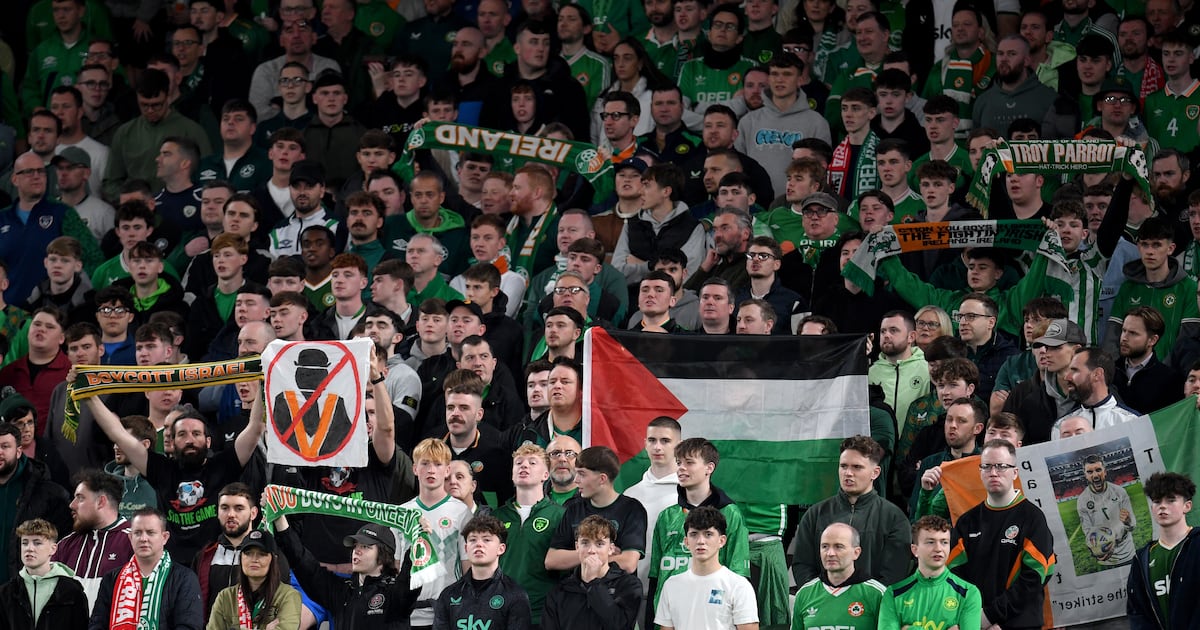
For all the fraught forecasts and queasy concerns in advance of this sole home game of the international window, the Aviva Stadium instead chose to focus on football against Austria. By the end, fans drifted off into the mild October night with a familiar compound of conflicting feelings. Hours earlier, the five o’clock sun was a butter yellow and a dozen or so protesters were gathered by the river Dodder, waving Palestinian flags in front of a banner daubed with the message “Stand With Bazunu”. The murmur of the protesters’ conversation was audible whenever they hit pause on their public address system, which was otherwise blasting out a reworking of Put ‘Em Under Pressure, which replaced the olé, olé, olés with the message, “Don’t Play, Don’t Play”. READ MORENearby, a security guard was running through a demonstration of an effective pat-down for the stewards arranged around him, using one of the FAI’s security staff as his mannequin. “This is one for the lads,” he said, “but you have to pat the crotch. They could have tennis balls or any shite in there.” Though the scene was swaddled in the garish yellow jackets of security guards and gardaí, it was placid and still, and it was through this preamble the Irish bus was determined to pass. The Irish team arrived at the ground much earlier than expected, turning down Herbert Road at 5.35pm. There were approximately 15 protesters on the scene, and they chanted “stop the game” and “shame” as the Irish bus zoomed by, the players barely visible behind tinted windows.A tennis ball thrown on the pitch by protesters in the Aviva Stadium. Photograph: Nick Elliott/Inpho Brian Kerr stood with another group of protesters on Haddington Road, some of whom held up an oversized football emblazoned with the words, “Don’t play ball with genocide”. One fan carried a mocked-up Dublin street sign that read Bazunu Road, the postcode replaced by a map of Palestine. The security presence around the match was vastly increased, with media and staff entering the stadium passing through airport-style security scanners. This was not an abrupt response to the fracturing of relations between squad and press over the last few days, but one added element of this game’s use as a test event for the Euro 2028 matches to be held in Dublin. Given the rancorous build-up to the game, the timing of Uefa’s visit felt like the parish priest stopping in for tea during a family feud. The front two rows of seats inside the stadium were blocked off for use, as they will be out of commission at the Euros because of the installation of larger LED advertising hoardings. The timing, however, was obviously convenient for the FAI, given the wire mesh thrown across the seats could work as a kind of trawler net for any would-be pitch invaders.[ Troy Parrott lights up Lansdowne for Ireland but Austria storm back to salvage pointOpens in new window ]With the Irish team arriving so early to work, the stadium was virtually empty when Bazunu trotted out to warm up with the other goalkeepers. The FAI moved the home game against Israel to Serbia because of tennis ball protests in May’s friendly against Qatar, and before this international window started, chief executive David Courell pleaded with fans not to interrupt the game. Courell spoke before the temperature skyrocketed in Debrecen, with Hallgrímsson admitting last Sunday night he worried about the reception the players might receive. He need not have worried.Troy Parrott celebrates scoring his first goal. Photograph: Ryan Byrne/Inpho Fan groups had made clear in the intervening days that they would support the players as usual, and thus the team kicked off to the usual rumble-and-roar. Within 12 minutes the crowd were losing themselves in giddy disbelief, having watched slack-jawed as Troy Parrott slalomed his way around a pair of Austrian defenders before slotting the ball through the goalkeeper’s legs. There was more characteristic behaviour just before half-time, with queue-beating fans rushing back up the stadium steps when they realised Parrott was standing over a penalty. There were only minor interruptions between these two latest Parrott flourishes. Around 30 tennis balls were thrown on to the pitch after 19 minutes, which the Stop the Game movement subsequently stated was “a token act, deliberately limited” and intended in solidarity with Bazunu. The protest was met with a chorus of boos from the stands, as the referee took the players to the side of the pitch to allow the balls to be cleared. One fan bolted across the netting and made it on to the pitch 15 minutes later, doing his best to unfurl a Palestine flag as he was swallowed by security and carried off the pitch.[ Paradonna lights up the Aviva with a twisty, turny, dribbly, nutmeggy piece of artOpens in new window ]The second half brought no further interruptions, but instead an Irish performance that grew passive from the moment Hallgrímsson removed Adam Idah and Liam Scales to squat defensively with Jayson Molumby and Liam Kitching. From there the game slipped away from Ireland, conceding a pair of terribly soft goals. First Kitching dawdled with the ball with his feet to present the ball to Austria, and then Michael Gregoritsch curled a free-kick through the Irish wall. It was, to be fair to the players, the first moment at which they have shown any lack of unity since taking to the field against Israel. Now Ireland fly to Serbia to conclude this bewildering international window. A reminder that a focus on football is a blessed relief, but a maddening frustration, too.
Protests prove only a minor interruption as Aviva chooses to focus on football
Full Article
Original Source
Read the full article at Irishtimes →KhanList aggregates and links to publicly available news content. We do not host full articles from third-party sources. Always verify important information with original sources.