
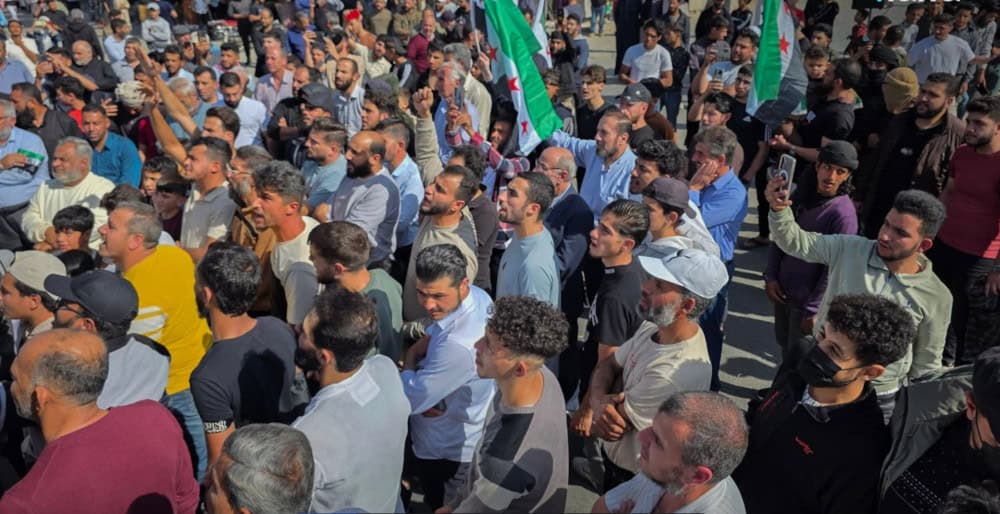
Protests took place in Syria on October 23 as Syrians condemned “Israeli incursions and attacks,” according to Syrian state media. The protests came a day after Syrians claimed an unarmed civilian was killed in an Israeli raid near the border. The Israeli military has not commented on the incident. The demonstrations also occurred amid a flurry of diplomatic activity by Syrian officials, including a meeting between Syria’s President Ahmed al Sharaa and US Envoy Tom Barrack in Damascus. The protests followed an October 18 statement by Syria’s Foreign Ministry condemning Israeli military incursions into southern Syria. Israel took control of a buffer zone along the Golan border with Syria on December 8, 2024, when the Bashar al Assad regime fell. Israel also seized the peak of Mount Hermon. In the intervening year and 10 months, Israeli officials have said they will not leave the buffer zone as long as threats from Syria remain. Israel’s policy along the border with Syria is part of a broader strategy that has emerged since Hamas attacked Israel on October 7, 2023. On October 18, 2026, Israeli Prime Minister Benjamin Netanyahu noted that Israel’s national security doctrine has shifted to “giving priority to prevention and offense over containment and defense.” As part of the doctrine in Syria, the Israel Defense Forces (IDF) has established new positions in the buffer zone that runs along the 1974 ceasefire line. The IDF has also carried out raids into Syria to detain suspects and dismantle “terrorist infrastructure.” During one such operation on October 22, Israeli soldiers shot and killed a Syrian man with disabilities in the village of Jamla, according to Syrian state media. The village lies about half a mile from the Bravo Line, the Syrian boundary of a buffer zone established under the 1974 disengagement agreement between Israel and Syria. The Alpha Line marks the Israeli side of the zone. Before December 8, 2024, Israeli forces remained largely west of the Alpha Line, but they have since entered the buffer zone and expanded operations beyond the Bravo Line. The IDF does not comment often on these operations, but it said on October 5 that it had detained two suspects in Syria. On October 22, Syria’s Ministry of Foreign Affairs condemned the IDF operation. It added that Syria holds Israel responsible for the man’s death, “stressing that ongoing incursions and attacks against Syrian citizens violate the sovereignty of the Syrian Arab Republic, threaten regional security and stability, and hinder recovery and reconstruction efforts.” The next day, protests were held in the country. “In Quneitra, hundreds of men, women and children took part in a protest condemning Israeli aggressions and reaffirming Syria’s territorial unity,” the Syrian Arab News Agency (SANA) said. Quneitra is near the Golan border with Israel. Protests also occurred in Syria’s southern Daraa province and in Damascus. Syria has called on the international community to help end Israeli operations. Syrian officials also held a number of meetings with partners in the region on October 21 and 22. On October 22, Jordan’s King Abdullah II hosted Syrian Foreign Minister Asaad Hassan al Shaibani, during which Shaibani discussed Israel’s “attacks” in southern Syria. Abdullah previously criticized Israel’s role in Syria in a speech at the United Nations General Assembly in September. On October 22, Shaibani held a phone call with United Arab Emirates Minister of Foreign Affairs Abdullah bin Zayed Al Nahyan. Syrian officials provided only general details about the call. Syrian President Ahmad al Sharaa met US Special Presidential Envoy for Syria and Iraq Tom Barrack in Damascus on October 23. “The two sides discussed cooperation aimed at advancing both countries’ interests and strengthening security and stability,” SANA reported. Barrack, who is also the US ambassador to Turkey, described the meeting as productive and added that “Syria plays a pivotal role in securing lasting peace—its destiny touches every face of the Middle East’s Rubik’s Cube.” Reporting from Israel, Seth J. Frantzman is an adjunct fellow at FDD and a contributor to FDD’s Long War Journal. He is the senior Middle East correspondent and analyst at The Jerusalem Post, and author of The October 7 War: Israel’s Battle for Security in Gaza (2024).
Protests break out in Syria against ‘Israeli incursions and attacks’ as tensions rise
Full Article
Original Source
Read the full article at Fdd →KhanList aggregates and links to publicly available news content. We do not host full articles from third-party sources. Always verify important information with original sources.