
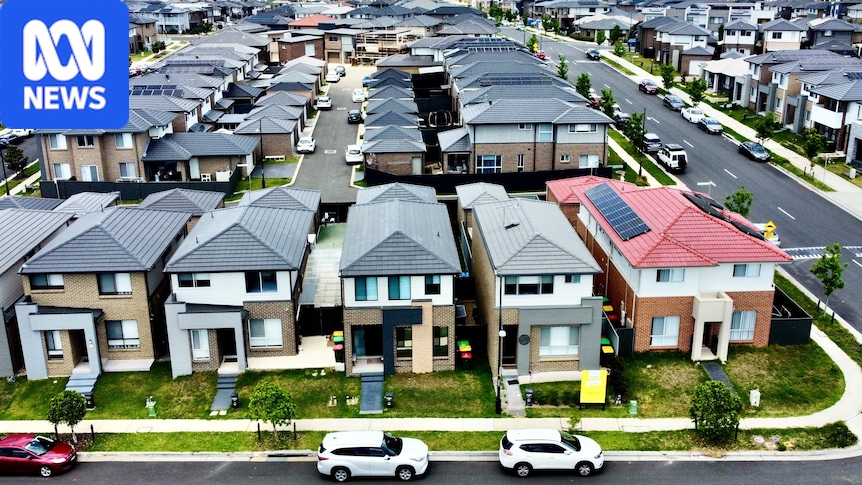
Property data firm Cotality has released its monthly national Home Value Index (HVI) showing a 0.9 per cent fall in August.This marks the fifth straight month that Australian property prices have slipped.The data also shows the nation's housing downturn has accelerated, as most suburbs recorded weaker auction results in the final month of winter.The country's median property value is now 3.6 per cent below the record high recorded in March.Sydney continued to lead the pace of declines, with home values down 1.4 per cent in August to be 7.1 per cent below peak levels recorded in February."The combination of a sharp drop in demand and higher than average advertised stock levels are weighing more heavily on Australia's largest housing market," Cotality research director Tim Lawless said.Prices in Melbourne and Canberra both fell 1.1 per cent, while Brisbane dropped 1 per cent.The other mid-sized capitals were not far behind, with Adelaide and Perth home values dropping 0.8 per cent in August.House prices in the capital cities continue to fall. (Supplied: Cotality)Trend expected to continueIndependent economist Alan Oster pointed to some large geographical differences across the national housing market."If you go to Perth, they're still going at an annualised rate of 20 per cent," Mr Oster said."If you're in Sydney and Melbourne, they're sort of going backwards at around 7 to 8 per cent."I suspect those sorts of trends will continue for a while."The national property market has been hit by several headwinds in recent months, including three Reserve Bank interest rate hikes, and the federal government's decision to restrict negative gearing and increase capital gains tax.Cotality said more expensive houses continue to record larger declines.Mr Lawless said the latest figures show the downturn was no longer confined to select markets or higher-value segments."What started as a more concentrated easing across higher-value segments has now become a much more generalised softening, with the vast majority of capital city suburbs recording some level of decline," Mr Lawless said.The proportion of capital city suburbs recording a fall in home values more than doubled through winter, rising from 45.8 per cent in autumn to 93 per cent, highlighting a much broader weakening in housing conditions.Cotality data shows this weaker phase of the housing downturn has been largely driven by falling demand, with the firm's quarterly estimate of home sales tracking 15.5 per cent lower than at the same time last year and 11.5 per cent below the five-year average.Brisbane, Perth, and Sydney have recorded the largest declines in transaction activity, with estimated sales volumes down more than 20 per cent compared with a year ago.Fewer people inspecting housesRay White chief economist Nerida Conisbee said "uncertainty" was the dominant theme in the housing market.The real estate agency tracks about 13,000 open homes each week."We can see that buyer activity is particularly low," she said."Last year, we were seeing on average around four people attending open homes. This year, it's sitting at around two people."The number of people inspecting house on the market has dropped. (ABC News: Rachel Clayton)Ms Conisbee said fewer properties were coming to market."Even though buyer activity is slow, it's leading to very few sellers coming out," she said."It may sound like bad news, but it does show that we're not really seeing distress amongst owners."Mr Oster also believed Australia's unemployment rate would climb higher and faster than the Reserve Bank was anticipating.The RBA has forecast the jobless rate to hit 4.7 per cent by June 2028.Mr Oster believed it could be approaching 5 per cent a lot sooner than that, and this could see further deterioration in the property market."My worst-case scenario would be that unemployment goes a lot higher than we all think," he said."Because at present, what's happening is, sure, people aren't confident, but they've still got a job [and] they can cut back their spending, and they can try and get a second job."If you suddenly had a problem in the unemployment market, that would escalate everything."And so, you don't need to get unemployment back up to 10 per cent or 11 per cent."He said nowadays a jobless rate of 5 to 6 per cent would "well and truly be a problem".That is particularly given Australian households are carrying some of the largest debt burdens in the world, with the nation's household debt to income ratio one of the highest in the world.
Property downturn worsens with buyer activity 'particularly low'
Full Article
Original Source
Read the full article at Abc →KhanList aggregates and links to publicly available news content. We do not host full articles from third-party sources. Always verify important information with original sources.