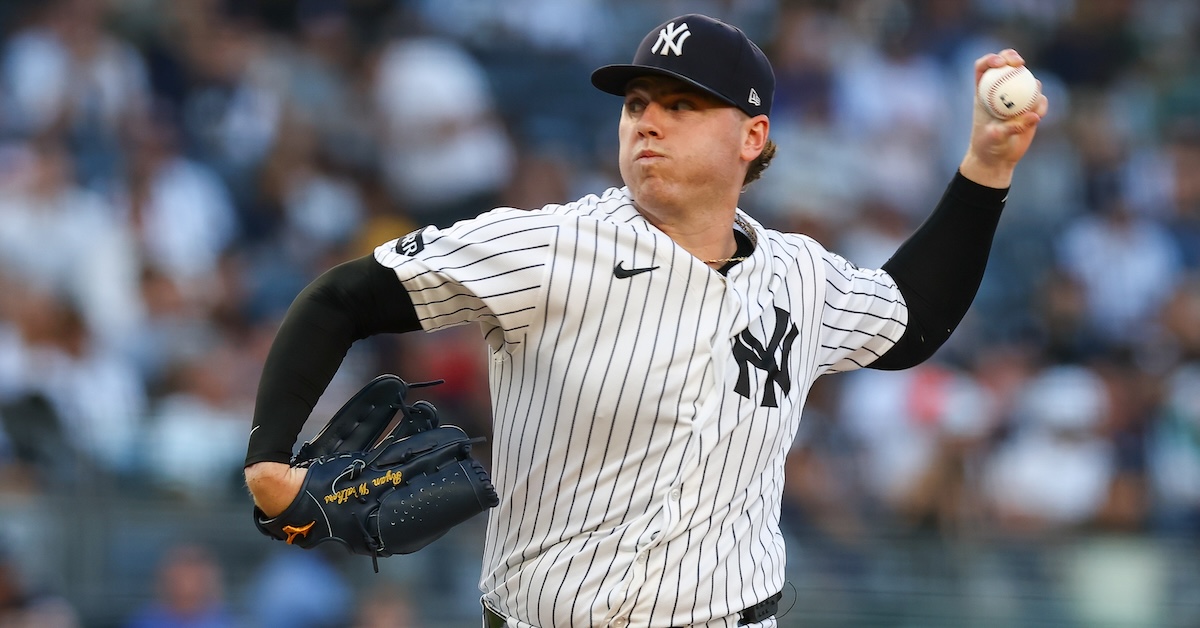
Vincent Carchietta-Imagn Images Ryan Weathers allowed a lot of home runs in the early months of the season. Going into the final week of June, the 26-year-old New York Yankees southpaw had been taken deep 16 times over 14 starts comprising 80 2/3 innings. Frustratingly gopher-prone, he had a 4.13 ERA and a 4.31 FIP. He has since been keeping balls in the yard. Over his last nine outings, the son of longtime big-league hurler David Weathers has surrendered just a pair of home runs over 46 innings while logging a 2.93 ERA and a 2.71 FIP. The reasons behind his turnaround? I haven’t spoken to Weathers since June 27 — one start into his resurgence — but based on that conversation and his pitch-usage numbers, an answer isn’t hard to deduce. Weathers has thrown his four-seamer just 16.3% of the time since he stopped surrendering home runs at a 2004 Jamie Moyer pace, whereas he had previously been throwing it at a 27.8% clip. Meanwhile, his slider and changeup percentages have jumped as he has held his two-seamer usage fairly static. Homeritis and sinkers were the subjects at hand when I sat down with the lefty at Fenway Park in late June. “I haven’t been getting my four-seamer to spots as well as I want to,” Weathers said of the homer damage. “I think I’ve given up 16 on the year, and 10 or 11 have been on my four. We obviously want to limit slug as best we can, and for me, throwing more of a runner profile [a pitch that runs more than sinks]… the last couple games, it’s kind of hovered around six to seven [inches above the zero line] vert and 18 to 19 horizontal, so it’s been developing into something in between a sinker and a two-seamer. I don’t want it to get metrically close to the changeup, because I want my changeup to have its own profile because it has kind of been my go-to pitch.” The analytically-savvy southpaw discussed his Tarik Skubal-influenced, splitter-like changeup here at FanGraphs during spring training. The pitch has long been a staple of his arsenal, but the two-seamer/sinker is another story. Thrown sparingly in previous seasons, he has utilized it 19.2% of the time in the current campaign. The offering has been fairly effective, eliciting a .369 slugging percentage and a .322 wOBA. You Aren't a FanGraphs Member It looks like you aren't yet a FanGraphs Member (or aren't logged in). We aren't mad, just disappointed. We get it. You want to read this article. But before we let you get back to it, we'd like to point out a few of the good reasons why you should become a Member. 1. Ad Free viewing! We won't bug you with this ad, or any other. 2. Unlimited articles! Non-Members only get to read 10 free articles a month. Members never get cut off. 3. Dark mode and Classic mode! 4. Custom player page dashboards! Choose the player cards you want, in the order you want them. 5. One-click data exports! Export our projections and leaderboards for your personal projects. 6. Remove the photos on the home page! (Honestly, this doesn't sound so great to us, but some people wanted it, and we like to give our Members what they want.) 7. Even more Steamer projections! We have handedness, percentile, and context neutral projections available for Members only. 8. Get FanGraphs Walk-Off, a customized year end review! Find out exactly how you used FanGraphs this year, and how that compares to other Members. Don't be a victim of FOMO. 9. A weekly mailbag column, exclusively for Members. 10. Help support FanGraphs and our entire staff! Our Members provide us with critical resources to improve the site and deliver new features! We hope you'll consider a Membership today, for yourself or as a gift! And we realize this has been an awfully long sales pitch, so we've also removed all the other ads in this article. We didn't want to overdo it. And then there is his mid-90s four-seamer. On the year, opposing batters have punished it to the tune of a .593 slugging percentage and a .401 wOBA. I asked Weathers if he could elaborate on the damage hitters have done against it. “It’s been purely location-based,” Weathers opined. “I’ve been getting into hitter’s counts and missing. I’m maybe trying to go down and away, and missing middle down, or in that down-and-in range. The more I get my heater to the top, the more I limit slug, just because of the pitch profile and my arm angle. When I’m misfiring down, it kind of flattens out and is a lot more appealing pitch to hit.” “In the past, sometimes I’ve missed down there and they have been popped up,” the pragmatic pitcher continued. “I’ve just been in one of those stretches where if I’m missing on the margin, it’s a homer. That stinks, especially as a starter who is more of a four-seam guy. But it’s going to happen. There is nothing wrong metrically, or sequence-wise, I have just been throwing too many hitter-friendly pitches in hitter-friendly counts.” Having both a four-seamer and a two-seamer/sinker in your arsenal allows for more options, and Weathers was predictably astute when addressing how the fastball pairing can be employed. Part of that equation is how some hitters typically handle one better than the other. Even so, pitches aren’t thrown in a vacuum. “The body of work against a specific pitch tells you something,” said Weathers. “For the most part, if you throw a runner to a hitter with a flat bat path, that helps them out. I’m not saying they’re going to slug it, but it gives them the ability to shoot it down the line, because they’re through the zone for a long time. But sometimes you get into a mode where you know a guy is selling out for a four-seamer — even if it’s a guy who hits two-seamers well — and you identify that as a good time to go to your two-seam. The game tells you things like that. You get a good feel when you want to throw a certain pitch.” By and large, hitters with flatter bat paths are better at handling high heaters than hitters with steeper swings. Broaching that subject with Weathers led to a series of interesting exchanges. I asked for an example of a hitter whose flatter path makes him a good low-ball hitter. “Willson Contreras has always been a good low-ball hitter,” he replied. “He’s got a pretty flat bat path. But it varies. Honestly, hitters with steeper swings are usually better low-ball hitters. Flat swings, it’s harder to get them out at the top with the four-seam. Juan Soto is extremely flat in the zone. He hammers fastballs that are a ball above the zone, because he’s so flat. He backspins those pitches for slug. Dillon Dingler with the Tigers. He’s got a little bit of a… I wouldn’t say he’s a steep profile, but he’s not flat either. He’s more in between. He does a really good job of getting to the bottom of the zone. Mike Trout is obviously a really good low-ball hitter. It’s usually those more compact guys; they stay really compact and short to the ball.” In part because we were talking at Fenway Park, I asked Weathers if he could elaborate on Contreras. “Honestly, he hits all kinds of pitches,” the 2018 first-round draft pick out of a Loretta, Texas high school responded. “He was a catcher at one point and can think along with the game. I feel like there are times where he’s a guess hitter, and there are times where he is absolutely locked in to where it doesn’t really matter; it’s just about keeping him in the ballpark. He’s a really good hitter. Facing him, you’ve got to monitor your patterns, your speed changes, your locations. You have to stay out of an area for multiple pitches at time.” “You’re definitely aware of it when guys hit you well, although I don’t think it changes your thought process,” he added. “You’re still focused on getting them out. But sometimes hitters have your number, no matter what you throw. That’s always going to be in the game. You just want to face them with nobody on base, or when the score isn’t within arm’s reach. You can’t take that to the mound with you, but you do know who has had success against you.” Along with Contreras, Weathers named Corey Seager and George Springer among the hitters he’s found most challenging. But as any pitcher will tell you, most everyone wielding a bat at the big league level is a threat. As evidenced by his mis-located four-seamers in hitter’s counts, damage happens. Moreover, the baseball gods aren’t always going to be on your side. “Sometimes it’s just not your day,” reasoned Weathers. “Sometimes you just don’t win on the margins. Sometimes the margins go against you, and sometimes they go with you. As much as them going against you sucks, that’s just baseball. I gave up a triple deck homer to Kazuma Okamoto, and it was on a slider dotted down and in, on the corner, on a 2-2 count. You want action on that count. You want a swing, and the swing he took was really good. He’s a big league hitter and sometimes it’s their day, just like you’re a big league pitcher and sometimes it’s your day. There are times when you’re missing in the middle of the zone and guys aren’t hitting you. Baseball can be funny like that. You just hope that when it’s going bad, it doesn’t get as bad as it sometimes gets.”
Prone To Gophers Early On, Ryan Weathers’ Homeritis Has Subsided
Full Article
Original Source
Read the full article at Blogs →KhanList aggregates and links to publicly available news content. We do not host full articles from third-party sources. Always verify important information with original sources.