
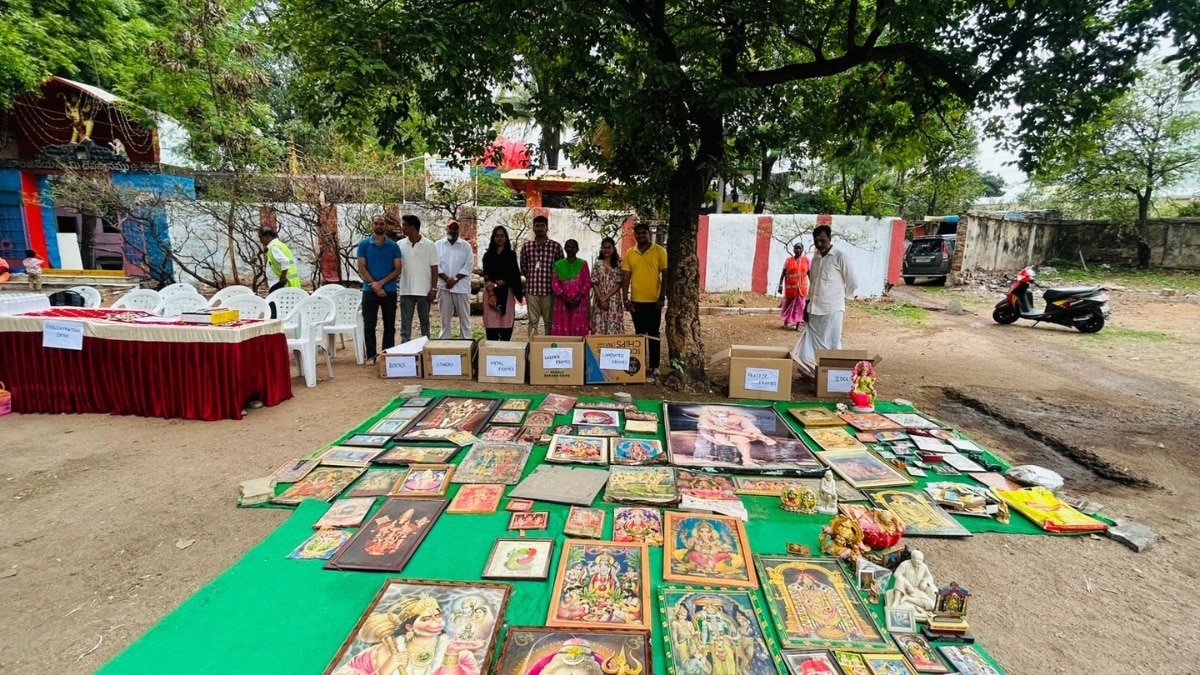
The civic body project, launched this year, provides citizens a dignified and environmentally responsible way to dispose of idols, worn-out photos of deities and puja materialIn a dilemma what to do with worn-out photo frames of deities, broken idols you worshiped for years or other sacred material lying at home? In Hyderabad, the civic authorities have a solution—Project Udvasana.Across the Telangana capital, thousands of households typically preserve old photographs of deities, damaged puja frames, broken idols, calendars and other sacred material for years due to the absence of a dignified disposal mechanism. Often, such items are eventually left under trees, at temples or in water bodies or end up getting mixed with municipal waste.Recognising this longstanding gap, the Greater Hyderabad Municipal Corporation (GHMC) introduced Project Udvasana this year to provide citizens with a respectful and environmentally responsible alternative. The initiative combines traditional Udvasana (farewell given to a deity) puja, segregated material recovery and responsible recycling, all done with a strong community participation, ensuring that devotion is handled with dignity while contributing towards a cleaner and more sustainable Hyderabad.“Project Udvasana is a unique sustainability initiative of GHMC that seeks to bridge faith and environmental responsibility by creating a formal ecosystem for the respectful collection, handling and recycling of worshipped sacred items,” R.V. Karnan, commissioner, GHMC, told INDIA TODAY. Beginning as a pilot at one temple on June 6, the project has now expanded to several temples across the city, witnessing a big response from citizens, temple committees and volunteers, said Karnan.So far, 4,372 kg of worshipped sacred material has been collected. This includes over 4,000 puja frames and deity photographs, 600-plus idols besides hundreds of calendars, books and other devotional material that could have otherwise ended up in bushes, public places, lakes or municipal waste.Some frames in good condition are voluntarily taken for reuse by underprivileged people, giving the sacred objects a renewed purpose.Following Udvasana puja by a priest at a temple, every collected item is carefully examined and manually dismantled by volunteer teams. Materials are segregated into different streams such as glass, paper, wood, metal, plastic, cloth and Plaster of Paris (POP) to maximise resource recovery. These segregated materials are then handed over to authorised recyclers and processing agencies for environmentally responsible recycling.The neighbouring Cyberabad Municipal Corporation (CMC), which encompasses the IT hubs and large residential societies, has adopted Project Udvasana, calling it a “Divine Waste—Devotional Collection Drive”. In the first round held on July 18, the CMC collected 783 kg of divine material from five temples under its limits.“After the successful first round, we have planned to scale up the model with bigger drives. The next one is planned on August 22, this time covering all 16 circles under Cyberabad,” said Venugopal Reddy, additional commissioner (health and sanitation), CMC. The CMC is doing the registration of volunteers, temples and public requests online under the project.The success of Project Udvasana, GHMC officials said, has inspired similar initiatives in other cities, “reinforcing the Hyderabad Model as a scalable and replicable framework for the sustainable management of devotional material across the country”.Subscribe to India Today Magazine- EndsPublished On: Aug 10, 2026 17:39 IST
Project Udvasana: Hyderabad shows how to bid adieu to gods without guilt
Full Article
Original Source
Read the full article at Indiatoday →KhanList aggregates and links to publicly available news content. We do not host full articles from third-party sources. Always verify important information with original sources.