
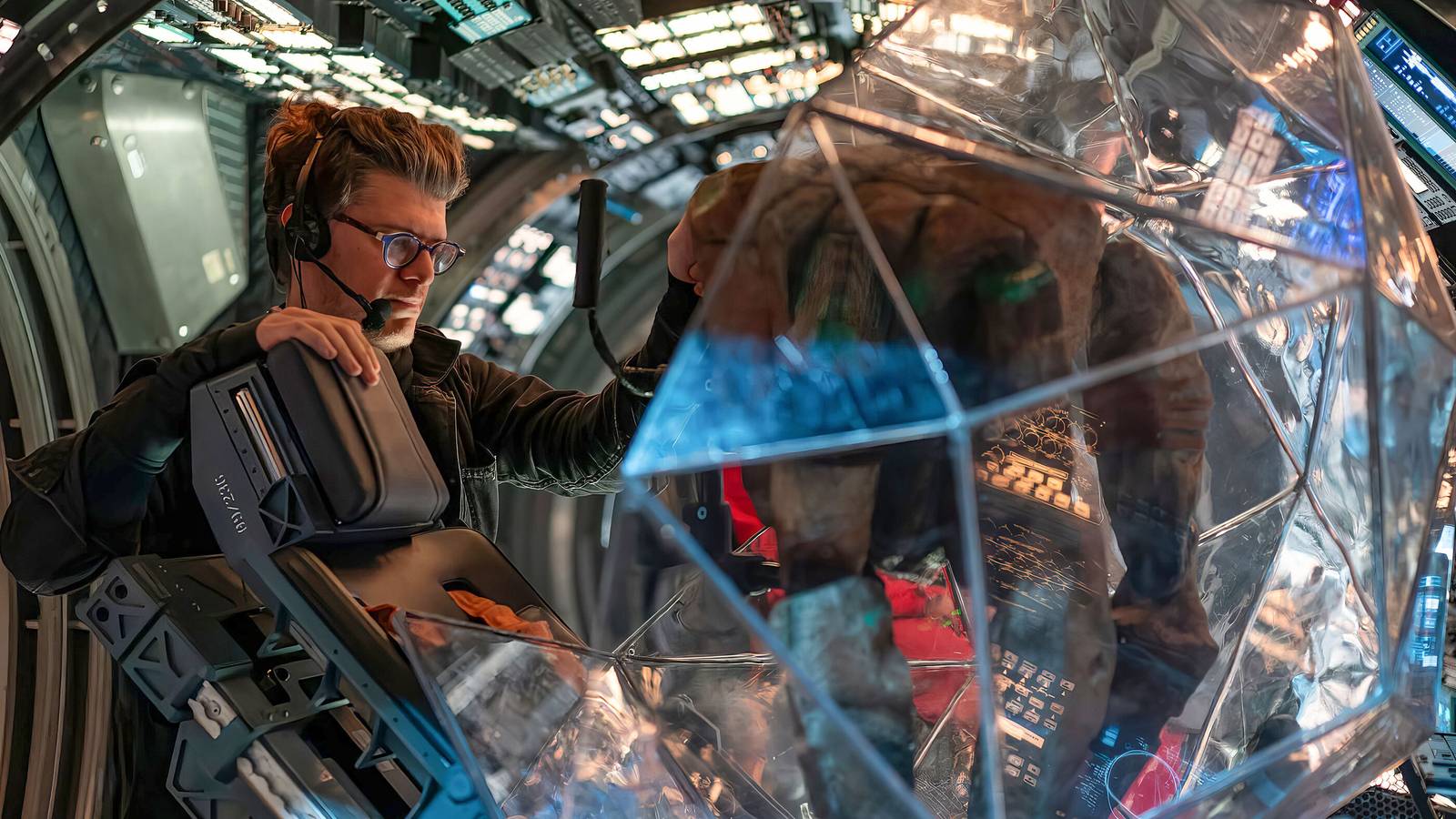
‘Project Hail Mary’ Changed One of Rocky’s Most Important Lines Just Weeks Before Release Image via Amazon MGM Studios Published Nov 21, 2026, 6:15 AM EST Sign in to your Collider account Summary Collider's Steve Weintraub talks with James Ortiz for Project Hail Mary. Ortiz discusses the practical puppetry and improvisation that make his performance as Rocky an Oscar contender. He shares stories from set, how he discovered Rocky's most iconic moments, working with Ryan Gosling, and more.. In a historic move, actor and puppeteer James Ortiz is eligible for a Best Supporting Actor nomination at the 99th Academy Awards for his standout performance on Project Hail Mary. He’s the mind and movement behind the blockbuster’s lovable alien creature, Rocky, who led a team of puppeteers on set, essentially performing “Waiting for Godot in space” opposite Ryan Gosling with take after take of improvisation. From filmmakers Phil Lord and Chris Miller, Project Hail Mary took audiences out of this world in an Andy Weir adaptation, penned by Drew Goddard, that wasn’t just visually stunning, but was a surprisingly moving two-hander between a man way in over his head and a creature made of rock, both on a dangerous mission to save their home planets. At this year’s SCAD Savannah Film Festival, Collider’s Steve Weintraub had the pleasure of moderating an in-depth Q&A with Ortiz to discuss the artistry of bringing one of 2026’s most memorable characters to life. Alongside Gosling’s Ryland Grace, Rocky becomes Project Hail Mary’s beating heart, and during this conversation, Ortiz shares the behind-the-scenes work it took to bring them from the page to the screen. We learn all about the practical puppetry, the limitations that allowed their creativity to soar, how Rocky’s most iconic moments and quips came to be. Don't miss the full Q&A in the video above, with a transcript provided below. James Ortiz Reveals the Origins of One of Rocky's Most Memorable Lines “I was working so hard on just trying to make Rocky as truthful as possible.” Image via Amazon MGM Studios COLLIDER: Let's talk a little bit about your background and how you got involved in the project. JAMES ORTIZ: So I was cast as an actor a thousand years ago by the casting director, Jeanne McCarthy. You may have seen her name at the end of this film. I was cast in a pilot that no one ever saw because it never aired. It was for a network that we don't have to mention. It was a great experience, but shortly after that, in New York, where I'm based, I was developing this sort of side career that turned into my full career, which is puppeteering and designing puppets for the theater. It kind of became this funny opportunity for me to play characters against my type. I could play things that I would never, ever be cast as because not every day you need, like, I don't know, a gay mad scientist. So, sometimes you need other flavors, and it was so exciting to be able to do that. So Jeanne remembered that I existed, and she would bring me in for stuff, but oftentimes I would go, "Oh, I can't come in because I have this puppet thing." And she would go, "Puppets?" And long story short, she gave me a phone call. She told me about this story, and I went, "This sounds incredible, but do they really mean a puppet? Do they mean that?" And I had a great meeting with Phil [Lord] and Chris [Miller]. It was love at first sight. We absolutely adore each other. And then we were off to the races, and I was on set trying to make a faceless five-legged creature lovable. If Rocky could watch Project Hail Mary, what would he complain the filmmakers got wrong about him? ORTIZ: I think Rocky doesn't think that they're funny, so I think Rocky would hear everybody laughing and go, "Not funny, not funny." I think that'd probably be the biggest thing. If you could sit down with Jim Henson, what would you want to talk about? ORTIZ: I don't know if I would say anything. I would just sort of sit there like a loser. I've been really fortunate; I've met a lot of his children because they run different puppet organizations all over the country, and it's been really, really special. I did a show called The Woodsman a thousand years ago in New York, and it was really, really special. Cheryl Henson moderated a talk-back very much like this, and she told me very effusively how much her father loved the Oz stories, and it was really meaningful to hear that. Image via ATV How many voicemails have you recorded for friends and family as Rocky? ORTIZ: The limit does not exist. I couldn't even begin to give you a number. How do you feel about doing the voice in public, like in moments like this? ORTIZ: Yeah. What are we trying to communicate? I'm sure there are some people in the audience that would like a voicemail from Rocky. ORTIZ: I think what it would probably be would be, "You reach voicemail of this human. Make no sense. Leave message after beep. Beep now. It's time for a beep. Where is beep, question? Make no sense. Make no sense. Uh, uh, uh." And then it gets cut off, because I don't think Rocky fully understands what's happening. When was the first time you said, "Fist my bump," and did you realize what it was going to become? ORTIZ: I had no idea. We worked on the movie. We worked so hard, and I left, and I had such a great experience. And then I really had no sense that anybody would like it, frankly. That's maybe a failing of mine, but I've been around long enough to know that even if everybody that worked on it did everything right, it doesn't always translate. It doesn't always land, and the fact that it has is pretty, pretty wild. So, I didn't really think that far ahead, to be honest. Frankly, also, I was only meant to be the person on set to help Ryan [Gosling], to help the DP. I was the steward of the character. I was just borrowing Rocky. And the fact that they lent him fully to me towards the end is still something I'm going to be processing for the rest of my life. I'm going to dig down a little bit, but do you remember when you first said, "Fist my bump?" ORTIZ: It had to have been in one of the scenes. It probably was in an improv that we were just kind of going. I was working so hard on just trying to make Rocky as truthful as possible that sometimes I would forget that there were catchphrases I had to hit. So most of the way that we were shooting is that Phil and Chris had an earpiece in my ear, and they could offer thoughts in between, in takes. So sometimes they would go, "Say fist my bump," and you're like, "Right. ‘Amaze, amaze, amaze,’” or whatever, right? So I can't actually tell you when I did it, but I know it would've been at some point then. Ryan Gosling's Grace Called Rocky "Very Demure" While Improvising Rocky is very mindful. Rocky doesn’t do too much. Image via Amazon MGM Studios You said you and Ryan would sometimes improvise for incredibly long stretches. What's something Ryan did or said as Grace that completely caught you off guard, and how did you respond as Rocky? ORTIZ: [Laughs] The only thing that's coming to mind right now is because when we shot it, remember that meme that went around three years ago that was “very demure?” There was one day where we were just going and riffing and riffing and going, and at some point, we were talking about Rocky or something, and he went, "It's very demure." And you saw him in real-time go, "No,” and try to backpedal. And in real-time, I think I went, "What is demure, question?" We just kind of would go. We would just waste camera time. We're at SCAD, and there are a lot of students in the audience, and I am 100% sure there are a few people out there that would love to do what you do. What advice would you like to share? And part two is, what advice were you given that was absolute horseshit? ORTIZ: Oh, damn! Sorry for the language. ORTIZ: I may have to curse to answer this question, too. I was told by an acting professor a long time ago, "This is one motherfucker of a business." And, yes, it's hard, but I don't think that means it's bad. I think the most rewarding things have been the things that have been hard-won. That's what I would say. But I would also say about the first question, if you want to play characters that are not easy to define, act more. Act all the time. Try to get opportunities to play characters that you wouldn't be cast as. Read roles that you're like, "I don't think this is for me. Let's try." And also, I think puppetry is an inherently physical art form, so I would also say invest in using your body to play the character. Something that I've been saying endlessly all over this process has been saying that Rocky's movement is actually Rocky's subtext. The thing that Rocky is feeling is actually what is coming out in his body. The thing that he's saying is the best the translator can manage. So, that was something that I was always tracking: What is Rocky feeling at any given moment? Even though I don't know if Rocky has a deep sense of that themself. They don't. And over the course of the story, we get to see that Rocky actually learns what feeling is through Grace. So, that was another whole evolution. But I guess the answer is movement theater, playing wacky parts, and letting your imagination not be limited. I would also say, just from my perspective, I don't think people realize you really have to work your ass off to do something. You've got to give almost everything of yourself to something that you love to be successful. ORTIZ: Yeah. I think that's completely right. I knew when I got the job that it wasn't going to be me at the end, but what does that matter? My job was to be of service. My job was to make the film work. My job was to make this character that is totally untenable — five legs, no face, speaks in this way, comes from a culture that is unimaginable — and I just went, "I want to always deliver something that feels consistent, that feels alive, that feels surprising, and I want to help Greig Fraser, who's shooting this movie, who has to emotionally find where the camera should go, and emotionally help Ryan in these long scenes where he has so much to do." Can you imagine him trying to do this to a tennis ball? It would've been a nightmare. So, it was always the objective of just going all the way, and I think I have a “too much” gene as it is, so I couldn't help it. Was there a moment during filming when you realized Rocky had stopped being a puppet and had become a real character in everyone's eyes? ORTIZ: Everybody was talking to Rocky and not me. [Laughs] It was exactly that. The first few weeks of the process, we were still finding our sea legs and figuring some stuff out. Phil gave me some great advice. We shot a scene that actually didn't make the cut — it's on the deleted scenes. My first day of shooting was this scene where we were in these two bunk beds. It was a great scene, and I loved doing it, but you could feel everybody on set who might've been skeptical that this would work, you could feel every crew member's shoulders just relax and lean in. But Phil pulled me into his little tent with all my other Rocketeers, and we looked at some of the footage from that day, and he was like, "I think you can trust stillness more," because I was overcomplicating the fact that he doesn't have a face means you have to communicate through movement. But I think I was doing too much, and he was like, "Remember, this is in IMAX, so you can't be like [thrashes around] the entire time.” So, it was a really cool lesson. It was a little bit like going to the Michael Caine school of acting, of never blink, always look at that side of the camera, not that. It was all that stuff that I was learning on a creature with no face. By the way, that advice that Michael Caine said about not blinking is dead-accurate. ORTIZ: It's completely true. If any of you are acting students, I swear to you, you've got to learn how to not blink, and if you look at people's performances, like great actors, you will notice they do not blink. They're very specific when they blink because they feel that it's like a character moment. ORTIZ: Yes. I swear it's a little thing that you should absolutely practice. ORTIZ: There's footage you can find of Michael Caine explaining this. Do it. It's so valuable because it's about using the medium. Theater people know how to use their whole body, and a lot of film acting is like, "This is now your proscenium. What are you going to do? How do you use it?" And, yeah, that's always the exercise. James Ortiz Reveals How Many Puppeteers It Took to Bring Rocky to Life He also shares how one of Rocky’s most iconic moments was a “happy accident.” Image via Amazon MGM Studios/Couresy Everett Collection Let's talk a little bit about what the physical rig was like. How many people does it take to operate Rocky, and how do you keep the team in sync? ORTIZ: Great question. So it was me — I was basically always on the carapace, the main body. There were handles coming out of his mid-back, sort of like a fighter pilot, and that was how I could animate the movement of the head. There were sometimes three to seven people operating his other appendages, and I was always sort of leading the charge on what that was. So we spent eight weeks basically learning how to work together as kind of a company. But the thing that would keep us tethered together, because puppetry can inherently be very technical — I promised Ryan the first day that we started talking about this project, and I had already gotten the part, I did say, "Listen, puppetry can be technical, but I guarantee you can improv with me, and I'm not going to leave you hanging, and I'm not going to let the technical side win." Right? It has to be an emotional performance. And sometimes when I could feel my other performers trying to do one thing with a leg, and it wasn't going to happen, and they were getting frustrated, all of that, I would just say, "Let's not try to aim for perfection. Let's just focus on the feeling." So sometimes we would finish a take, and I would go, "That was awesome. Let's try it again, and this time it's Christmas morning, and you're tiptoeing down the stairs, and you're so excited." That has nothing to do with the scene, but that's the emotional beat that we were trying to sort of land. So, that would be the one way, especially when we would be improvising and had to just lean in. Was there ever a scene where the limitations of the puppet made the performance better? ORTIZ: [Thumbs down] So, I think it's been well documented that basically they were like, "So he's going to do a thumbs up," and I was like [shakes head], because Rocky's elbows don't rotate. Rocky doesn't have wrists, which was something I would say all the time, and they'd go, "What does that mean?" And I was like, "Well, you can't do a thumbs up without a wrist." And we would try to do his finger, but that looked like something else. That looked like, "One minute!" So that didn't work. That was something that we sort of showed on the day, and it was something that one of my puppeteers was like, "Wouldn't it be funny if he goes, 'Thumbs up?'" [Thumbs down] And it is! So that was one sort of happy accident, as Bob Ross would say. James Ortiz Gave Rocky's Trauma a Meaningfull Payoff in 'Project Hail Mary' "Grace say Grace will die, Rocky fix.” Image via Amazon MGM Studios Phil and Chris are known for finding movies in the editing room. Did they do anything with the editing that really surprised you about Rocky's performance? ORTIZ: Yes. What I loved about working with them is that, again, I was a theater person from nowhere. The theater credits don't always transfer in the world of movies, and they would shoot every scene until basically everybody's ideas had been wrung out. It wasn't just like, "Let's do the scene on paper." Which, by the way, Drew Goddard wrote an incredible script, and we would do that, and then Ryan would have a cool idea, or I would have a cool idea, or Phil and Chris would go, "We were thinking it would be fun if..." And we would just shoot. Sometimes it would be a three-line scene, and we would shoot a take for 45 minutes, going back and going back, and, “Try it again, and add this.” So, we had so much material that frankly, I left every day going, "I have no idea what we just did." I completely blacked out. I was just trying to stay in the scene and trying to stay alive. So when I saw different cuts of the movie, they in fact were very different films from my estimation. The way that the scenes would be juxtaposed next to each other meant something else. When I saw the final cut, I actually did go, "I think I want to try to get into the ADR booth and maybe try to complete some of Rocky's arcs a little bit more." Because we didn't have the real estate. The movie is from Ryan's perspective. Literally, you're inside of his head most of the time. When he realizes that Rocky speaks that way, we suddenly can see in Rocky Vision, right? So there wasn't a lot of real estate to put Rocky's arc in there. The TLDR of what I'll just sort of say here is that we didn't have this moment where Rocky's sort of traumatic 80 years left alone on a spaceship was ever paid off. Through a series of just trial and error, we were able to find something, and I sort of raised my hand and said, "I think we need to change this line in this scene where I give him the astrophage.” And Rocky saying, "Grace say Grace will die, Rocky fix" was something that we added truly a month before the movie came out. And it was something that really made me so happy because, again, it's that moment when I was going, "I feel so much for this character. I really want to do him service." And we hadn't landed the plane on, well, where does that trauma go? We never addressed it. And I think the trauma has to turn into something positive. Rocky then takes the awful experience that they had, which we don't really talk about, and turns it into help for the person that he cares about the most. So anyway, that's a roundabout way of answering that. It has to be really crazy to be a part of a film like this that means so much to so many people. What has it been like meeting fans, and what do they always want to talk to you about? ORTIZ: Oh, it's incredible. Like I was saying, we made this movie kind of in a bubble, and then it came out — and what we don't have time for is the time that I met Steve the first time. Do you want to do it? Can we do it? This is your Q&A. You do whatever you want. ORTIZ: Let's do this because I think it's real charming. So basically, we were doing a press junket in LA before the movie came out, and the only people that had seen the movie were press. We were doing this thing where they were being interviewed downstairs, and I was up with the Rocketeers doing basically a meet-and-greet with Rocky. So press was coming in. There were little bits of footage. The footage was still coming out. And it was good, but it was quick. It was two minutes with each person. We should say the room that you were in was in a hotel, and there were curtains, so you could not see past the curtain to know what was inside. And the publicist would only say, "We have something we want you to do." We were not told what was inside that room. At least for me, they were like, "We just want you to go in the room." ORTIZ: And basically, there were cameras set up that people could see Rocky because Rocky was on a table and alive, and, "Hello, friend!" And we would interact, and it would be a two-minute sit in the chair, take a picture, have a video, move on. And it had become kind of a little rote, and everybody was like, "I loved the movie," and that is kind of a kiss of death. We're like, "Did you?" And this human walked in, the curtain parted, and Steve's face went [looks concerned]. And we were trying to engage, like, "Come over here and take a picture." He went [holds up hand and shakes head], and he just sort of moved towards us, and it was so moving. I told you this already. It was so moving because it was the first inkling I had that maybe this character worked because you were so affected. I had to break character. I was still puppeteering, and I went, "Steve, do you want to sit down?" It was so moving. We went long just to let you have your experience. It was really meaningful to me. I'm very, very lucky with what I get to do, and as I told you backstage, I've interviewed Kermit and Miss Piggy. Literally, you just become a child. You do not see the puppeteers. You just see Kermit and Miss Piggy, and you just want to talk to them, and you completely forget about everybody else. I was just in London for something that I can't talk about, but they had, in this one room, the Rocky puppets. I was just there seeing them, and everyone was freaking out. ORTIZ: That’s cool. That's nice to hear. Anyway, non-sequitur. I wanted to tell you that story because we had met before, and it was really meaningful to me. It was really meaningful, Steve. I say thank you. ‘Project Hail Mary’ Almost Had a Rocky and Mary Knock-Knock Joke Ortiz also explains how they brought this world to life without fully relying on CGI. Image via Amazon MGM Studios Is there a deleted Rocky scene or an extended sequence that you think fans would absolutely lose their minds over if they saw? ORTIZ: There's one little moment, and it wasn't even a deleted scene; it was sort of an addition to a scene. There's a scene when we are training to go fishing, and the actress who played the voice of Mary, Priya [Kansara], who's an incredible actress and was on set with us for only a few days. It was thrilling because Ryan and I had been shooting for five months, just me and him, basically doing Waiting for Godot in space, and then Priya would show up, and we had another scene partner, so we all just woke up in a fun way. We had this funny idea that was maybe just for one or two takes total, where when Grace was sleeping, Mary and Rocky had been hanging out, and that Mary had taught Rocky knock-knock jokes. So in the middle of the scene, she goes, "Tell joke now." And then Rocky went, "Knock, knock." And then Grace went, "Ugh, who's there?" "Rocky!" And that was it. It went nowhere, and it didn't help anything, but it was a moment on set where we all kind of went, "Oh, this is silly. We're having a silly time." What was the single most technically difficult Rocky scene to perform, and what's something audiences would never realize went into making those few seconds work? ORTIZ: God, I don't know if there's one scene I could say that was really the hardest thing ever. What I would say is… I'll give you some wacky fun facts. So, every scene was a total challenge. Anytime that you see Rocky in camera, we were really there putting him there. The challenging part was making sure that we had enough space for the puppeteers, not Rocky, in every single take — and I mean shot, not scene. Every single shot there's a different use of it's CG, it's half CG, it's fully puppet, it's two-part puppets, whatever. But I will say the scene where we're playing with the tape measure, the thing that thrills me beyond belief is that there's only one shot or two shots total in that when it gets cut back and forth that is CG. Everything else is us. I have to shout out Claire Roi Harvey, one of my puppeteers, and Fred [Buhagiar]. They were literally using these mechanical fingers to do this thing, and we would just cut and play, and it was the silliest day on set. It was so fun. The hardest thing was the fact that they made Rocky out of fiberglass, which is what I asked for. It's a lightweight material. But all the Xenonite is made out of plexiglass. If you don't know, fiberglass will scratch the hell out of plexiglass, and you can't polish it. It's a streak, and it's ruined. So, we weren't allowed to touch our house because every time that we did, it would leave a God-awful gash, and then Greig didn't have anything to shoot through. So, they basically added layers of transparency the first few days that was protectant, but it made it more blurry, and then Greig was not happy, and then we had to go back and forth. So there's only two shots in the movie — it's actually in the clock when Rocky pulls out the clock — that there's real glass that's actually there because real glass doesn't scratch the way that it does with fiberglass. So everything else is this bizarre thing where we weren't allowed to touch our home, which is challenging, as you can imagine. Release Date March 15, 2026 Runtime 157 minutes Director Christopher Miller, Phil Lord Cast James Ortiz Rocky (voice) Writers Drew Goddard, Andy Weir Producers Aditya Sood, Amy Pascal, Andy Weir, Christopher Miller, Phil Lord, Rachel O'Connor, Ryan Gosling
‘Project Hail Mary’ Almost Had a Completely Different Ending for Rocky
Full Article
Original Source
Read the full article at Collider →KhanList aggregates and links to publicly available news content. We do not host full articles from third-party sources. Always verify important information with original sources.