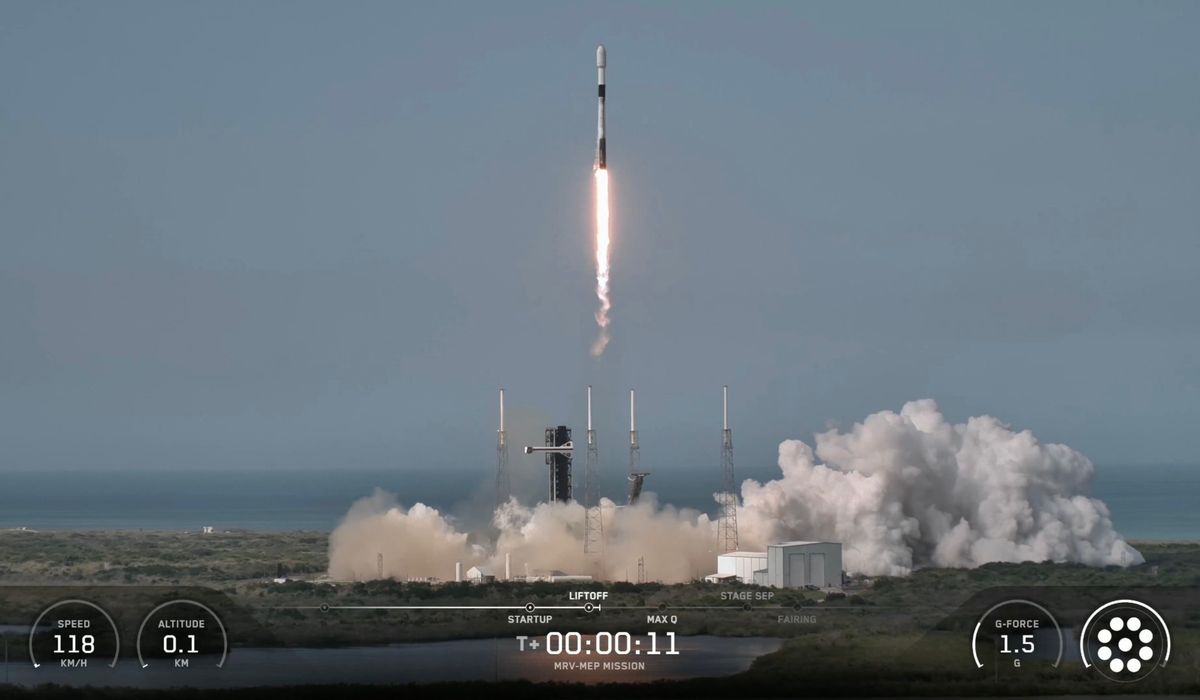
CAPE CANAVERAL, Fla. — A two-armed space robot blasted off on a private salvage operation Tuesday afternoon to slap life-extending jetpacks on old satellites running low on fuel thousands of miles up. It’s the second satellite-saving mission to launch this month, all part of a growing, money-saving effort to keep old spacecraft running as long as possible. Another company’s three-armed spacecraft rocketed into orbit on July 3 to boost NASA’s Swift Observatory so it doesn’t crash to Earth this fall. Launched by SpaceX, Northrop Grumman’s mission robotic vehicle - dubbed MRV - and its jetpacks will spend the next year angling into the proper orbit 22,300 miles above Earth. Hundreds of satellites orbit at this so-called geosynchronous orbit, where they match the speed of Earth’s rotation and keep to the same part of the sky for continuous coverage. Once in place, the minivan-sized spacecraft will use its 10-foot arms to attach a jetpack to an aging communication satellite. Then it will zip off to two more satellites in need. For its debut flight, the spacecraft carried three electric-propelled jetpacks that were programmed to peel away following liftoff and, like the MRV, use their own xenon gas thrusters to get to the desired orbit. The jetpacks will wait for the robot to grab them, one at a time, and plug them into satellites in need. Each jetpack - the size of a washing machine - will provide the necessary oomph for an out-of-gas satellite to keep operating for several more years instead of retiring. If it works, it will be a boon for satellite operators SES of Luxembourg and Optus of Australia, saving them millions of dollars in replacement costs. This is Northrop Grumman’s latest foray into the satellite-servicing business. In 2019 and again in 2020, the company launched a pair of spacecraft that latched onto faltering communication satellites and steered them, providing extra years of life. Northrop Grumman designed its new robotic helpers to be even more resourceful. The company envisions future versions repairing and relocating live satellites, and even latching onto dead ones for removal from highly trafficked orbits. The company is collaborating with the U.S. Naval Research Laboratory and the Defense Advanced Research Projects Agency. Katalyst Space Technologies, meanwhile, continues to test its Link satellite helper in orbit before rushing to the Swift Observatory’s rescue. Flight controllers had to overcome initial communication and pointing problems with Link, beaming up software patches. Launched in 2004, NASA’s Swift telescope has been sinking faster than usual because of all the recent solar activity. A boost by Link in the coming weeks could give the nearly $400 million gamma ray observatory many more years of studying some of the biggest explosions in the universe. NASA is paying Kataylst $30 million to raise Swift to its original 373-mile altitude. Northrop Grumman provided Link’s ride to orbit, using a plane-launched Pegasus rocket. ___ The Associated Press Health and Science Department receives support from the Howard Hughes Medical Institute’s Department of Science Education and the Robert Wood Johnson Foundation. The AP is solely responsible for all content. Copyright © 2026 The Washington Times, LLC.
Private mission launches to extend life of out-of-gas communication satellites
Full Article
Original Source
Read the full article at Washingtontimes →KhanList aggregates and links to publicly available news content. We do not host full articles from third-party sources. Always verify important information with original sources.