
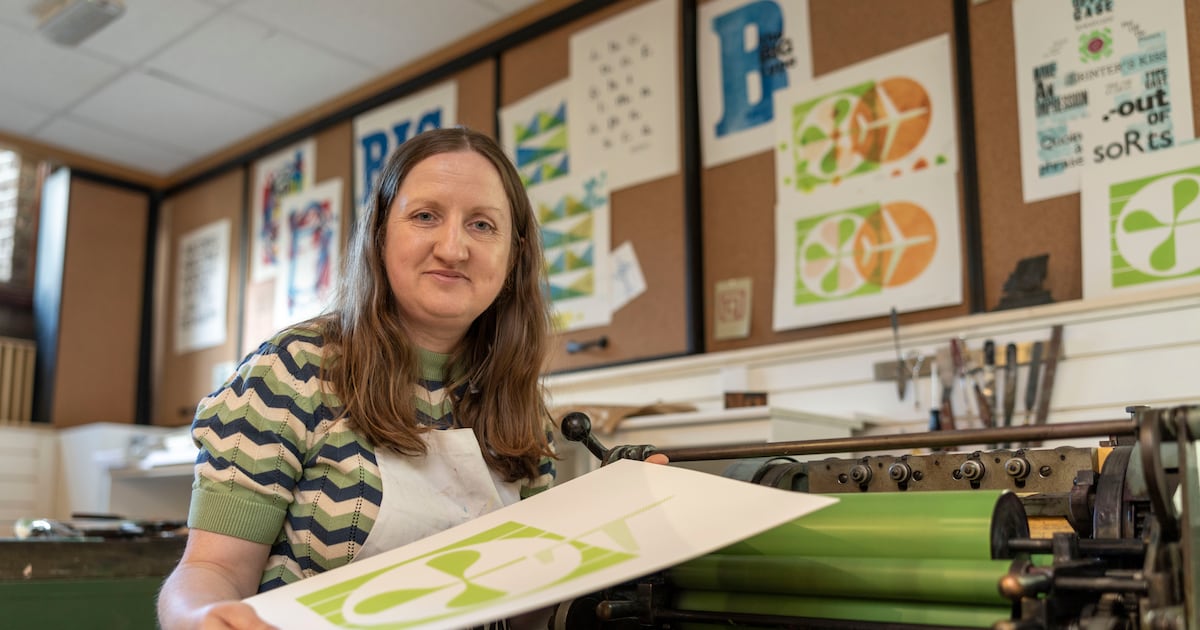
Few people in Ireland have a deeper knowledge of letterpress printing than Mary Plunkett.Her work has been gifted to three former presidents – Barack Obama, Joe Biden and Michael D Higgins – in the form of specially commissioned books of WB Yeats’s poetry.Plunkett, who is exacting, printed the books on an Albion press manufactured in 1840, the same type of iron press Yeats’s sisters, Elizabeth and Lily, used to print Irish revivalist literature through their Cuala Press.“There aren’t that many people now doing letterpress printing, and in the next generation there are even fewer taking it on,” Plunkett says, speaking from her corner of the National Print Museum, in the Garrison Chapel of the 19th-century former army barracks at Beggar’s Bush in Dublin. “People aren’t learning to be printers full time. In that way print really is gone.”READ MOREPlunkett’s job, as the museum’s letterpress learning officer and technician, is to strengthen the practice of letterpress in Ireland by passing on knowledge and keeping it forward-focused and open to evolution.She runs outreach days, when she brings a small portable press to schools or institutions, and organises workshops in the museum, collaborating with students and designers to produce posters or greeting cards.“One of the things I really like is that you are limited by what you physically have,” she says. “It’s not like you open up the computer and you can use any type that ever was. Those limitations actually give you freedom. You need a level of ingenuity.”Almost all text in Ireland was printed by letterpress until the second half of the 20th century, when offset lithography gradually took over. Every book, every manual, every newspaper was created using the same movable-type method first developed in China in the 11th century, and later introduced to Europe by the German goldsmith Johannes Gutenberg in the mid-1400s.Replicas of the 1916 Proclamation being printed at the National Print Museum The mechanism is straightforward: a raised surface with the image reversed, such as metal type with backwards letters, is coated with ink and then pressed on to a sheet of paper to produce a positive image. The practice is more complicated. The machines that surround Plunkett in the museum look imposing to the uninitiated, and are impressively noisy when they get going.There are hand-cranked Peerless Platen Treadle presses, similar to the ones that printed menus and newspapers on board Titanic; a manual Vandercook press, which Plunkett uses for posters; and an electric Heidelberg Platen, which is useful for printing large volumes of pages.Around these heavy machines, cases of metal type are stacked in drawers – thousands of letters, symbols and numbers, with every character needed to communicate in English or Irish.Learning how to use the presses takes time. A printer’s apprenticeship was much sought-after in early-20th-century Ireland. Boys – the industry was male-dominated – typically signed seven-year indentures, agreeing to forgo sex, drinking and gambling in exchange for their masters’ instruction and knowledge.As their ultimate test of proficiency, apprentices were blindfolded and asked to lay the type for “The quick brown fox jumps over the lazy dog.” It is a pangram, or a sentence that uses every letter of the English alphabet at least once, and a legend that’s recorded in a 2023 book, Strange Types & Odd Sorts: A Peek into the World of Printing in Ireland.These rules were relaxed over time, and the industry went from strength to strength. In 1963 Dublin had more than 100 printing and print-related businesses, according to an advertisement in The Irish Press that year.But, combined with offset lithography, which gives a sharper result by using a large rubber roller between the inked plate and the paper to transfer text and images to the page, the arrival of modern phototypesetting in the late 1970s drastically changed the industry, as it eradicated the need for some of its previously key mechanical processes.By the mid-1990s almost all of the printing presses in Dublin had ceased operation. In just a few decades, presses went from being the essential tools of trade, commerce and communication to being cast aside and broken up for scrap.In 1996 a group of printers, called the Chapel, saw what was happening and the skills that were at risk of being lost forever. They banded together to push for the creation of a National Print Museum. They salvaged presses from skips, saved cases and cases of typeface, and fought for a location to house it all.Carla Marrinan Funder, chief executive and director of the National Print Museum. Photograph: Tom Honan The core of the museum’s collection still consists of the material they saved, according to Carla Marrinan Funder, the chief executive and director of the National Print Museum.“We decided that our commitment is to keeping not just the collection but the craft alive as well,” she says. Ireland has a nearly 500-year-old unbroken tradition of letterpress printing; it’s one thing to save the machines, but preserving the practice takes a different approach.In 2019 Marrinan Funder led the successful application to have letterpress printing in Ireland included in the National Inventory of Intangible Cultural Heritage, where it sits alongside other traditional crafts, such as curragh making and lace making. That year the museum also received Creative Ireland funding to train volunteers on some of the machines, with the idea that they could act as reserve members of the Chapel.“We had more than 80 applicants for eight places,” Marrinan Funder says. Six of the chosen applicants are still heavily involved with the museum, and a second round of volunteers was recruited in 2024 with funding from the Heritage Council and Meath County Council.Mary Plunkett: 'You need a level of ingenuity.' Photograph: Tom Honan “Our annual budget is €155,000 to run the whole museum. I suppose that is the biggest challenge for us. We do a lot of activities to bring in income, but entry to the museum is free. That is vital, because we want to show people the power that print had to educate, to inform, and we want to keep that access to information, that democracy.”The museum is about to celebrate its 30th birthday with the Big Type Festival, which runs over the first weekend in September. It will include a half-day letterpress workshop alongside talks from the graphic designer Annie Atkins, the children’s illustrator and author Chris Haughton, and Maser, the contemporary visual and street artist.Although letterpress printing has become obsolete as a mass commercial endeavour, it has taken on a different significance as an artistic practice, and there are studios around Ireland producing greeting cards, posters and prints.Marrinan Funder has consciously opened up the collection of historical presses to designers, illustrators and writers, encouraging an atmosphere of creativity around how to work within the technology.One of the museum’s most interesting collaborations has been with Anthony Burrill. The renowned graphic artist, printmaker and designer, who is leading a sold-out workshop at the museum for the Big Type Festival, is an artist whose work focuses on positivity.His first print with the museum was a limited-edition run that he designed with Mary Plunkett. It featured a single word printed in capitals: “HOPE”. The next planned print is a single sentence: “Answer your own question”.Acclaimed graphic artist Anthony Burrill is delivering a sold-out workshop at the National Print Museum for the Big Type Festival Anthony Burrill's first print with the National Print Museum was a limited-edition run designed with Mary Plunkett Burrill and Plunkett's design featured the single word 'HOPE' “Sure, it’s niche, and it’s unusual, but print is just a great way of delivering powerful direct messages to people,” Burrill says. “I think the humanity of handmade production makes it so appealing. It feels like it means something more than just looking at something on a shiny screen.”Letterpress printing, Burrill has found, can bring together layers of the past and present in a way that information produced on a screen never can.[ ‘I instinctively picked up the H, O, P, and E’: Print Museum and graphic artist collaborateOpens in new window ]As just one example, Burrill’s Hope poster was made on a Wharfedale press, the same type of machine on which the 1916 Proclamation, one of the most important documents in the history of the Irish Republic, was printed.The Wharfedale occupies a vast corner of the museum. Just one remaining member of the original Chapel, Freddie Snowe – who is also a former press and publishing manager of the Irish Times print facility – knows how to use it.Snowe has spent his working life in the print trade. In the 1960s he worked in the caseroom at Hely Thom printers, in Glasnevin in Dublin, alongside Liam Ó Briain, one of the three men who risked execution to print the Proclamation in the basement of Liberty Hall over Easter weekend in 1916. Under enormous pressure, Ó Briain set the type alongside Michael Molloy and Christy Brady, who printed 2,500 copies.Printers Alf McCormack, Billy Ryan and Freddie Snowe check a limited-edition print run of 100 copies of the Proclamation of 1916 to comemorate the 100th anniversary of the Easter Rising at the National Print Museum. Photograph: Cyril Byrne “I was a young boy working in Glasnevin then. Liam, or Willie as we knew him then, was a lovely man, very quiet,” Snowe says, adding that working in the printing trade was the best job he could ever have had.Last year Burrill worked with Snowe and another printer, John King, to create the Hope print on the Wharfedale.[ Inside the Irish Times printing press: Calm, orderly working at breakneck speedOpens in new window ]“It was a great challenge to do that print; the type blocks were so big and warped, and the machine is so old,” Snowe says. “It’s a very dangerous machine to operate; there are no safety guards on it. You have to be extremely cautious – and I am because of my experience of losing my finger.”Snowe’s index finger was permanently severed from his left hand in an accident on the Irish Times press at the paper’s former premises on D’Olier Street in September 1989. He laughs about it now, but he lost a lot of blood at the time.“The Hope print took a lot of work to get exactly right,” Snowe says. “A good printer – and I’m not saying I am – but we do what needs to be done.”One poster, printed with just four letters, carries a tangible connection to 110 years of Irish history, bravery and skill.The Big Type Festival, celebrating print, typography, design and creativity, is at the National Print Museum, in Dublin, from Friday, September 4th, until Sunday, September 6th Print by David McGinn, Black Church Print Studio Satellite Salon: A different type of printingWhile the designers working in letterpress printing are finding new ways to work with the technology to keep it alive, fine art printmakers at Black Church Print Studio, in Temple Bar in Dublin, face a different set of challenges.Over the years printmakers have suffered from a lack of spaces to show their work, and from a lack of understanding about what printmaking is.“There is a certain ignorance around printmaking. You get it all the time. People saying ‘I don’t want to buy this. I want to buy an original artwork,’” says David McGinn, Black Church’s technical manager.“But each print is individually made. Sure, each one is meant to be identical, but we know as printmakers that is not always the case. It’s not this mechanical thing; each one is hand printed each time.” Print by Liza Kelly, Black Church Print Studio Black Church is a member-led studio with a current community of more than 80 people, who pay an annual fee and have 24-hour access to the facility.The work of past and present members lines the staircase that leads to three large studios, each housing a different printing process. On the first floor is lithography, where artists draw directly on to a rare type of limestone and their design is ultimately transferred to paper.The next floor up is intaglio, a printmaking process in which lines or areas are etched using acid into a metal plate in order to hold ink. The top floor is devoted to screen printing, where ink is pressed through a stencilled mesh screen to create a printed design.“In some ways print may have played second fiddle in terms of importance to other mediums, possibly because they are made in editions,” says Colin Martin, an artist and curator of Satellite Salon, a new group exhibition from the printmakers at Black Church.Colin Martin of Black Church Print Studio “Personally, I feel it makes things much more available and accessible, and in terms of collecting work it’s much easier to collect prints, they’re more affordable, and there is less preciousness around them.”The Satellite Salon is a fully inclusive show for all of the members of Black Church studio; any member who wanted work exhibited will have it shown.“Studios are democratic places where recent graduates and more established artists come in and work shoulder to shoulder,” Martin says. “I wanted the show to reflect what is actually happening here.”Satellite Salon, curated by Colin Martin and commissioned by Black Church Print Studio, is at the Library Project, 4 Temple Bar, Dublin 2, from Friday, September 4th, until Saturday, September 26th[ ‘I instinctively picked up the H, O, P, and E’: Print Museum and graphic artist collaborateOpens in new window ]
‘Print is a great way of delivering powerful, direct messages. It’s more meaningful than looking at a screen’
Full Article
Original Source
Read the full article at Irishtimes →KhanList aggregates and links to publicly available news content. We do not host full articles from third-party sources. Always verify important information with original sources.