
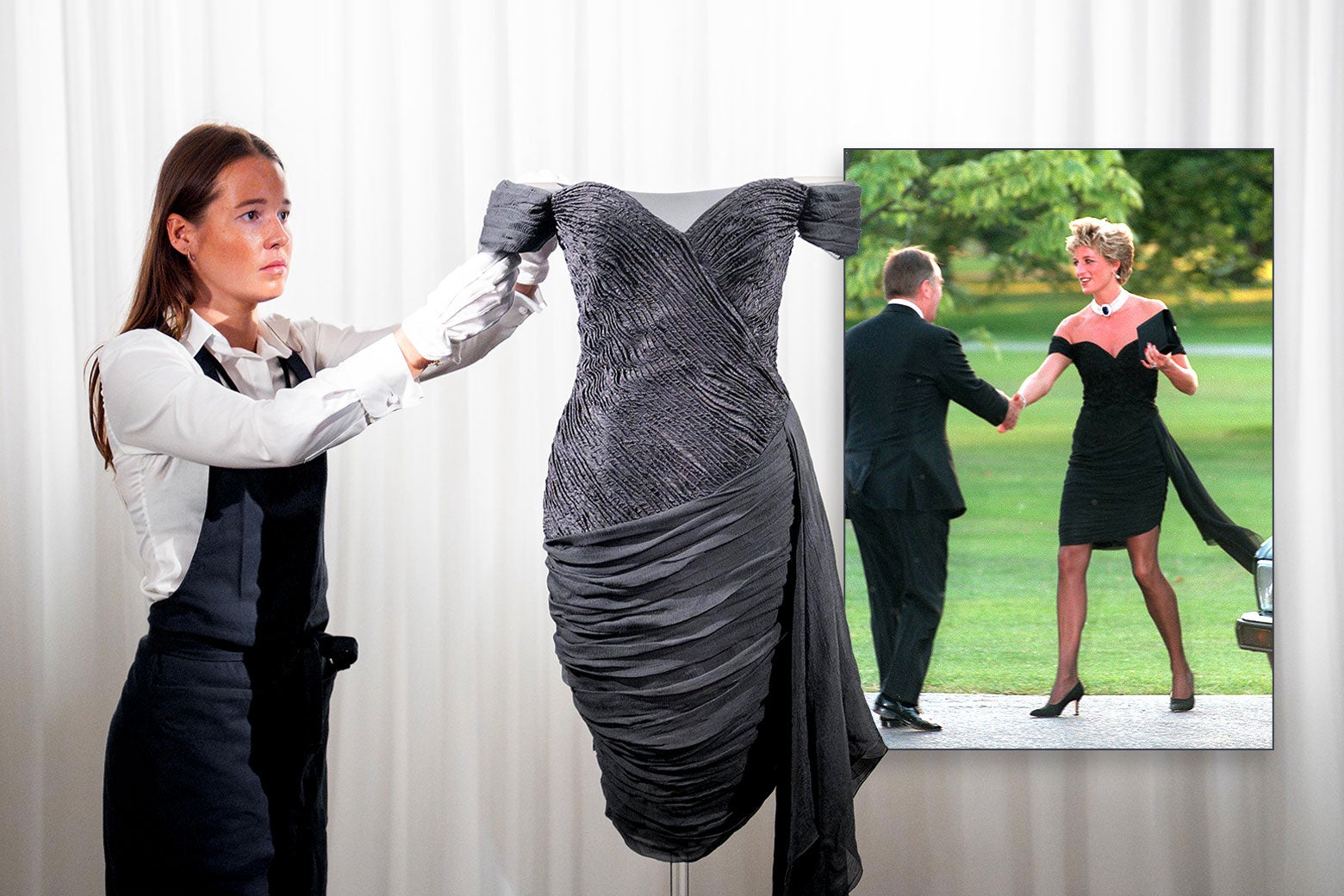
Fame I Went to See Princess Diana’s “Revenge Dress.” It Unearthed Something in Me. I thought I was just going on a journalistic lark. Turns out that’s impossible for a British woman. Photo illustration by Slate. Photos by James Manning/PA Images via Getty Images and Anwar Hussein/WireImage. Sign up for the Slatest to get the most insightful analysis, criticism, and advice out there, delivered to your inbox daily. When people picture the late Lady Diana, she is probably wearing one of two outfits in their minds. The first is the sports-day look: high white socks, an effortlessly slouchy sweatshirt, running shoes. The second is a little black dress. In 1994, on the same day her sometime husband, now King Charles, was due to appear on television and admit that he had been having an affair during their marriage, Diana attended a fundraising dinner at London’s Serpentine Gallery. As the story goes, she changed her mind about what to wear at the last minute, and arrived at the event looking so good it went down in history. The black sheep in her black dress, looking impossibly glamorous in an outfit that the royal family would never have allowed her to wear. A photograph taken of her arriving at the event, having just stepped out of a Jaguar, became an instantly iconic image. The off-shoulder silk gown, made by Greek designer Christina Stambolian, became known as the “revenge dress.” The picture of Diana in that dress lives in the mind of everyone in Britain, and many more people around the world besides. But the dress itself has been out of sight for almost 30 years. Diana herself auctioned it off in 1997 for cancer and AIDS charities, along with 78 other gowns in her possession, just two months before her death. It sold for 39,098 pounds to a couple in Glasgow, who have owned it, and kept it out of the public eye, ever since. Until now. Sotheby’s announced last week that the dress will go up for auction at the end of this year. Before that, though, it would go on public display, first in London, then in Hong Kong and Geneva, and finally in New York, where the auction will take place in December. It’s listed at an estimated $150,000 to $300,000, some of which will be donated to National Health Service charities, but it’s expected to go for much, much more. To put it in context, a red sweater featuring several sheep, one of them black, that Diana wore to a polo match in the ’80s—another candidate for the outfit that a Diana of the imagination is wearing—sold for $1.1 million in 2023. The gown is in London this week, and so on Saturday afternoon I went to get a look at one of the most famous dresses in the world. I thought it might just be a lark, a way to while away a slow weekend, another reason to get mad at the British press. I ended up having another reaction entirely. Although news outlets around the world have reported that the dress is on display, there is no signage outside Sotheby’s to indicate that one of the most well-known garments ever worn is just inside its doors. No doubt this is about classiness: Sotheby’s, an auction house in the heart of one of London’s most chichi neighborhoods, Bond Street, would not stoop to something so vulgar as a sandwich board. Inside, positioned among four white columns and flanked by three of the most alert security guards I’ve ever come across, was the dress, held up by a transparent pole rather than on a visible mannequin. There was a fan artfully wafting the dress’s chiffon train, so that it might look as much as possible like it does in the infamous photo, which is blown up on the wall beside the dress. For an exhibit that exists in front of a tabloid photo, it’s an oddly reverent affair. People talked in whispers, almost as if the sight of the dress abstracted from a body conjured the spirit of Diana herself to the room. “How tall was she?” someone murmured, to which someone else replied “5-foot-10 in flats” without missing a beat. I found it almost funny, so somber and respectful was the atmosphere around what was ultimately just some cloth on a stick. “It made me more emotional than I thought it was going to,” said Maddie, a 26-year-old upholsterer visiting that afternoon. “She was supposed to not be seen or heard by anyone, she was supposed to just be there. So I think her doing this, when there was already going to be press around their relationship and they put her into the spotlight, she was kind of reclaiming her own feelings.” Other onlookers commented on how strange it was to see the texture of the dress: more ruched than the tabloid photos from 1997 conveyed; the star turn from the fan unit. Some thought it looked grayer than they expected, some thought it was larger, some smaller. Everyone that I spoke to had different reasons for revering the woman who wore it. One cited her kindness toward AIDS patients, another her attempt to modernize the monarchy, a third her style. They all loved her. Diana herself is an icon at a level that is mind-boggling. Her death was a national event that serves as a before-and-after generational barometer in the same way 9/11 does in the U.S.: If you remember her death, you’re a millennial. My own fifth birthday party was apparently quite a somber affair for the adults present, one that was almost canceled outright by my parents because it fell on the weekend after Diana’s death. Here in the U.K., I would be surprised if a single day has gone by in the past 29 years when something has not been published about her in the media. If you go into a supermarket here, in 2026, there’s a fair chance you’ll find a magazine with her on the cover. On our version of SNL, the cast member Jack Shep is currently doing a repeat turn as Diana in the revenge dress. It can sometimes feel a bit tiring, this endless reverence and reference, a bit perplexing that we have to continue talking about her. Curiously, though, those feelings melted away as I spent more time that afternoon in the presence of the dress. I, too, came to be moved more than I thought I might be, and part of that came from talking to the other punters. Ignasio, originally from Spain, had been brought down by a fashion-enthusiast friend. “Empowerment is something we say now very often,” he said, but the revenge dress, despite being debuted all those years ago, is still one of the most iconic cultural moments of female empowerment, to his mind. I also met Amanda and Tracey, a pair of sisters in their 40s and 50s, one visiting the other in London for the day. “It’s sort of like a symbol of power, isn’t it,” said Amanda, “for women around the world that have been wronged, downtrodden by a man. Which is pretty much everyone in some way.” Diana’s story is so familiar to people here in the U.K. that it can be easy to overlook the impact and the import of its details. A woman inducted into the royal family who refused to follow the rules, and refused to be made into a victim by the neglect of her husband, despite his enormous power and influence. And it was only on seeing the dress in person that I realized that this dress, and the moment at which it was worn, had seeped its way into my consciousness and my behavior too. Some years ago, I went as Diana in the revenge dress for Halloween. That’s not so unusual—it’s a bit of a staple costume here, among girls and gays. But the context was: I had recently been badly heartbroken. I didn’t think much about the choice at the time—I had short blonde hair, it seemed like an easy move—but looking back, it’s clear to me that it expressed something I wanted to say at that moment. Not to my ex, who wouldn’t see me in the dress, but to myself. That I, too, had dignity and glamour in the face of romantic rejection and humiliation. It made me feel powerful, despite the fact that my dupe was purchased for something like 15 quid from the internet, along with a plastic pearl choker to complete the look. And there was something special about seeing the real deal, and remembering that clothes have this power: to speak for us and about us even when hiding away in silence might feel more comfortable. Celebrities Fashion History Royals
Princess Diana’s Iconic “Revenge Dress” Is Up for Auction. I, a Jaded British Journalist, Went to See It. My Reaction Was a Complete Shock.
Full Article
Original Source
Read the full article at Slate →KhanList aggregates and links to publicly available news content. We do not host full articles from third-party sources. Always verify important information with original sources.