
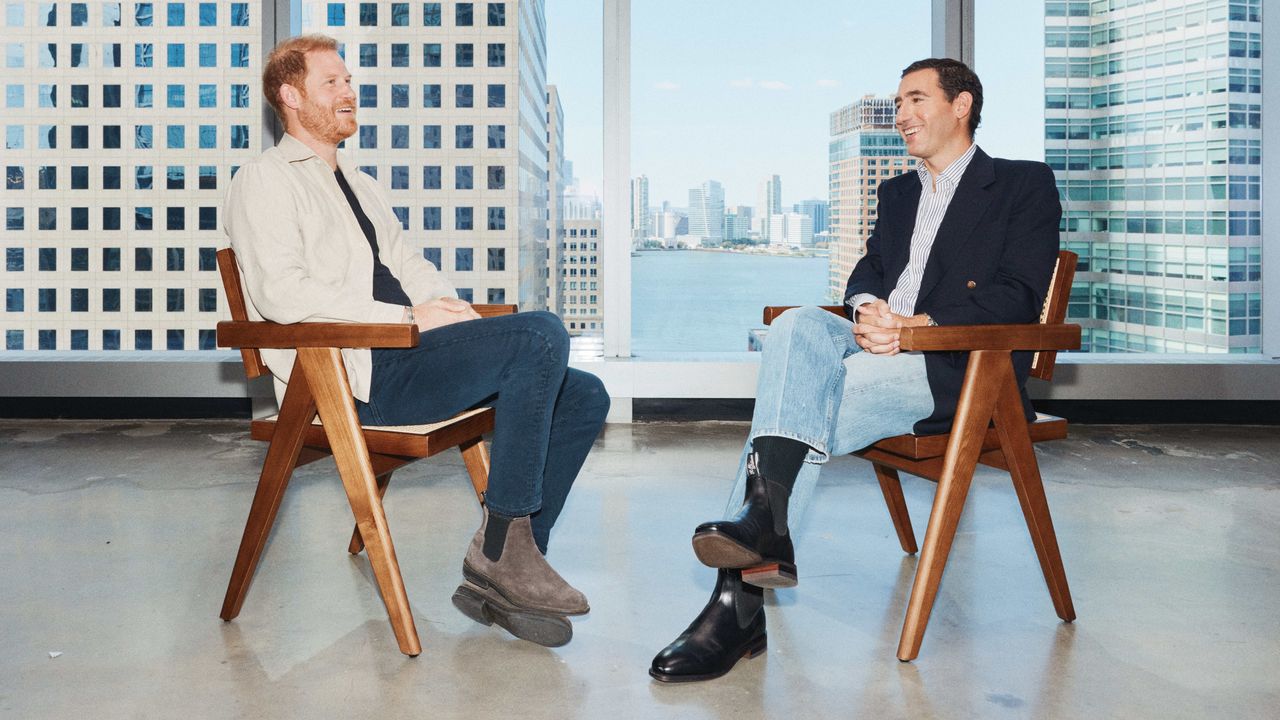
“As a 42-year-old man with two kids, a boy and a girl,” Prince Harry says, “you start to look back at your past and your parents as to what you have carried from them, what they’ve handed over to you, what you want to take on and what you don’t.”If this feels like a startlingly intimate place to start, well: Welcome to this conversation. Prince Harry, Duke of Sussex, has recently moved back to the UK from California with his family, but he’s in New York this week, at the end of September, to give a speech during the UN General Assembly. And right now he’s at the GQ offices in One World Trade Center, talking about grief.Grief is the subject of his new MasterClass, Redefining Grief: Building Resilience Through Loss, which the Duke did alongside the scholar Dr. Mary-Frances O’Connor. It is also, of course, in some ways the main subject of Prince Harry’s life. He was just 12 years old when his mother, Princess Diana, died tragically, at the age of 36. He has been reckoning with that loss ever since. “Still to this day, people very often come up to me and say, ‘I remember exactly where I was on that day in 1997, 31st of August,’” he says.In this conversation we talk about his mother, and how he has learned to cope with the impossible. We talk about his grief over certain current relationships within his family, which he says he is working to repair. We talk about having sick fathers, about journalism, about being parents.“I certainly don’t want any sympathy,” he says. “We’re way past that.”Why? I ask.“Why?” He’s incredulous. “Because I’m a prince.”The following conversation is lightly edited and condensed from the latest episode of One More Question with Zach Baron. Watch below or on YouTube. Listen on Spotify or Apple Podcasts.We’re taping this in New York. You just moved back to the UK. Why?Opportunities for the family. Being able to put the kids in a British school has meant a lot to me. I didn’t know how important it was to me. I always thought it was going to be something that we would try and do, but now they’ve been in school for two weeks. They’re loving it and it’s just giving them a whole different experience. I’m not criticizing American schools. But I think for kids at seven and five, to be able to have that comparison and to have two completely different cultural experiences is so important today. But yeah: To be back closer to my family and to be back on UK soil for longer than a few days or a week here or there. It’s nice to be back.I imagine it’s not easy to uproot your family the way you did.No, it’s not. Look, there’s no part of anything, really, that’s easy anymore. For lots of people. And this wasn’t something that we planned for a long time. It’s something that we’ve thought about and we’ve considered. But for us, when certain stars align and it’s clear that this should or probably will end up being the case, then we lean into that.Was the decision more about what life was like here in the US, or more about something you were craving back there?I think that, having been here for six years now, and only being able to go back to the UK for short periods of time, to actually have my whole family there with me, the place that I grew up, wanting to be able to show my kids where I grew up and have them have the experiences to some extent that I had, the good rather than necessarily the bad, provided real proper serious thinking as to: This is an opportunity, let’s do it now. It’s good to be outside of the US for the next few months, perhaps. Let things settle down for a bit and then we work it out from there. But we’ve had plans in the past, and I think for lots of people, it’s like, if you’re going to make a big move like this, that’s going to take a lot of planning. For us, it was very short.There were reasons why you guys left in the first place, whether the media or other things you’ve spoken about in the past. Do you think it’s going to be different, or do you have a different attitude about it?I think a combination of two of those. I think that certainly our attitude has changed.In what way?Well, there’s your One More Question thing.I’m sorry!It’s okay. It’s your job. I think once you’ve been through it, once you’ve been able to talk about it and raise awareness to it, then people see it for what it is, which makes the environment slightly easier. And it’s not going to necessarily stop the behavior, but then that’s the second part, which is the behavior: My hope is that it will change. What happened back then was then, what’s happened over the last six years has been a continuation of that. There are some battles that have been fought, necessarily so. But hopefully we can all draw a line under that. And with everything else that’s going on in the world, there’s aspects of the past that I’m sure all of us, me, my family, some of the British press, that we’d all like to leave behind us and work for the greater good.And it sounds like you’re actually optimistic about that, which is—I am optimistic. I’m hopeful. I’m not naive. I have been naive in the past. But I think it’s important to remain optimistic. And I think a large part of this is about respect as well. And I can respect them if they respect me and our position. Our position is really quite clear now, and hopefully we can get on with life.I’ve let too much time pass already before asking the most important question, which is: How are you?I’m good. I know why you asked that question.For those that don’t know, you have a MasterClass on the subject of grief and in it, you talk about how you gave the same answer to that question for more or less 20 years every day, which was—“I’m fine.” Which I think a lot of people do. I think a lot of us, when someone is suffering from anything, grief, loss, trauma, just a bad day—some people don’t ask at all, but I think friends and companions or work colleagues, if you say, “How are you?,” it’s a sort of natural reaction to say, “I’m fine.” And then everybody sort of moves on. You’ve done your part—you asked and you’ve done your part by saying, “I’m fine.” But underneath that, I’ve always felt, certainly from my perspective, there was always more. If someone had asked us the follow-up question, “Are you sure you’re fine?” I don’t think that would’ve changed my response.My follow-up question was going to be: Are you actually good?No, I am good. I’m exhausted, as tired as you are. You’ve just come off a red-eye. I’ve been in New York for the last three days, so it’s interesting to be jet-lagged in New York where it’s normally the other way around. But the work that I’ve done over the last few days and the work that I do, that’s the stuff that energizes me. Being around good people, trying to make an impact in the world, that is genuinely what energizes me. And I’m in a much better place now than I was 10 years ago.In what way?There’s a really interesting thing about grief. It’s very personal for people. It’s very individual to that person’s circumstance. But I’ve learned to, I guess, accept and understand that you don’t ever get over grief. You learn to live with it. And also, I’ve never wanted to get over the grief. And that was where I was stuck many, many years ago was the fact that if I give up on the grieving, does that mean I give up on the memory of my mother? And at the same time, if I become happy, is that a betrayal of her memory? And in the MasterClass series, I say: I am a student of grief. And the expert is Dr. Mary Francis O’Connor.Who is the scholar that you did this with, yes.She’s an expert who’s been studying grief and loss for decades, and she also lost her own mother as well. She’s been studying: What does that do to the brain and the body? But sitting here now, recently turned 42 years old, had I known what I know now back when I was 12, my life would’ve been very, very different. The point of the MasterClass is to give as much guidance and as many tools as possible to those people who are grieving or have faced some form of loss. It doesn’t have to be a family member or a friend. It could be a pet, it could be loss of identity. It could be your job. It could be a limb. It really is one of the most universal aspects of being human. And yet within society, we are encouraged to suppress those feelings and those emotions.You’ve talked about how your personal experience after your loss was that you were basically encouraged, if I understand correctly, to not acknowledge it publicly or even privately.Yeah, but I think that’s the same for so many families and so many cultures as well. There are cultures around the world where in the opposite sense, you are encouraged to grieve and for three or five years.That’s not the one you come from.No, but is it the one you come from?No, not really. No.It’s not a criticism. But now as a 42-year-old man with two kids, a boy and a girl, you start to look back at your past and your parents as to what you have carried from them, what they’ve handed over to you, what you want to take on and what you don’t. And again, culturally, within your own family, there are certain things that you can do to, I guess, help your kids through that, despite what may be the case at school or within the country you are in.Well, you have talked about trying to break the pattern of the way that your father was parented and the way that you were parented and trying to do it differently, right?Yeah. I think that is probably the same for many parents. If the world around you is changing, then you can’t stay the same. Again, from a British standpoint, what’s really interesting, and maybe this is larger than a British standpoint, but so many people over the years have said, “Oh, he’s changed.” It’s like: “So I’m no longer falling out of nightclubs drunk? Is that what you wanted for me?”Is that a fair characterization of the way that you ever were?No. No, no, of course not, because the work was the work and the play was the play, and I was quite good at trying to balance the two. But when I was young, was I going out and having a good time with friends? Yes. Was I sometimes doing that to suppress the sadness of losing my mom? Yes. Was I aware of it at the time? Absolutely not.You have studied the different ways in which grief can manifest—anger, irritability, depression, and so on. For you, how did it manifest?All of it. I think what is more relatable to people is the distraction piece to it, the busyness of life. The fact that when it happens, everyone’s there for you, but then they quickly, not disappear, but everybody moves on, as if to say that grief is—that there’s a beginning, a middle, and an end. And from what I’ve learned from Dr. O’Connor is that’s the opposite to how it is. But I love the fact that I’m able to now carry the memory of my mother with me, with my work, rather than it hold me down, pull me back or me wallowing in that grief. I don’t think I ever wallowed in it. I don’t think I was ever allowed to. I don’t think it never really occurred to me. But I think that us as human beings—It’s remarkable that it didn’t occur to you to wallow in it, because although everyone knows what happened to you, what happened was still extraordinarily traumatic. You lost your mother when you were 12 years old, in a horrific way, in front of the world. I genuinely wonder: Does something break inside a person when something like that happens?I don’t know if it breaks you, especially when you’re that young. I don’t think you can really fully comprehend what’s happened. I think that certainly over a period of time, the resilience inside of each of us starts to grow, and it’s up to us to know ourselves. Back then, I didn’t know myself. The grief, the trauma, the loss, the fact that I was 12, I had no idea who I really was. But over the years with life’s challenges, it has grown this resilience inside of me to realize, wow, this grief can either hold you back or it can help you grow.You have talked about basically suppressing your feelings for 20 years. What has life been like for you since you stopped doing that?Better and harder. Therapy was the thing that really changed it for me, because it gave me permission to grieve and to acknowledge the fact that yeah, losing your mom really sucks, and you’re allowed to cry about it.Another thing you didn’t do for 20 years is cry, right?Yes. Despite trying hard. But again, I think the harder you try to cry, the harder it becomes to actually pull that off. But yes, crying eventually feels great. It really does. The suppression of grief, the suppression of feelings is a really interesting thing, but when I tried therapy, it didn’t take me that long to realize, “Wow, I’ve been numb to this.” So when I talk about, yes, it’s become easier and become harder, or better and harder, it’s become better because now I can be really emotionally connected to my friends, family, and specifically my children. But at the same time with the state of the world, I’m now more sensitive to things that back then I was probably more numb to. So I look at it in a very interesting way. It’s like, “Wow, for today or this week, I wish that I was still that guy.”How often do you feel that way?Luckily, not too many times. But having had one foot in that world and another foot in this world, I try to find the right balance. And life is about balance, right? There are some times when you need to be able to block it out and there are other times when you need to be vulnerable and be open to it. And my first therapist said something very interesting to me, this was from the UK, he said: “Try to imagine yourself in a glass jar with the lid open and all the negative stuff, the stuff that you don’t want to come in, just have it bouncing off the side. You get to choose what comes over the top and in.” Now that was, I don’t know, probably more than 10 years ago. Have I perfected that? No. Am I still trying? Yes, absolutely. But there’s what’s in our control and then there’s what’s not in our control. And you’ve got to manage that and have the perspective of the things that really hurt can be really good lessons for you.When you mentioned a glass jar, my mind went somewhere else, which is—Goldfish? Goldfish bowl?Exactly. You’re in this difficult place with grief. And then for you, there’s this additional thing of the intensely public nature of the life that you’re leading. I can’t imagine that did anything but exacerbate those feelings.Yeah, pressure’s a real thing, but it’s all relative in different contexts. My goal with being able to share my story—I don’t do it for myself. Anyone who is grieving, anyone who has grieved or had significant loss in their life will probably say the same thing, which is: I’ve shared what I need to share in order to help heal. But for me, I know because I continually get told by everybody from 90-year-olds down to nine-year-olds that the sharing part of my experience, sharing part of my story, has helped them. And as long as that’s the case, then I’m always going to try and make it easier for other people. It doesn’t matter whether it’s one or a million.You have written and talked about how, after your mom died, you walk in this procession and you’re touching these hands that are wet with tears. People are crying for your mother, a person that they’ve never met. I’m not sure I could come back from something like that.What do you mean come back from it? Now I’m the one asking you questions.There is something uniquely intense, imagining a 12-year-old processing that. I tried to imagine: Could I have experienced that and gone on?Of course you could. As human beings, we’re constantly tested. And look, let’s not forget, I’m a prince, right? So all of the resources to me should have been available for the reasons that we’ve discussed. They weren’t always available, but could I afford it? Yes. Was it accessible? Yes.But yes, the world saw it. I mean, still to this day, people very often come up to me and say, “I remember exactly where I was on that day in 1997, 31st of August.” And when you’re surrounded by people and different generations, where they can remember exactly where they were when that happened, and then they look at me and/or my brother and go, “Wow, you guys were teenagers, not even, and this happened to you on such a public scale, where do you go from that?” And that’s again, from my standpoint, it’s like, right: You’ve already seen my whole life. I don’t have a choice in that. So the least I can do is try to give back, in a sense, that this is actually what perhaps I was thinking then, and how I’ve sort of recovered from that. And I hope that that gives some encouragement to people that when you are rock bottom and when you’re finding things really, really hard, that you can come back from that.You guys also talk in that class about how grief takes many forms. Forgive me because I don’t know the details here, but you have talked about at times having a complicated relationship with your brother, your father. Is that something that you grieve?Yes, of course. I think from a family perspective, again: another massively relatable issue for so many people. There’s sibling disagreements, there’s broken relationships between kids and their parents, kids and one parent. That continues to come up with me the whole time by people that I speak to. So I know how relatable it is. That’s probably why there’s so much fascination. And then people maybe look at us and go, “How are you going to work it out?” And then, maybe, how I see you’re going to work it out, maybe that will help me work my stuff out. And some people don’t want it to work out. I want it to work out.You do?Of course I do. Again, with everything else that’s going on in the world, the most important thing is to reconcile. That’s the key point.Well, so much of the class is about this idea of repair, right? That grief is not an inevitable fact, but something that can be repaired. And so the follow-up to that would be: Is this wound something that you think you can repair?Yeah, of course. Look, scars stick around forever, but what your perception is and what your mindset is to those things that have happened, certainly letting go of the past, that’s something that I would encourage everybody to do. If there’s certain things from the past that are still affecting your every day, that’s harder to let go of. But yeah, for me, there’s enough drama in the world and enough drama in people’s lives than to continue with issues with family.“It’s not worth it.”That’s hard to say to people when you’re in it. I mean, are you on good terms with everyone in your family? Maybe you’re not, but this is the first time you’re about to share that you’re not? And they suddenly realize: “But I thought we were on good terms?”You didn’t ask for this confidence, but I know your father’s been sick. Mine was diagnosed with prostate cancer a few years ago. He’s actually doing well. But another thing watching your class made me think of is, I’ve felt, in moments, almost a kind of anticipatory grief. I wonder if you’ve felt something similar?Yes, I have. And I think that that is perhaps helpful. It’s the one thing that we are all going to experience, which is the loss of a parent, both parents, and the loss of friends. That’s universal.Well, you’ve done a lot of charitable work and a lot of thinking about PTSI, post-traumatic stress injuries—Thanks for referring to it as PTSI.I would think, having suffered the traumatic death of a parent, that having a sick parent now could be very triggering in that respect.Yes, but he’s getting better. So, yeah. I think there’s a big difference between losing one parent and losing two. From the friends of mine that have lost two, they go, “Well, now I’m an orphan, even if you’re in your 40s or 50s.” I’d never heard someone say that to me before. I was like, “Wow, I hadn’t considered that.” But then also I’ve always thought to myself since I was a young kid, and in conversations with other friends of mine, which is, “If you had a choice, what would you choose to have a parent ripped away from you suddenly without any preparation, or having the long-term suffering, but the ability to say goodbye?” And it turns out that there is no answer because I’ve got friends and family who are suffering from cancer. I’ve had a mom that was taken away from me too soon, and I have spoken very openly about one of my biggest regrets is that last phone call I had with her. If I’d known it was the last call with her, how different that conversation would’ve been. And I’m the one that has to live with that. And the fact that as a 12-year-old kid, all I wanted to do was go off and run and play with my cousins.You have to know that, though, [that you were a kid]. Especially as a parent yourself now.Of course, of course. But before I was a parent, that was a bit of guilt and stuff that just really stuck with me. It was heavy. And then yeah, when you become a parent, of course it changes things. But I haven’t even asked you: When it comes to grief and loss, what is your experience of this?I have a surreal experience. It’s sort of what I was alluding to earlier, which is that both of my parents have had relatively bad forms of cancer that they both have survived. So I’ve had the anticipatory grief, and I have many friends who have lost one or both parents. In fact, I had a conversation with my father where he was sort of preparing me for his death, if we’re being honest with each other. And was like, “I haven’t experienced this, but I barely have a friend who hasn’t. You don’t have to tell me that this is going to happen.” But also I sit here knowing that I do not know what is coming and I cannot be ready for it.And how would you prepare yourself for it? I mean, did watching the class help?Of course it helps. I mean, I think you in general sharing your story helps.Well, anyone sharing their stories should help. That’s the point of it.Well, I have a journalist’s mind, so there’s a certain vividness and narrative power to the version of it that you experienced, which is—I mean, how many books have been written about this, about your mother and your family?I mean, thousands. I wrote one, but they all wrote thousands.I was going to ask you about this too, because you make stuff. I’m not a royal family expert, but—You look like you are. You’re wearing a blazer.Let me in! You wrote a book. You made this MasterClass. When you guys came to California, you were doing Hollywood stuff and production stuff—but that’s not common for your family to make stuff, right?But it’s storytelling. It’s being in certain situations and being able to use, creatively, the platforms that are available to be able to share stories. My whole life, my whole background, is charity. And what I realized very quickly when I moved over here was, charity is so much at the downstream end. What can I do with my life that is more upstream? It’s not about putting charity out of business, but if the problem now exists and it’s so big that it needs charitable support, then what can you do other than put a plaster or Band-Aid on it? So my work with BetterUp, for instance, the online coaching platform, was really focused on the upstream. If we can democratize and basically get as much coaching out there as possible from everyone from the CEO to the janitor in these large corporations, large businesses, then hopefully they won’t be in the situation that I was, which is lying on the floor in the fetal position in your kitchen.Which is a thing that happened to you?Yeah, that’s a reality, right? It’s just interesting how life pans out. It was like, wow: The sooner that you can get to know yourself, and what I mean by that is actually who you are, what is your identity, what are the things that you love doing, what are the triggers, what are the things that you know that you should avoid, and what is your shield? The moment you are able to establish those things, then you know yourself better. You can protect yourself better from the things that are outside of your control. So I now know how to grieve. I know that when the next person in my life passes and I lose them, I don’t know how I’m going to react. I assume that I’m going to break down and cry. And if I can’t cry, I’m going to be like, “Come on, how are we in this situation again?”But I find myself getting very emotional in all sorts of different situations. And normally there’s a whole crowd of people, there’s cameras and stuff like that, and it might be a really happy moment. I’m like, “Whoa, where’s that come from?” And then I don’t cry because I’m in front of everybody. Then I go home and go, “Right, now cry.” Nope—the moment’s passed.I mean, what you’re describing is very difficult, which is: I feel a feeling, but I’m being observed, so I can’t fully feel it. And then I go home and try to recreate it and it’s not there. You must feel insane.No, you don’t feel insane. And I certainly don’t want any sympathy. We’re way past that.Why?Why? Because I’m a prince.So?Well, thank you for saying that. That’s great. But I’ve got a support network around me. I’ve done different forms of therapy and I’ve put in the work. I didn’t have to. I wonder where I would be if I didn’t. It could be a very different situation. And 10 years in the military really grounded me. It gave me a specific set of skills, but it gave me a certain set of values that I will live by for the rest of my life.I was reflecting on the fact that your time in the military is clearly a very important chapter in your life and it seems like, maybe before marriage and kids, the happiest that you ever were.Yeah, you know what was weird? It was an escape for me and I didn’t realize what it was doing for me then, or what I was using it to get away from. I was running from something and being in the military gave me the perfect distraction. And I was also the perfect candidate—[a] highly adrenalized 20-something-year-old.You make a joke about this in your book. It’s like: Divorced parents? Lost mother? Come on down. Join up.Yeah. And strip away the title and who I am and everything else, it’s like—you come from a broken home. And so many people come from broken homes. And actually when it comes to recruiting, we are very good at recruiting from broken homes and highly adrenalized individuals will operate really well in uniform. But this is when post-traumatic stress and all that stuff comes up and where the research shows that so many of us who have served operationally, who might be suffering from some form of post-traumatic stress, that the incident was the trigger, but what it has now opened up precedes service. And it’s childhood trauma of which so many of us carry. Some of us are aware of it, a lot of us aren’t.It’s also a place where the guy next to you isn’t going to turn to you and have a really emotional conversation.No, of course not. Well, that’s again, the cultural aspect. We are encouraged as men not to be vulnerable. But then the moment you have kids, you realize that you need to be vulnerable. And I’ve said over and over again for years and years and years, being vulnerable is not weakness. It is strength, especially the fact that in my life I will defend my family with full strength, but at the same time I can be the vulnerable individual, whether it’s as a husband or whether as a father. And again, it goes back to balance. You can’t just be this macho dude who has no sensitivity, is unable to be vulnerable and is basically just a douche.Although it’s interesting, I have two young children, and I think about this because they’re still at the age where they think I can do everything. So then I’m like, “Well, can I show vulnerability? Am I going to puncture that idea that their dad is invincible?”They need to know that you are not invincible, I think is the key. None of us are invincible. And certainly in the military, we always had this ability to be able to put on the cloak. The uniform was the cloak. It’s like, “I am invincible.” And that mindset certainly got yourself into shit, but also out of shit. But we all have got to learn when to take that cloak off. And it’s not always wearing the cloak and it’s not always not wearing it, but it’s finding the right moments to go, “Okay, this is when I need to be this version of me and this is when I need to be this version of me.”I think you said in the class that you think about your mother almost every day. What do you think about?I don’t go too deep. I don’t sit there—and I probably should—but I don’t sit there and go really deep into: “How am I feeling?” It’s just a quick sort of like, “Wow, miss you. Wonder what the world would be like if you were still here. Wonder what my family would be like if you were still here.” So there are questions that I ask myself. Sometimes there’s questions that I ask her, looking for some kind of response, and sometimes I do get a response.You get an answer.Yeah. And that’s the thing. I think it’s really interesting when—maybe I’ve spent too much time in California, but having done the work that I’ve done, there is a connection still with my mom that I really do feel her energy at certain times and certain parts of my life.We don’t have to blame that on California. That’s a legitimate feeling.Is it though? It’s a legitimate feeling, but for a lot of people watching this would be like, “Oh, were you now connected to your mom and all this stuff?” It’s like: yes. The answer would be yes. There’s an energetic piece to this, which I never appreciated, never realized. But when my son, when Archie was born and I had to go back into London and do the 40-minute drive in and out of London, I was so stressed with everything that was happening and everything that I was having to deal with. But then I would come back and I would literally take Archie off of Meghan. And if I was still stressed, he would feel it immediately. And I got into this habit of, right, okay, now I’m going to use this 40 minute drive to be able to try and just get that [calm]. And even when I got to the door of the house, I’d be like, “Let’s test this now.” And I go in, I hold him and he leans into me. I’m like, “Whoa, okay.” So that’s just a real thing. And I think as a parent, we’ve just got to be so conscious about what we carry that they can pick up. That we know how we’re feeling and maybe we don’t know how we’re feeling. Your kids will be the first people to tell you because they won’t want to hang out with you.You have mentioned, a few times now, this idea of sharing your story. Do you ever feel like, “Oh man, I’ve put a lot out there?”Yes, but I prefer me to be putting things out there rather than the machine creating stuff. Someone like me, if you’re sitting back staying quiet, keeping low, the stories don’t stop. The stories are continuous. So you either just sit there and accept that all this crap is going to be created and people are going to write books about you and people are going to write stories, the hundred thousand millions of stories about you over the years, and the vast majority of them are made up, untrue, or just really badly sourced or with an agenda. So why not share some of your story? Why not try to be in control of your own story? Because if they can’t be responsible enough to tell your story, then you have to tell your own story. But at the same time, I’ve been really criticized for telling my story. And I find it is fascinating because everybody else is allowed to tell their version of my story, but God forbid I should be able to tell the other side of it. Just by telling my own story, it takes away a lot of power from other people.I was thinking that, in some ways, the press is such a great wound in your life. And I probably look a lot like the press to you.You don’t look, sound, or feel like a journalist. That’s not a criticism.I was like: Oh, no!But no, look, I find myself in a very interesting place, 42 years old, where growing up, I was surrounded by some of the worst forms of journalism. And yet here I am at 42 years old doing the best that I can, doing everything I can to try to uplift and support journalism, because of the experience that I’ve had growing up, where I’ll be damned if you guys who pretend to be journalists are going to drag this whole profession down the drain. And I take real issue with that because proper journalism is so important. Just look around the world at the moment.As we’ve been talking, I’ve been thinking: You talk in the MasterClass, and have talked before, about the search for purpose. And now here you are talking about grief and the most vulnerable things in your whole life. Do you think this is ultimately the purpose that you found?I think it’s multipurpose for me. I think without purpose, I would be very lost, like most people. I think we all have a purpose, we just need to find it. My work drives me. The Invictus community inspires me and I will do and continue to do everything I can to help others find their purpose and encourage them to search for that.Probably helps you too though.Massively.Prince Harry, thank you so much.Oh, thank you, Zach. It’s been great. Much better than I thought it was going to be.
Prince Harry: ‘This Grief Can Either Hold You Back or Help You Grow’
Full Article
Original Source
Read the full article at Gq →KhanList aggregates and links to publicly available news content. We do not host full articles from third-party sources. Always verify important information with original sources.