
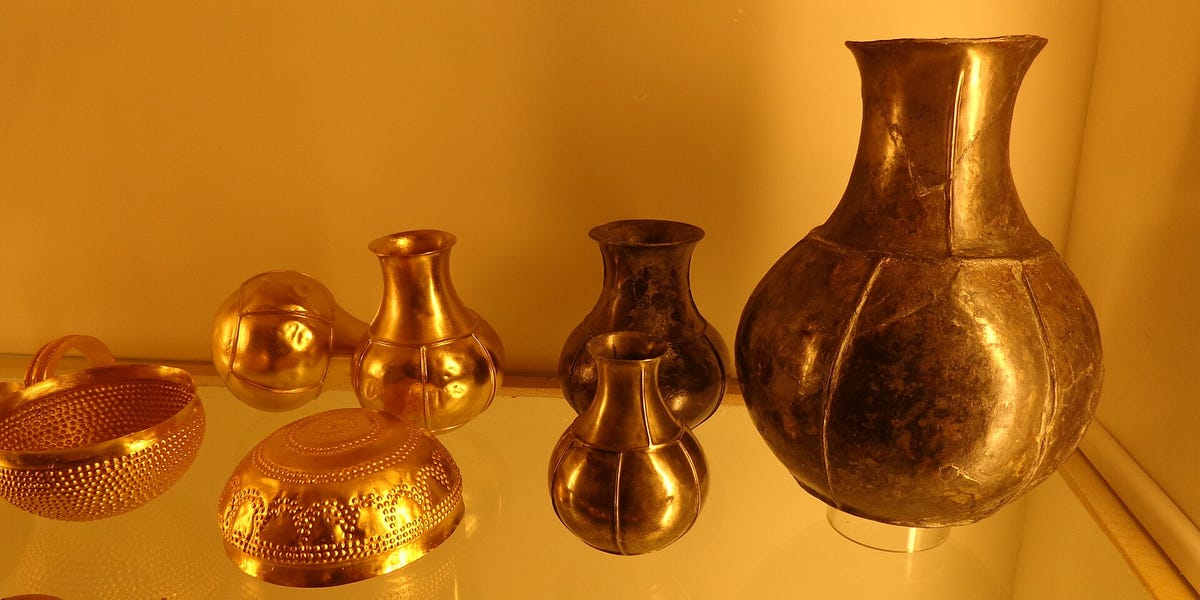
4 min readHere’s what you’ll learn when you read this story:On August 27, 2026, thieves in Spain made off with the golden hoard known as the Treasure of Villena, which is approximately 3,000 years old.The same day, a diamond and platinum Van Cleef & Arpels necklace that once belonged to Egypt’s Queen Nazli was snatched during another robbery in Vienna.Whether these robberies are related is unknown, and no suspects have yet been identified, but investigations are ongoing.Nearly two million dollars in ancient gold artifacts—vessels, bowls, and bracelets made by a mysterious Bronze Age people—and a platinum necklace set with 673 diamonds (and worth about $4 million) have recently gone missing from museums in Spain and Vienna. And though the thefts are shocking in and of themselves, the ease with which the thieves swiped them from their display cases may be even more disturbing.The discovery of the Treasure of Villena is credited to Spanish archaeologist José María Soler. When, in 1963, construction about eight miles from Villena, Spain, unearthed a heavy metal bracelet from the gravel and sand of the desiccated stream bed known as the Rambla del Panadero, worker originally thought it was scrap metal from a truck engine, and it spent weeks sitting out in the open on a construction site. Nobody came to claim it, so one of the laborers eventually took it home, and his wife carried it to a jeweler she knew on Calle Mayor in Villena.The jeweler, Carlos Miguel Esquembre Alonso, immediately realized that the object was valuable, and telephoned Soler the same evening. Because the bracelet had traveled into town inside a load of gravel, Soler first had to trace the load back to the spot it came from, which took five weeks of interviews with truckers and laborers. Soler’s eventual excavation revealed a ceramic vessel containing an entire cache of Late Bronze Age objects made mostly of gold. Evidently, 3,000 years ago, someone had buried a hoard of bowls with intricate raised patterns, elegantly curved bottles for pouring libations, and bracelets that would have gleamed on wealthy arms. Among them were also some pieces made of silver and amber.The find was a triumph of weeks of hard work and dedication. The theft took under four minutes.The alarm at the Villena Museum sounded at 5:20 a.m. on August 27, 2026, four minutes after a false alarm at the town’s sports center had drawn police away. Cameras recorded images of men wearing hoods arriving at the Villena Museum in several vehicles, prying a window out of the side of the building, climbing in, and working while the alarm shrieked behind them. Breaking through the reinforced glass panel that guarded the treasure, they swiped 59 gold pieces and three crowns before escaping at 5:24 a.m. While the gold is estimated to be worth $2 million, its historical value is priceless—especially because it offers a glimpse into the lives of Bronze Age Iberians, whose unique language (unrelated to any other) has long since been lost.The irony in this heist is that the most valuable piece of the treasure was left behind—a bracelet that seemingly failed to interest thieves because it wasn’t gold. But though it seems dull in comparison, it’s actually made of iron that fell from outer space. Only two pieces in the hoard were made of meteoritic iron: this bracelet and a small hollow hemisphere, probably the finial of a scepter, that had been sheathed in gold. The thieves took that one, undoubtedly drawn by its gold sheathing. Both objects were forged in an era before iron was mined or smelted anywhere in Iberia, which means that the metal was far rarer than gold. Only royalty and those in the highest ranks of society could obtain something made of meteoritic iron, such as the dagger that accompanied young Egyptian pharaoh Tutankhamun to his tomb.The piece taken in Vienna had a royal history as well, though its owner was modern: Nazli of Egypt, who was queen consort from 1919 to 1936. This set of unmasked thieves operated in plain sight. On the same day the Villena gold vanished, the thieves bought tickets to the Museum of Applied Arts (MAK) like any other visitor, then casually made their way into the gallery, where they used a hammer to smash the display case holding a platinum and diamond bib necklace. Queen Nazli of Egypt had commissioned legendary jewelers Van Cleef & Arpels (known for their iconic alhambra motifs) to create it and a matching tiara for the 1939 wedding of her eldest daughter. The necklace glitters with hundreds of brilliant- and baguette-cut diamonds in an Art Deco design that vaguely echoes geometric motifs seen throughout ancient Egypt.Queen Nazli was the second wife of Sultan Fuad I, and when his title was changed to King, she became queen consort and remained so until his death in 1936. She eventually auctioned off her most valuable pieces of jewelry through Sotheby’s in the 1970s (after being disowned by her son, King Farouk, because of religious tensions), which included stunning tiaras and other statement pieces that are now worth millions upon millions. Her great-granddaughter, Fawzia Farouk, posted on Facebook “with profound sorrow” regarding the theft of the necklace, calling it “an irreplaceable part of our family’s history and of Egypt’s cultural heritage” and “a precious testament to an era of elegance, artistry, and vision, whose significance extends far beyond personal interests.”It’s possible that both of these heists were inspired by the infamous Louvre break-in from 2025, when four thieves raised a truck-mounted lift to a second-floor window, cut open two cases in the Apollo Gallery, and left with eight pieces of the French Crown Jewels worth nearly $100 million. They did it in the morning, with the museum open, in under eight minutes. Rising museum thefts are now a concern to Europol, who published a recent report investigating changes in what thieves are looking for and how they operate.Elizabeth Rayne is a creature who writes. Her work has appeared in Popular Mechanics, Ars Technica, SYFY WIRE, Space.com, Live Science, Den of Geek, Forbidden Futures and Collective Tales. She lurks right outside New York City with her parrot, Lestat. When not writing, she can be found drawing, playing the piano or shapeshifting.
Priceless Treasures Were Stolen from Two Museums in Two Countries on the Same Day
Full Article
Original Source
Read the full article at Popularmechanics →KhanList aggregates and links to publicly available news content. We do not host full articles from third-party sources. Always verify important information with original sources.