
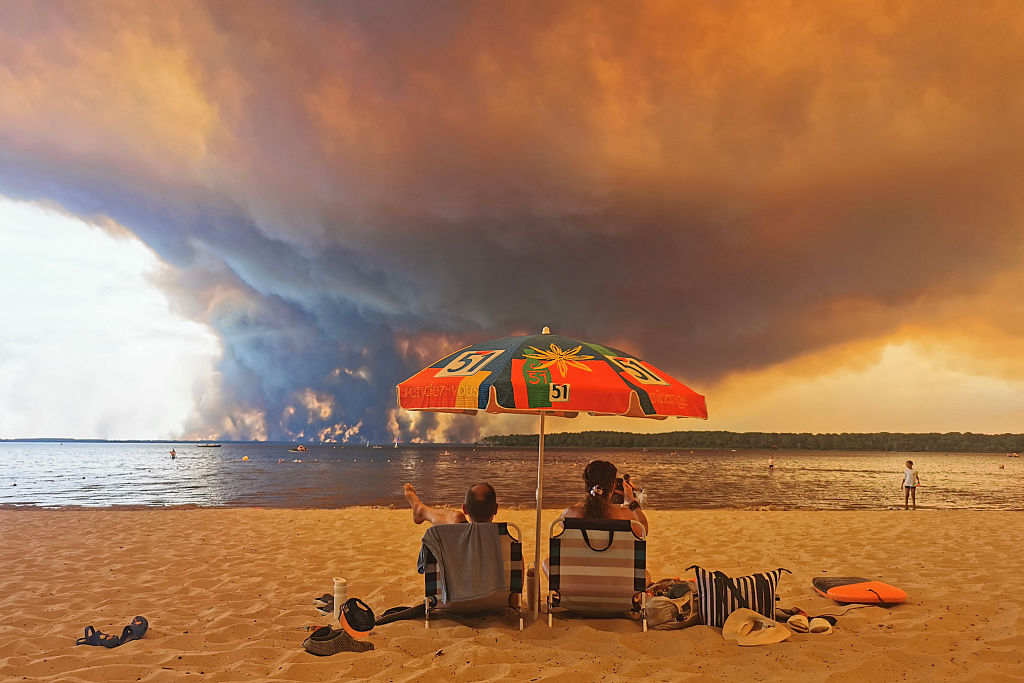
Culture The conflagrations in France provide an occasion for deciding what is actually valuable. All four of my grandparents were refugees, fleeing real persecution and the prospect of death. My mother was a refugee, and her sister was a refugee twice in her life by the age of 42. I, however, have never faced any danger (give or take a serious illness or two) that I did not court voluntarily. Sometimes I feel a little guilty at my own good fortune by comparison with that of my immediate ancestors. Recently, however, I experienced a very faint echo of what it is to be a refugee. A serious forest fire broke out not far from my house in France, emitting smoke of many colors that went high in the sky, made the eyes water, and could be felt at the back of the throat even at a considerable distance. In fact, there was more than one fire, almost certainly the work of a fire-setter or of a band of fire-setters. The temperatures have ranged from the mid-90s to 107 for several months, with hardly a cloud or a drop of rain: perfect weather for a little bit of arson. People we know and have lunch with every week, who live two kilometers away from us as the crow flies and 17 kilometers as the car drives on the mountain road, received the order to evacuate, and their house was sprayed from the air with fire retardant by one of the 10 aircraft that, together with the 300 firemen, put the fire out after a day and a half. Our friends were taken to a village hall, where, with the other evacuees, they were given a meal of pasta and then, with the others, dispersed to those who would take them in. The call to evacuate never came to us, nor was our house sprayed, but we made a bag ready just in case, for when the gendarmes arrive with the order to evacuate, they mean at this very moment, not in five or 10 minutes; nor can you take more than you can carry with you. We even turned the car round in the right direction to be able to leave as rapidly as possible. We reacted like refugees—real ones, I mean, not economic migrants. What were the contents of the bag that we prepared? This surely would be an indication of the essentials of modern life. We took passports, credit cards, driving licenses, car registration papers, keys to another property, pill boxes, makeup (in the case of my wife), a sponge bag, a change of clothes, a bottle of water, telephones and telephone chargers, two computers, and an iPad. I rushed to my library of about 15,000 books and picked out two not-very-large volumes that were nonetheless valuable and would, if sold, keep us from destitution for a couple of weeks. It was not that I was especially fond of them; it was just that they were of high value per cubic centimeter. I was prey to strange thoughts and emotions. My library, for example, is in effect an autobiography that only I can read. There is evidence in it of serial obsessions, of subjects or countries that have occupied my mind long enough to accumulate a significant number of books about them. To anyone else, they would seem the strange melange of an undisciplined mind. I have lived a dialectic between life and books for many years, and the latter became, not surprisingly, very precious to me. Yet strangely enough, what I once valued so highly has, of latter years, become something of a burden to me, even a millstone round my neck. This is true of my possessions in general. (I do not claim any originality in these developments.) They were once a token of tolerable success, or at least of an absence of complete failure. But now they limit my options. To whom, for example, does one give 15,000 books? Most people don’t have the space for them and wouldn’t want them if they had. Most are not worth much. and those that are worth something are indistinguishable from the others except to bibliomanes like me, who are fewer and fewer. No one will ever comb them for those that are valuable. Our consumer society has become so abundant that there are many things that you cannot even give away: Charities, for example, won’t accept them, though poverty is supposed to be widespread. Electrical goods that would have astonished Louis XIV have to be thrown away because they might be defective and no one wants to be responsible for having passed them on to and thereby electrocuted the recipients. Better an immense amount of waste than one electric shock; besides, industry, even if it be in another country such as China, has to be stimulated somehow by a demand for the new. The anarchist Bakunin said that the destructive urge was also constructive, but we say that disposal of the still-functioning is also productive. Satisfaction with what we have, if it became widespread, would be the end of prosperity, an utter economic disaster. Waste not, want not, said our ancestors not so very long ago. But we say, waste not, impoverish the world. Subscribe Today Get daily emails in your inbox I faced the approach of the fire with a calm that surprised me. I envisaged my house being burnt down, particularly the possessions in it, leaving nothing but charcoal and ruins. This would, in some way, simplify my life, once the inevitable subsequent bureaucratic processes were over. No more insurance of valuables! No more multilever locks! No more video installations as a precondition of insurance! No more roof repairs! No more upkeep! I am not so rich, and never will be, that I can pay someone to perform all the boring mundane tasks of life for me. I recognize, of course, that my position is not universal. I have somewhere else to go if needed. In fact, no fire can render me destitute; only government policy can do that, and in Britain, at least, the government is making a good fist of doing it: for destitution is the wealth of the welfare state. Paupers, apparatchiks, and nomenklatura: such is the utopia of many politicians. Still, one can become a prisoner of, even a slave to, one’s private possessions; and, like many a condition of servitude, it is difficult to escape, if the need should ever be, or if, in age, one desires to escape it.
Preparing for the Fire
Full Article
Original Source
Read the full article at Theamericanconservative →KhanList aggregates and links to publicly available news content. We do not host full articles from third-party sources. Always verify important information with original sources.