
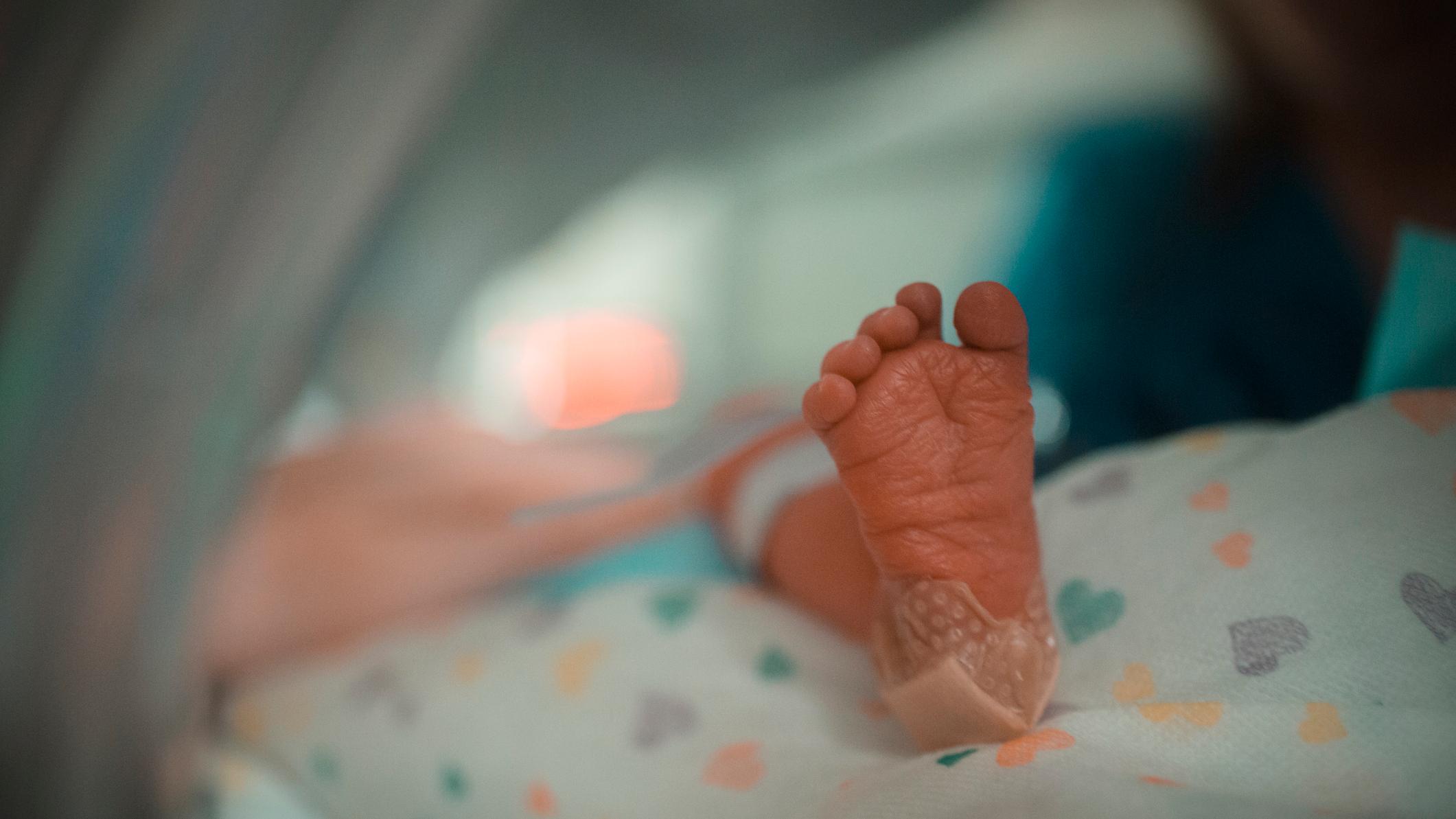
What followed that day is a blurry haze. When I try to remember specifics, it plays in my mind like quick cuts in a television show: A kind resident swabbing my cervix calmly, but then returning to the triage room with a larger group of doctors, all with somber faces. A fast transfer to a labor and delivery room. A steroid shot for my baby’s lungs and a magnesium drip for his brain; IV antibiotics and a fetal monitor. Our son, holding on. We made it to 24 hours after my water broke without delivering—a critical milestone, we were told—before I was transferred to the antepartum wing. We met with the NICU team, who prepared us for what delivering a 26-week-and-4-day baby would look like. He was measuring just under two pounds at that point. “That’s a big baby for us,” the team shared. Somehow, it wasn’t reassuring. I learned quickly that preterm premature rupture of membranes (PPROM) affects only 2% to 3% of pregnancies, and most women who experience it deliver within the first week, with more than 50% in the first 72 hours. But the closer to 34 weeks I could get him, the better off his chances would be. Best-case scenario, I was staring down an eight-week hospital stay.There was nothing funny about the situation—except when, perhaps as a result of the years I spent making comedic television and stand-up specials, I found there was.A hospital volunteer brought in flowers, said “congratulations,” then panicked when she realized there wasn’t a baby in the room. That happened four more times. I could only think about how the repetition was so specific and messed up that the only other setting it could happen in would be in a dark comedy. Though I was stuck in the hospital, I wasn’t on bed rest—so I walked. I would often encounter a nun as I turned a corner. Why did I keep running into her? Was I imagining her? Did she know I was Jewish? It became a running gag in my mind—beats I might read in a script. The experience turned my idea of trauma upside down. Before then, I felt sympathy for people who experienced it. I intellectually understood that people did whatever they needed to survive and heal. But trauma, I thought, simply wasn’t for me. Not because I was better than anyone else, but because I was lucky. I believed this so wholeheartedly that when facing this textbook traumatic experience and found myself laughing at the circumstances, I didn’t immediately understand what was happening. If I was living in a dark comedy, it couldn't really be traumatic, right? The blur of birthWhatever this was, trauma or not, a new routine began because it had to. Vitals and meds every six hours and an unchanging series of questions: “How’s your pain? Any changes to the fluid? Feeling baby move? Any bleeding?” Three times I had what we thought was true labor; three times my doctors were able to stop it. My 2-year-old daughter began to visit—the only thing that scared her was the hospital bed when it moved—and my husband Drew began to sleep at home some nights. I was unable to imagine staying any longer in the hospital but scared to wish this would all end. Then, at 29 weeks, the blur of quick cuts started again. This time, they can’t stop my labor. I stare up at the bare white ceiling in the delivery room, with a feeling greater than fear. The epidural stops working; the magnesium drip for my baby’s brain slows labor; pitocin can’t be used when delivering a preemie. Still, there are moments of humor amid the dread: Drew finds a cheese plate in the communal fridge and weighs eating it, before opting for sad cafeteria sush“You better not get food poisoning today,” I say. Pushing is the easy part. My son flies out in 15 minutes. A moment of piercing silence. Was it a second? More? I’m not sure, but then he cries on his own. My eyes scrunch shut, afraid to look. When I open them, he is already in a transport blanket to keep him warm. Bloody and tiny, but there in front of me, for a second or two. Then the neonatologist takes him, and her team follows. So does Drew. My doctor stitches me up herself. Barely a scratch, she says—the perk of pushing out a 2-lb.-15-oz. baby. She tends to me with patience and compassion, but she can’t stay with me forever. The nurse also has other patients. He brings me a cheese plate. It’s the one Drew almost ate hours before. The cheese is supposed to be for celebrating parents to enjoy during their golden hour with their baby. I eat mine alone. “I am OK,” I tell myself, trying not to let the tears fall. I worry if they start, they won’t stop. Plus, I have cheese to distract me. We wait for two hours before the nurse wheels me through the winding hallways to the NICU. I push up out of the wheelchair and lean over the plastic incubator, or isolette. There isn’t much comedy here. Maybe this is the part of the season that gets particularly dark. Those shows are the ones that win awards, I tell myself. The first words I say to my son are “I’m sorry.” We pass our hands through openings in the isolette and touch his teeny fingers. His face is so obstructed by his CPAP that I won’t even know he has a full head of hair until a few days later. We won’t be able to hold him for three days. There isn’t much for us to do now for him. We name him Leo, something strong to celebrate the fighter he was from the moment he was born. Our lion. Two days later, we leave the hospital without him. A nun in the NICUThe elevator doors open on the third floor, exposing the wash station and security desk. I scrub in, putting the soap and water all the way up to my elbows like a doctor going into surgery. I hate looking at my arms. I see the marks from all the IVs. I cross the room, placing my phone into a clean, clear bag to prevent germs, and am buzzed through by security.The double doors to the NICU open slowly, revealing a cacophony of scents and sounds. The monitors ding constantly, cutting the silence of the halls. The squeak-buzz of the hand-sanitizer dispenser, the pulling of a curtain as it closes, the soft bubbling of a CPAP machine. Every sound comes with a glance: to your baby, to the monitor. You learn the alarms. Which beep belongs to your baby, which beep is your neighbor, what to look for if the beep gets louder or longer. Is it a benign deceleration or a brady? Does the CPAP percentage need increasing? Changing your baby’s diaper, then eventually clothes, while disconnecting, reconnecting, and rearranging his leads, pulse ox, and nasal cannula. Time passes in a strange, peculiar dance that becomes our new normal. Touching your baby on a schedule, you learn to live by the NICU clock. I sit in the chair next to his isolette and play music for him, watching his arms and legs move through the air in slow motion. I know those movements. I recognize their patterns as what I felt against my stomach, the sensation taken away from me far too soon. The music and my thoughts try their hardest to muffle the codes I hear from the other babies in his pod, those born even earlier than 29 weeks or with greater complications. Days become weeks, and Leo progresses.In what’s referred to in comedy as a “callback,” I became friends with the nun. She is real, and as it turns out, she visits the babies in the NICU every single day. We are not of the same faith. I am not even religious, but she radiates kindness, and I let her warmth wash over me. She blesses Leo every day. It makes me feel happy. Things happen slowly and then all at once. Leo goes from an isolette to room air, a feeding tube to learning how to drink from a bottle, then from needing extra oxygen during and after his bottles to not needing any extra support at all. Spring turns to early summer, and we are told he could go home in a matter of days, not weeks. My friends and I start a discharge pool. The first time they took off his leads and pulse oximeter, I was so scared. Even now, knowing they wouldn’t let us leave here unless they were sure he was ready, to take the leap of faith without the monitors to guide me feels surreal. Coming homeOn one beastly hot summer day, I glance at the baby monitor and catch Leo’s eyes open. He is swaddled tightly in his bassinet in his nursery. He doesn’t cry. Over the next 10 minutes, I watch him soothe and settle himself and fall back to sleep. Impressive for a baby his age, but it fills me with profound sadness. He must have learned this from the NICU. A fetus that grew outside my body for the final 11 weeks of pregnancy; 55 days filled with moments when Drew or I couldn’t be there. Sometimes I feel angry. I hate that this happened to us, and I can’t laugh that away. At what point did he realize that no one was coming? Is that something babies his age can even comprehend? Rationally, I know that his nurses were wonderful and he won’t remember being alone. But I will. For months we lived our life in tiny increments of progress. Then, suddenly, it’s fall. Leo smiles and laughs and rolls and is, dare I say, chunky. But every sneeze, every bottle he doesn’t finish, brings a wave of panic. What if he has to go back there? I’m learning that his development isn’t linear, and I'm frustrated a lot of the time trying to figure out how best to help him. More than that, I struggle with reconciling being one of the lucky ones to come out of the NICU with feeling so different from all of my friends with “normal” pregnancy and postpartum experiences. My social media algorithm has transformed into a flood of strangers’ NICU journeys. I identify with moments here and there, but everyone copes and shares differently. And no parent that I’ve seen has talked about anything funny they encountered in a NICU. But as weird as it feels, laughing has been my go-to way to process a trauma I may never fully understand. Maybe it’s a start.
Premature Birth Taught Me the Dark Comedy of Trauma
Full Article
Original Source
Read the full article at Time →KhanList aggregates and links to publicly available news content. We do not host full articles from third-party sources. Always verify important information with original sources.