
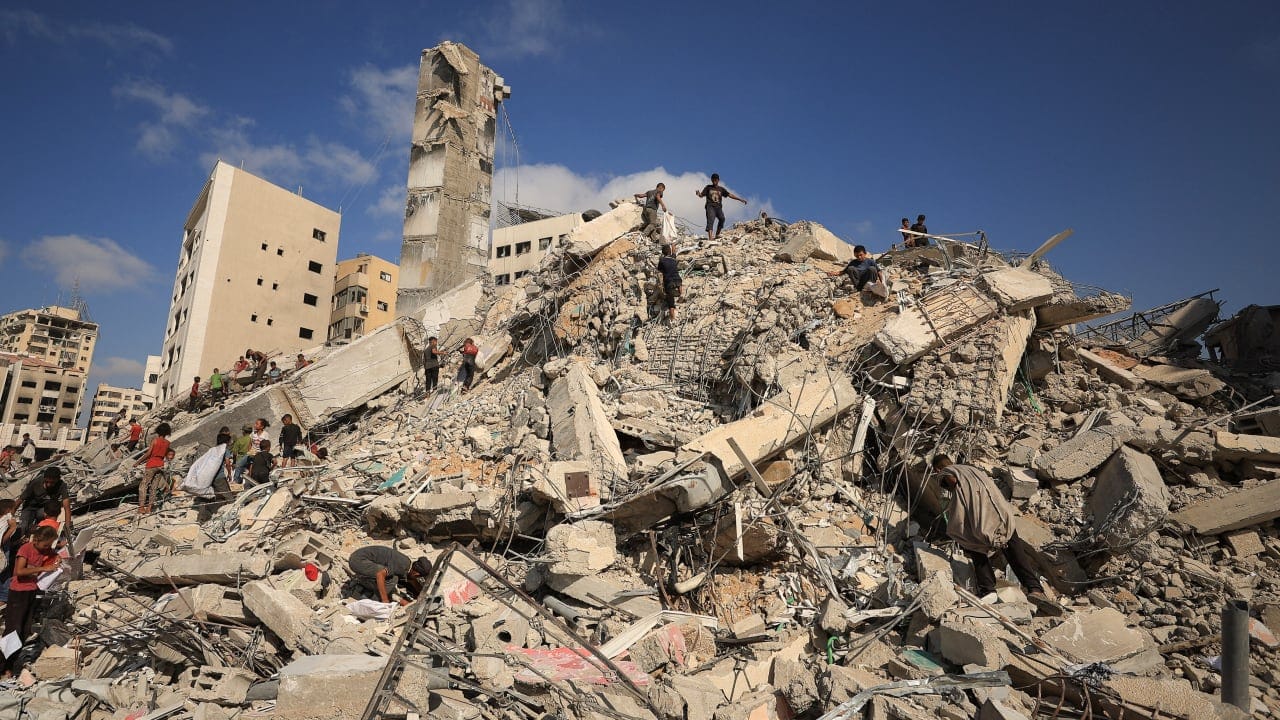
OCTOBER 17, 2026 16:06In late September, Gaza’s Hamas-run Health Ministry published its 2025 mortality report, the first since the war began to purport to count every death in Gaza.Of 24,650 deaths, it attributed 17,286 to “war operations,” without separating combatants from civilians, and 1,584 to accidents. Independent analyst Eirik Schrøder-Bråtane calculated that the remaining 5,780 nonviolent deaths roughly matched Gaza’s prewar annual nonviolent toll. The ministry also recorded 50,227 births.This was 2025: the year Israel halted aid for 11 weeks after Hamas refused to extend the truce and release more hostages, following a six-week ceasefire during which 25,200 trucks delivered nearly 450,000 tons of aid. Israel said Hamas was seizing and selling supplies to finance its war. By September, Israel counted over two million tons delivered during the war.It was also the year UN officials warned of babies dying by the thousands and the IPC, the UN-backed hunger monitor, declared famine in Gaza City.Yet the ministry’s own figures show nothing resembling the mass-mortality footprint those warnings suggested: no surge in nonviolent deaths from hunger, disease, or other indirect causes.A PALESTINIAN WOMAN flees with her triplet children from the area of Shifa Hospital, moving southward in the Gaza Strip, last week. (credit: REUTERS/Ramadan Abed)Andrew Fox, a former British Army officer and senior fellow at the Henry Jackson Society, argued in 2024 that Gaza’s war toll was being padded with natural deaths. Now, he wrote, the famine allegations and other claims had been “debunked by Hamas’s own numbers.” The modelers who predicted hundreds of thousands of deaths, he added, “should lose their careers.”Then he said: “They won’t. They’ll get a free pass.”That may be the safest prediction anyone has made about this war.For years, Israel’s accusers have issued confident predictions of mass death and confident counts of massacres. The headlines circle the globe. When the predictions fail, or the numbers collapse, the correction barely travels at all.On May 20, 2025, the UN’s humanitarian chief, Tom Fletcher, told BBC Radio 4 that 14,000 babies in Gaza “will die in the next 48 hours” unless aid reached them. Within a day, the UN clarified that the figure meant roughly 14,100 projected cases of severe acute malnutrition among young children under age 5.Not deaths. Not babies. Not 48 hours.The report does show deterioration: infant mortality of 15.8 per 1,000 live births and under-five mortality of 33.4, both worse than before the war. But in the year of the UN’s warnings, Gaza’s infant mortality roughly matched Egypt’s peacetime rate of 16.1, and both its rates sat below the global average. Worse, yes. Mass death, no.In February 2024, researchers at the London School of Hygiene and Tropical Medicine and Johns Hopkins projected as many as 85,750 excess deaths in Gaza over six months in a worst-case scenario of escalating war and epidemic disease. Activist outlets ran headlines like “Israel Could Kill 85,000 More Gazans in 6 Months,” and a lead author told US news program Democracy Now! that the escalation scenario was “currently what’s happening in Rafah.” That epidemic never came.In Sudan’s largely forgotten war, the same London School found the dead going uncounted: some 26,000 violent deaths in Khartoum State alone in the first 14 months, more than monitors had recorded for the entire country, and over 61,000 deaths from all causes.In Gaza, the alarm far outran the dead. In Sudan, the dead outran the alarm.In March 2024, the IPC projected famine in northern Gaza by the end of May if fighting and severe aid restrictions continued. By June, its own Famine Review Committee found the evidence did not indicate famine.The IPC declared famine in the Gaza Governorate in August 2025, over Israel’s objections to its methodology. Somalia’s 2010-2012 famine killed an estimated 258,000 people, including 133,000 children under five. At its peak, it killed about 30,000 people a month.Incentive to inflate numbersGaza’s Health Ministry, an arm of Hamas with every incentive to inflate, reported 455 malnutrition deaths across nearly two years of war, fewer than Somalia’s famine killed in half a day at its height.By the IPC’s own threshold, two deaths per 10,000 people a day, the declared famine should have killed about 9,000. Hamas’s own ministry counted fewer than 200, across all of Gaza, fewer than the US records in four days.Rafah followed a familiar pattern. Before Israel entered the city in May 2024, the Palestinian Authority’s Foreign Ministry warned an assault would bring “the annihilation of about 1.5 million Palestinians.” The EU’s then-foreign-policy chief, Josep Borrell, scoffed at evacuating civilians: “Where? To the moon?” Within three weeks, about a million people had evacuated Rafah. There was no annihilation and no apology.The pattern is older than this war, and it only ever runs in one direction.In April 2002, during Israel’s operation in Jenin, PA negotiator Saeb Erekat told CNN that Israeli troops had killed more than 500 people. The UN secretary-general’s own report later counted 52 Palestinians dead, at least half of them terrorists, along with 23 Israeli soldiers, and found the 500 figure unsubstantiated. By then, the “Jenin massacre” had entered the world’s vocabulary.Operation Cast Lead followed the same arc. Hamas initially acknowledged fewer than 50 dead combatants. The since-discredited 2009 Goldstone Report cited a Palestinian Centre for Human Rights tally identifying just 236 of the dead as combatants. Then, in November 2010, Hamas interior minister Fathi Hammad acknowledged that up to 700 men from Hamas’s military wing and security forces had been killed, close to Israel’s count of 709.Abroad, the dead were nearly all civilians. At home, they were Hamas martyrs.On October 17, 2023, Hamas’s health authorities instantly blamed Israel for the Ahli hospital explosion and reported nearly 500 dead. American, British, French, and Canadian intelligence assessments concluded that a misfired Palestinian rocket was the likely cause; US intelligence put the toll at a fraction of the ministry’s tally. The New York Times later conceded that its early coverage had relied too heavily on Hamas’s claims.The progressive Left, which prides itself on following the science, rarely asks why so many catastrophic predictions and claims about Israel fail. A growing faction of the populist Right, the so-called “woke Right,” recycles Hamas figures and UN forecasts it would ridicule on any other subject.The method works because the claims and predictions do their work before they can be tested. Put Israel in the dock. Push for sanctions or an arms embargo. Pressure Israel, but not those sworn to its destruction. By the time the evidence arrives, the damage is done.Tom Fletcher still runs the UN’s humanitarian office. The IPC has not retracted its 2025 famine declaration. Newsrooms still headline the forecasts and bury the accounting.In most fields, predictions this consequential would at least produce an audit. When the subject is Israel, they produce the next failed prediction.The writer is an attorney, former IDF soldier, and former NYPD officer. He writes widely on Israel, Zionism, antisemitism, and Jewish history. He serves on the board of Herut North America.Follow us on Google
Predictions of Gaza’s death toll were wrong - why is no one being held accountable? - opinion
Full Article
Original Source
Read the full article at Jpost →KhanList aggregates and links to publicly available news content. We do not host full articles from third-party sources. Always verify important information with original sources.