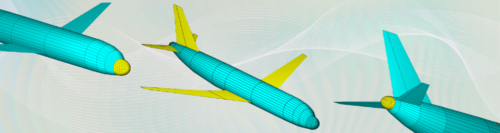
Download this complimentary White Paper today! This White Paper shows engineers and researchers how to predict, by simulation, the coupling between antennas mounted on electrically large platforms such as an airliner — and how to keep the results accurate even when the coupling is as low as -100 dB. What you will learn about: Why platform size and coupling strength are two separate problems, and why the antenna pairs hidden from each other are the demanding case. How higher-order basis functions allow patches up to 2λ in size, reducing the number of unknowns compared with conventional low-order triangular meshing — and why the cubic cost of a direct solve makes every unknown you avoid pay back many times over. Why every numerical model of a closed metal platform behaves like a cavity, and how the spurious fields trapped inside it, not the platform itself, spoil low-level results. How to treat the reference frequency as a convergence test, so you can see when a coupling result has settled instead of assuming it. How absorbing material and air-filled ‘bubbles’ suppress spurious fields, allowing accurate low-level coupling results with fewer unknowns. Click “LOOK INSIDE” to Download Now. IEEE Spectrum and Wiley are proud to bring you this white paper, sponsored by WIPL‑D. More Information Aircraft, ships and vehicles now carry many radio systems in a small space, so designers must know how much energy leaks from one antenna into another before any hardware is built. This leakage is described by the mutual s-parameters between the antenna ports, and it decides whether two systems can operate at the same time on the same platform. Measuring it by trial and error at every candidate position is slow and costly. Predicting it by simulation is difficult for two reasons. First, the platform is electrically large, which means that its dimensions span several hundreds of wavelengths, so the model needs a large number of unknowns. Second, the coupling levels of interest are very low, in some cases down to -100 dB, which leaves little margin for numerical error. This White Paper addresses both problems with a full-wave solution based on the Method of Moments applied to the Surface Integral Equation, using higher-order basis functions to keep the number of unknowns low. Two examples are studied in detail: a metallic cube carrying two quarter-wavelength monopoles, and a realistic airliner carrying five monopoles at 1.06 GHz, where the fuselage is about 140 λ long. Three modelling techniques for obtaining accurate low-level results are compared in terms of accuracy and the number of unknowns each one requires, and the complete geometry of each model is documented so that every result can be checked independently.
Predict Antenna Coupling on Electrically Large Platforms Before Building Hardware
Full Article
Original Source
Read the full article at Content →KhanList aggregates and links to publicly available news content. We do not host full articles from third-party sources. Always verify important information with original sources.