
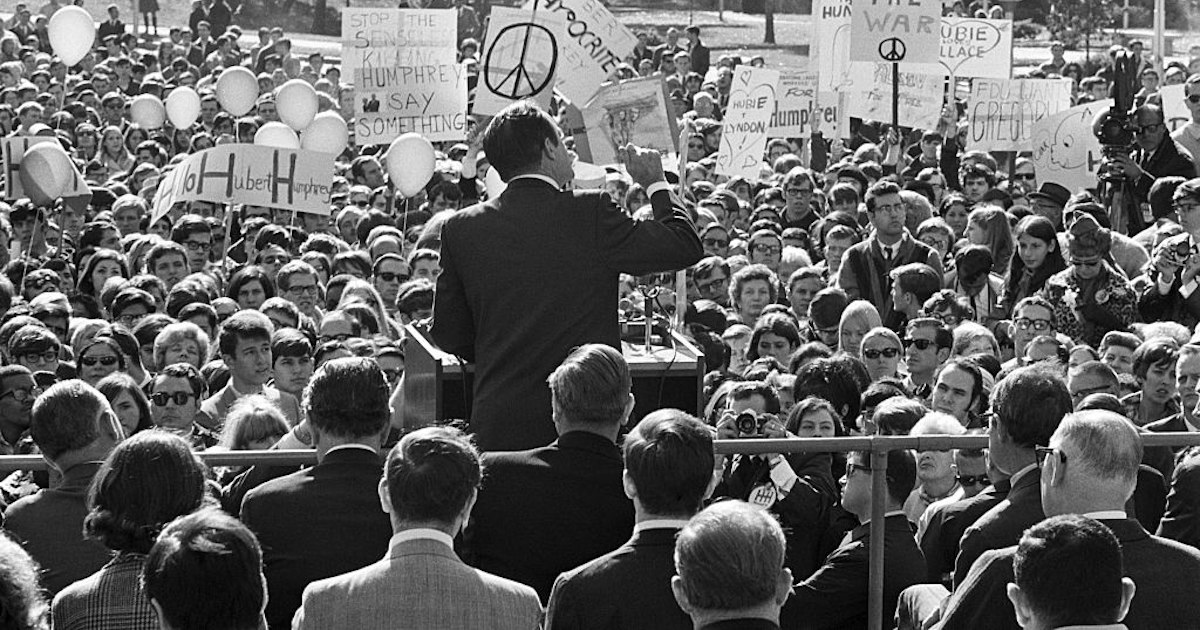
History The midterms were hard on the GOP, but all is not lost. The vice president is in a difficult spot. His boss, the president, has led the country into an unpopular foreign war. And while nobody thinks the VP ever really supported the decision, as the number two in the White House, he has taken hits. In addition, since the incumbent party has been dominant for so long, popular grievances on a variety of issues have accumulated—and voters have lashed out. No wonder the presidential party suffered a drubbing in the midterms. Since the president himself won’t be running again, the veep is seen as the frontrunner for his party’s nomination in two years. Yet the fear (and for others, the hope) is that POTUS and his unpopular war have poisoned the chalice for any would-be successor. This could be a sketch of Vice President J.D. Vance’s situation—many would say, his predicament. Yet actually, this outlines Vice President Hubert Humphrey’s situation in the 1960s. And we can learn from what happened to him then. Like Vance, Humphrey was a senator from the Midwest, focused on domestic issues. After auditioning other hopefuls, President Lyndon B. Johnson tapped Humphrey as his running mate in the 1964 presidential election. In that election, Johnson campaigned as the peace candidate. In his notoriously effective “Daisy” ad, he hinted that his Republican opponent, Barry Goldwater, was a nuclear warmonger. And as for the question of war in Southeast Asia—the country of South Vietnam then being under siege from communist forces—LBJ suggested he would show restraint. “We are not about to send American boys 9 or 10,000 miles away from home,” he pledged during the campaign, “to do what Asian boys ought to be doing for themselves.” On that platform, the Johnson-Humphrey ticket won a landslide victory. Yet just a few months later, the second-term president started escalating. The Johnson administration surged U.S. troops into Vietnam, ultimately sending more than half a million GIs—tens of thousands of whom would die in what was plainly a no-win war. So at their next opportunity, voters rendered their judgment on this toxic combination of broken promises and terrible outcomes. Johnson’s Democratic Party was clobbered in the 1966 midterms, losing 47 seats in the House and 3 in the Senate. After that, the 1968 presidential election loomed. Insurgent “peacenik” Democrats were furious at Johnson (and the hapless Humphrey), while stalwart Dems were merely fearful. Humphrey was nominated in August 1968, and then was defeated by Republican Richard Nixon in November. So we can pause here for the moral of the story: Fight an unpopular war and you will get punished at the ballot box, big time. Yet of course, history being the eclectic stew that it is, there are tangy morsels and what-ifs to consider. More on them in a moment. In the real world, Humphrey lost. So is the fate of that earlier vice president a doom-y augury for the current vice president? In fact, we can add the ominous omens of other presidents and vice presidents who found themselves overseeing unpopular foreign wars: In 1950, Democrats had to face the voters in the midterms while their leader, President Harry Truman, was embroiled in the Korean War; the party lost 33 seats in Congress. Come 1952, Truman’s vice president, Alben Barkley, sought the presidential nomination, but did not get it. Which was just as well, as Democrats were avalanched in the November election, losing not only the White House, but both chambers of Congress. More recently, in 2006, Republicans had their own rendezvous with midterm misery. George W. Bush, who had first campaigned for the presidency on a promise of foreign-policy humility, not arrogance, nonetheless embarked on a war of choice in Iraq. Unsurprisingly, when this went south his party was pummeled in the ’06 midterms, losing both its House and Senate majorities. Two years later, the vice president, Dick Cheney, didn’t even think of seeking the GOP nomination. That November, from presidential candidate John McCain on down, Republicans were routed. So that’s three midterm elections—1950, 1966, 2006—in which the war party was put to flight, followed by another defeat in the presidential election two years later. And now we return to the present. 2026 was the first half of this pattern; will 2028 be the second? With antecedents in mind, the White House reporters Nancy Youssef and Jonathan Lemire wrote of Iran in the Atlantic just two days before the election: “A devastating night for Republicans on Tuesday won’t necessarily reduce the chances of a resumption of hostilities, despite the war’s political toxicity.” The authors recalled that a day after the 2006 midterm massacre, Bush fired his defense secretary, Donald Rumsfeld (n.b. Pete Hegseth)—but then doubled down on Iraq. The troop surge was a tactical success, and yet it was a strategic nothing; Republicans were rebuked in the 2008 elections, and the new president, Democrat Barack Obama, would go on to withdraw from Iraq. Bush’s victories in Mesopotamia were thus Ozymandian. So what will Trump do now in Iran? On many occasions, he has indicated second thoughts about the war, and yet he always also insists his actions were right and necessary (on November 4 he said, “I’d do it again”). And he continues to play the Israel card. Still, in the wake of the midterm debacle, he has made some changes. And while the president has said he will keep Hegseth at the Pentagon, catty observers note the infirmity of his statements—and so Hegseth is scrambling his PR jets, even as Congress ponders his impeachment. Another architect of the war, Secretary of State Marco Rubio (who doubles as White House national security adviser), avers that he’s still fully supportive of the war, even as, of course, he is happier talking about Latin America. At the same time, Vance is struggling to broker some sort of deal to edge out of the conflict. Trump seems supportive of these efforts, and yet by now we have learned that the Trump “weave” means he contains multitudes, depending on the circumstances, audience, and mood. Meanwhile, the Israeli government and American neocons are keeping up the pro-war pressure. Given Trump’s stubbornness about not ever admitting a mistake, it’s quite possible that the commander-in-chief will yield to the continued entreaties of the hawks. Eyeing all this, Democrats, soon to control Congress, must decide what to do. Almost all of them campaigned on an anti-war platform, and some will seek to block the war, impeach Hegseth, etc. Yet slyer Dems will be happy if Trump quagmires himself deeper, so they can again win big in 2028, just as the opposition did in ’52, ’68, and ’08. Yet we don’t have to be doomed to repeat the past. As Ebenezer Scrooge says in the redemptive ending of Dickens’ A Christmas Carol, “Men’s courses will foreshadow certain ends, to which, if persevered in, they must lead. But if the courses be departed from, the ends will change.” So if Republicans wish to depart from frightful courses—perhaps joined by normie Democrats, fearful of Hasan Piker–ization if the masses are further radicalized by endless wars—we might ponder another, more hopeful, precedent. In August 1982, President Ronald Reagan committed U.S. troops to a UN–sponsored peacekeeping mission in Lebanon. We acted with good globalist intentions; our Marines joined soldiers from Britain, France, and Italy. To be sure, there was little evidence that these “peacekeepers” were actually keeping the peace, but haute diplomacy is all about fig-leafy fakery. When the American people went to the polls in the November 1982 midterms, only a few Marines had been killed in the mission. The big losses—the truck bombing and other attacks that killed hundreds —came the following year, 1983. So there are sharp distinctions to be made between Reagan and the aforementioned midterm warrior presidents: Reagan intended peace all along. And critically, when the mission turned into a war, Reagan did not double down. He did not “surge.” Instead, he wisely chose to cut his losses. The last Marines evacuated from Lebanon on February 8, 1984. The alleged “crazy cowboy” proved himself to be a cool realist. Free and clear from a land war in Asia, Reagan campaigned on peace and prosperity—and won a smashing re-election victory in 1984. Will Trump learn from Reagan? The 47th president has always been a fan of the 40th; the Gipper’s portrait is prominent in the Oval Office. We’ll have to see if Trump follows the course of the Gipper—or of W and the others. In the meantime, looking ahead to 2028, Vance’s path, like Humphrey’s before him, is daunting. Yet here we can introduce variables reminding us that history may often rhyme, but it seldom repeats. Most obviously, despite it all, Humphrey nearly won in 1968. Indeed, observers have argued that if the ’68 election had been held just a few days later, Humphrey would have won, such was the Minnesotan’s home-stretch momentum. Three factors lifted that vice president. First, Humphrey had a strong base. He was, in fact, a notable leader in civil rights and domestic social welfarism, back when “welfare” was still as seen as Bismarckian stability, not dependent pathology. We can pause here to compare Humphrey to Vance: The author of Hillbilly Elegy offers his own hardscrabble vision of middle class wellbeing, closer to what Bismarck had in mind than the Great Society avant-garde of the 60s. Second, Humphrey was never a true hawk on Vietnam. Yet the question, in 1968, was whether or not Humphrey could bring himself to differ with Johnson on the war. That is, would a hypothetical President Humphrey stay in the big muddy, or get us out? Voters cared about the answer, especially as Nixon was touting “peace with honor.” Humphrey dawdled on this question, torn by loyalty to Johnson—and also fear of his wrath. Yet Humphrey was on a downbound poll train and knew it. So he told LBJ privately on September 30, 1968, that he would support a “pause” in the bombing of North Vietnam; Humphrey was happy, two days later, when the news hit the front pages. On this score, Vance is way ahead of Humphrey; he has already differed on this war. The day after the midterms, Vance issued a remarkable declaration of independence. Interestingly, Trump himself said of Vance’s statement, “I think it was fine. I thought it was good.” Admittedly, Trump thinks a lot of things, and yet amidst the infinite social media commentary, Donald Trump, Jr.’s strong support of Vance, expressed repeatedly, stands out. In fact, Trump Sr. and Vance seem now to be on the same page in the search for a settlement, in contravention of Israel’s prime minister, Benjamin Netanyahu, who, as reported by the the Times of Israel, wants more war. Third, back in 1968, the electorate was heaving and fluxing, confounding anyone’s certitudes. The voters disdained the self-damaged Democrats, and yet, with the Depression still within memory, they distrusted Republicans. In fact, there was a third choice on the ballot in all 50 states that year: George Wallace, the former governor of Alabama. Wallace had been a Democrat, albeit of the rebel-yelling kind; he developed a substantial following among anti-liberal “backlash” voters. Had Wallace not been in the race, the bulk of backlashers would have voted for Nixon, and so Wallace’s 13 percent came out of the elephant’s hide. Wallace hated Humphrey, and yet his indy candidacy almost elected him. In our volatile era, we can speculate on possible geysers and fissures. Whoever their nominee proves to be in ’28, will Republicans split over Iran? Will the bruited Never Trumper scheme to blow up the GOP prove successful? And will Democrats split: moderates vs. socialists? Subscribe Today Get daily emails in your inbox Returning from the hypothetical to the historical, we can recall that the final result in 1968 was close: Humphrey lost the popular vote by just seven-tenths of a point. By these reckonings, Republicans have grounds for optimism in 2028—if. If, that is, they can get the Iran War behind them. As this author has argued here at TAC, in July and October, from an American point of view, the war itself has been small. Yes, the political impact has been huge—Republicans won their smallest share of the vote since the Watergate midterm of 1974. And yes, too, as Sean Davis argues, there’s the flaying sense of Trump traducing his own words. And yet the warfighting has, in fact, been mostly blockading. So it’s quite a testament to the overall ignominy of this war that even though America has suffered about 1/2800 the fatalities of the Vietnam War (21 KIA in Iran, 58,220 in Vietnam), the Iran War has less support among the American people. Laura Ingraham, a lonely prudentialist amidst the imprudent war gang at Fox News, believes Republicans still hav time to save themselves from another 2008. Indeed, Republicans can learn from Scrooge: If the courses be departed from, the ends will change.
Precedents for the Vice President: Humphrey or Reagan?
Full Article
Original Source
Read the full article at Theamericanconservative →KhanList aggregates and links to publicly available news content. We do not host full articles from third-party sources. Always verify important information with original sources.