
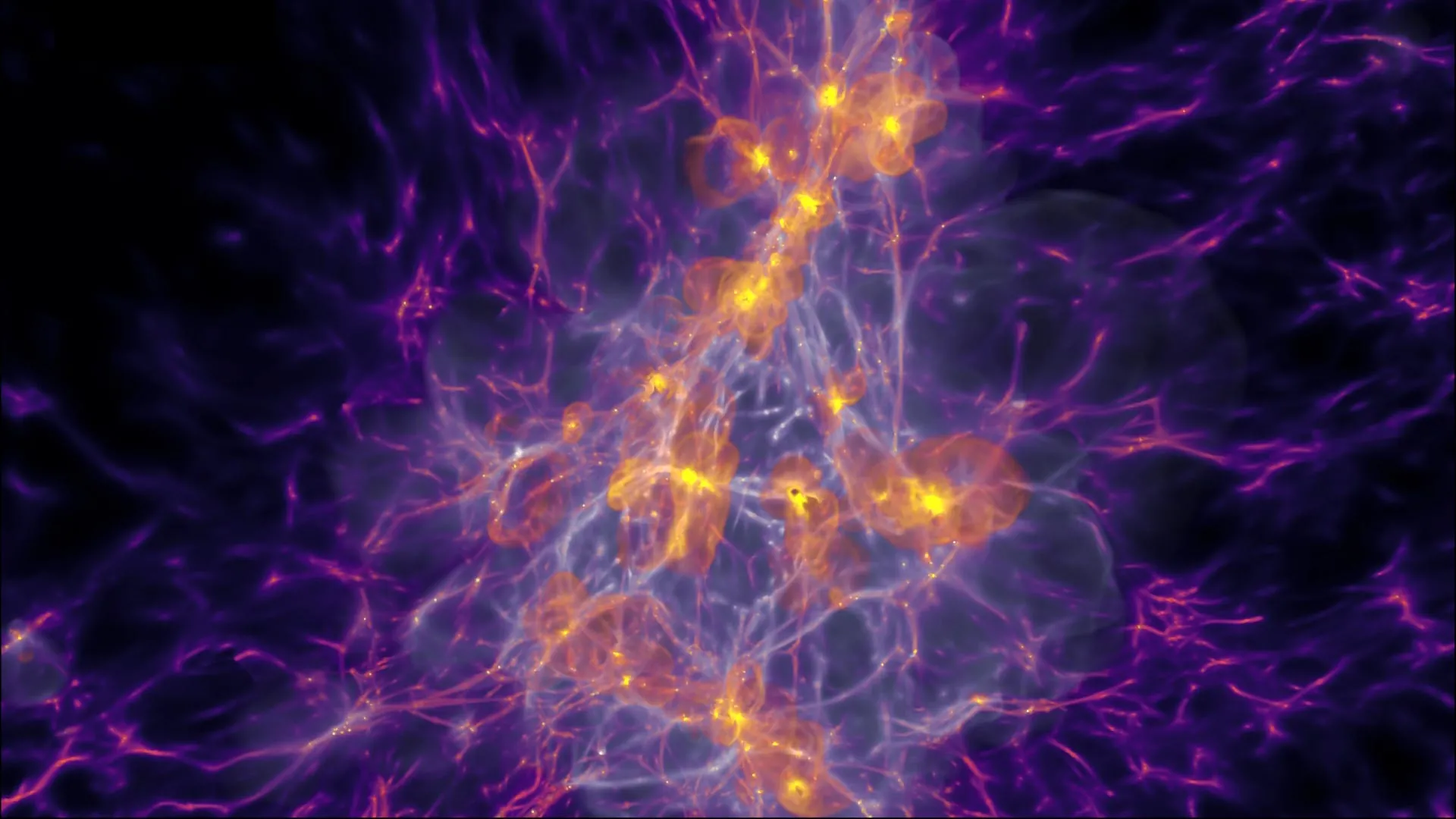
Researchers are using extraordinarily detailed computer simulations to reconstruct one of the most transformative periods in cosmic history: the era when the first stars and galaxies began to emerge. The work is part of the MEGATRON project, led by researchers at the University of Bath in the UK with collaborators at the University of Chicago in the US and the Institut d'Astrophysique de Paris in France. The project is designed to explore how the earliest stars and galaxies illuminated a previously dark Universe and began producing and dispersing the chemical elements that later became essential ingredients of planets, life, and the world around us. Four studies from MEGATRON, published in the Open Journal of Astrophysics, combine advanced cosmological simulations with detailed models of radiation, chemistry and galaxy formation. Together, they represent the collaboration's first major collection of published results, with additional studies expected in the future. Connecting JWST With Ancient Stellar Clues The findings show that researchers need to accurately model the complicated interactions among starlight, gas and newly created elements if they want to connect two different records of the early Universe. One comes from observations of young galaxies made by the James Webb Space Telescope (JWST). The other comes from chemical signatures preserved in some of the oldest stars in and around the Milky Way - the galaxy that contains our Solar System. JWST allows astronomers to directly observe galaxies from the Universe's infancy. Ancient stars provide a different kind of evidence, acting as a fossil record of events that occurred billions of years ago. By examining the chemical fingerprints inside these old stars, scientists can infer what the first stars were like and how they began enriching the cosmos with its earliest chemical elements. The MEGATRON simulations follow a young galaxy as it evolves toward becoming a system roughly comparable in mass to the Milky Way. The models simultaneously track how gas moves, how starlight travels through space and how the concentrations of different chemical elements change over time. This allows researchers to investigate how generations of stars alter the gas inside and around galaxies across billions of years of evolution. Simpler Models May Miss Important Physics The results indicate that less detailed models may underestimate how strongly stellar radiation and complex chemical processes affect the gas surrounding galaxies. By simulating these effects at exceptionally high resolution, the researchers were able to capture structures in the gas that simpler approaches can miss. That added detail could help astronomers make more accurate predictions for observations being collected now and for those planned in the future. A Direct Glimpse of the Infant Cosmos Dr. Martin Rey from the Department of Physics at the University of Bath and a lead contributor to the MEGATRON collaboration said: "The James Webb Space Telescope gives us a direct glimpse of the infant cosmos, while stellar archaeology allows us to study the relics of those earliest times in our own Galactic neighborhood. MEGATRON provides a physical bridge between the two." The simulations begin with pristine gas containing no heavy elements, reproducing conditions that existed shortly after the Big Bang. From there, the models follow the formation of the first stars, the radiation those stars release, the supernova explosions that occur at the end of their lives and the spread of newly created elements into later generations of stars and galaxies. Reconstructing this process could help answer one of astronomy's most fundamental questions: where did the elements that make up the modern Universe come from? Dr. Rey said: "The elements that make our world and life possible - carbon, oxygen, iron and many others - were forged by stars. To understand where those elements came from, we need to understand how the first stars formed and enriched their surroundings. MEGATRON allows us to test these ideas directly by comparing detailed simulations with observations from JWST and the chemical fingerprints preserved in ancient stars." Tracing the Origins of Cosmic Elements As the project moves forward, the researchers plan to use MEGATRON to make even stronger connections between theoretical models and rapidly improving astronomical observations. JWST continues to reveal new information about some of the earliest known galaxies, while large stellar surveys are producing increasingly detailed measurements of ancient stars in and around the Milky Way. Combining those two sources of evidence could give scientists a much clearer picture of the first generations of stars. Dr. Rey and his colleagues at Bath are already working on the next generation of MEGATRON simulations. The project has received 40 million processor hours on the UK's national supercomputers. That amount of computing power is equivalent to running five million laptops at the same time for an entire year. The additional resources will allow the team to build simulations with even greater resolution and more complete physical models. Researchers will then be able to make increasingly direct comparisons between their simulations, JWST observations and the chemical fossil record preserved in ancient stars. "MEGATRON provides a common physical framework for interpreting two of astronomy's most exciting new datasets: JWST's view of the earliest galaxies and the stellar fossil record," said Dr. Rey. "Together, these complementary observations allow us to test competing models of the first stars in ways that weren't previously possible." The MEGATRON project began in 2023 and is scheduled to continue through 2030.
Powerful simulations reveal how the first stars changed the universe
Full Article
Original Source
Read the full article at Sciencedaily →KhanList aggregates and links to publicly available news content. We do not host full articles from third-party sources. Always verify important information with original sources.