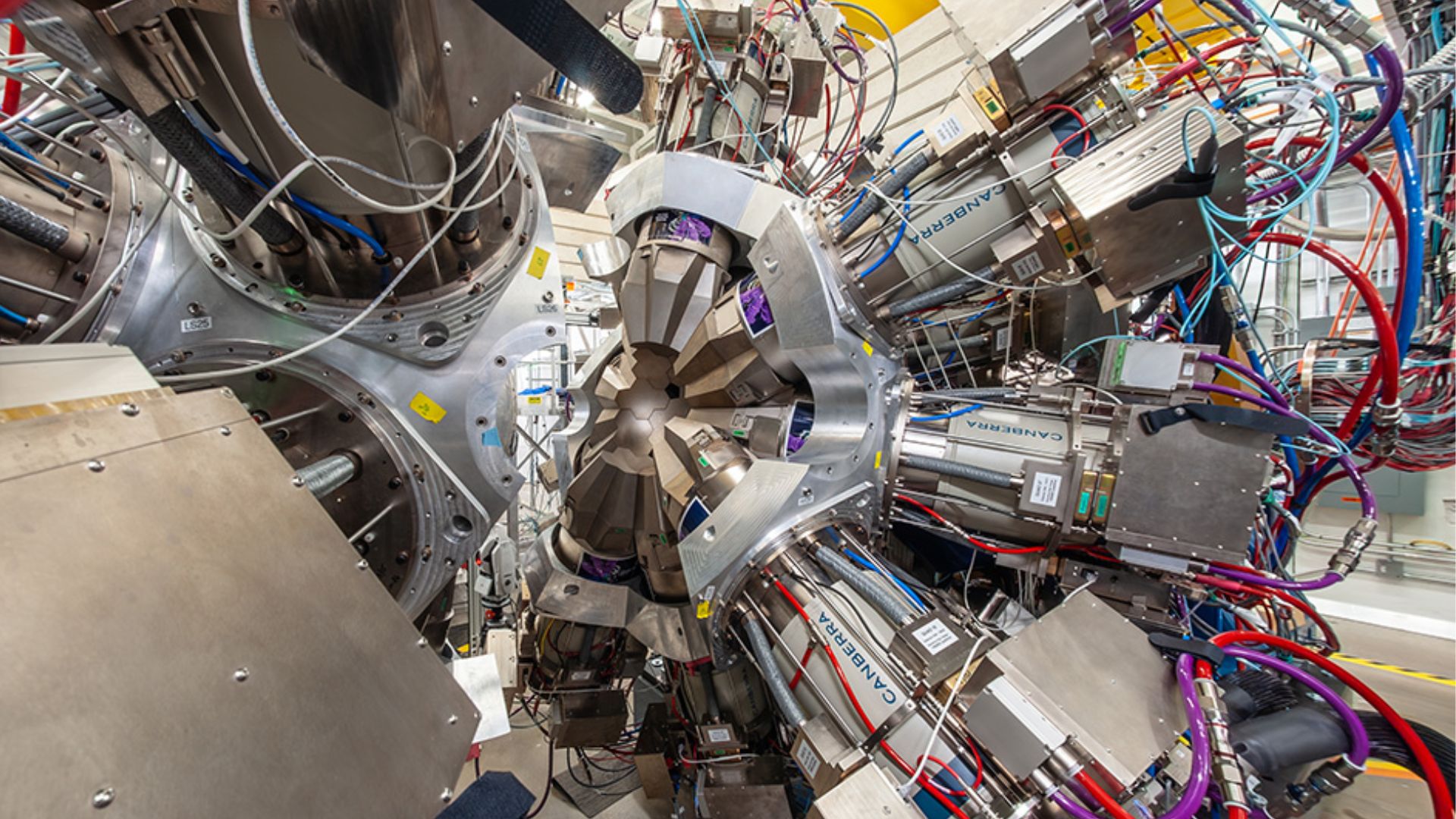
A next-generation nuclear detection system that could aid US national security efforts has logged its first operational measurements in Michigan. The Gamma-Ray Energy Tracking Array, known as GRETA, recently completed its initial characterization run at Michigan State University. Located at the Facility for Rare Isotope Beams (FRIB), the instrument met all primary performance targets during early beam testing. Physicists designed GRETA to map subatomic structures with unprecedented precision. The system detects gamma rays released when atomic nuclei collide and decay, giving researchers a direct look at the forces holding atomic cores together. Traditional gamma-ray spectrometers measure only the total energy an incoming photon deposits inside a single detector block. GRETA takes a fundamentally different technical approach. The instrument relies on high-purity germanium semiconductor crystals fitted with segmented electrical contacts. When a high-energy photon strikes the Calculating the exact three-dimensional coordinates Specialized digital acquisition hardware records these electrical pulses in real time. The system then calculates the exact three-dimensional coordinates where the photon hit the crystal. This tracking capability allows GRETA to separate faint signals from background electronic noise, a key requirement for studying rare, short-lived isotopes. Building GRETA required a multi-institution effort spanning several national laboratories. Engineers at Lawrence Berkeley National Laboratory assembled the core detector modules and tested the preliminary hardware. Collaborators from Argonne and Oak Ridge national laboratories built support subsystems and signal processing software. “During commissioning, scientists and engineers integrated GRETA at FRIB’s ReAccelerator beamline, calibrated the full array’s systems, and collected the experimental data to verify its performance,” said the researchers in a press release. To verify sensor calibration, researchers fired a beam of light nuclei into a stationary target. The resulting collisions formed excited compound nuclei that decayed through multiple gamma-ray steps. The test verified that the array’s synchronization timing and energy resolution match initial computer simulations. With characterization finished, GRETA is entering its regular operational phase as a primary instrument for FRIB users. Holding clues about subatomic physics Researchers from around the world will use the facility to study short-lived isotopes generated by heavy-ion collisions. These exotic isotopes exist for only fractions of a second, yet they hold key clues about subatomic physics. “By exploring the sensitivity of GRETA to the weakest gamma-ray transitions, we can benchmark the performance against previous gamma-ray detector arrays,” said Paul Fallon, GRETA project director and director of Berkeley Lab’s Nuclear Science Division. The precision data collected by GRETA will advance research across three major areas. First, scientists will measure stability boundaries to find out how many protons and neutrons a single nucleus can contain before breaking apart. Second, the array will track decay pathways that mirror stellar reactions, showing how heavy elements form during supernovae and neutron star collisions. Finally, engineers will log subatomic decay variances to test basic physical laws. “The measurements that scientists make with GRETA will improve the theoretical models of the atomic nucleus that underpin ongoing research in nuclear physics, astrophysics, energy, medicine, and national security,” concluded the press release. Recommended ArticlesGet the latest in engineering, tech, space & science - delivered daily to your inbox.An active and versatile journalist and news editor. He has covered regular and breaking news for several leading publications and news media, including The Hindu, Economic Times, Tomorrow Makers, and many more. Aman holds expertise in politics, travel, and tech news, especially in AI, advanced algorithms, and blockchain, with a strong curiosity about all things that fall under science and tech.
Powerful nuclear detector takes first beam, supporting critical US security missions
Full Article
Original Source
Read the full article at Interestingengineering →KhanList aggregates and links to publicly available news content. We do not host full articles from third-party sources. Always verify important information with original sources.