
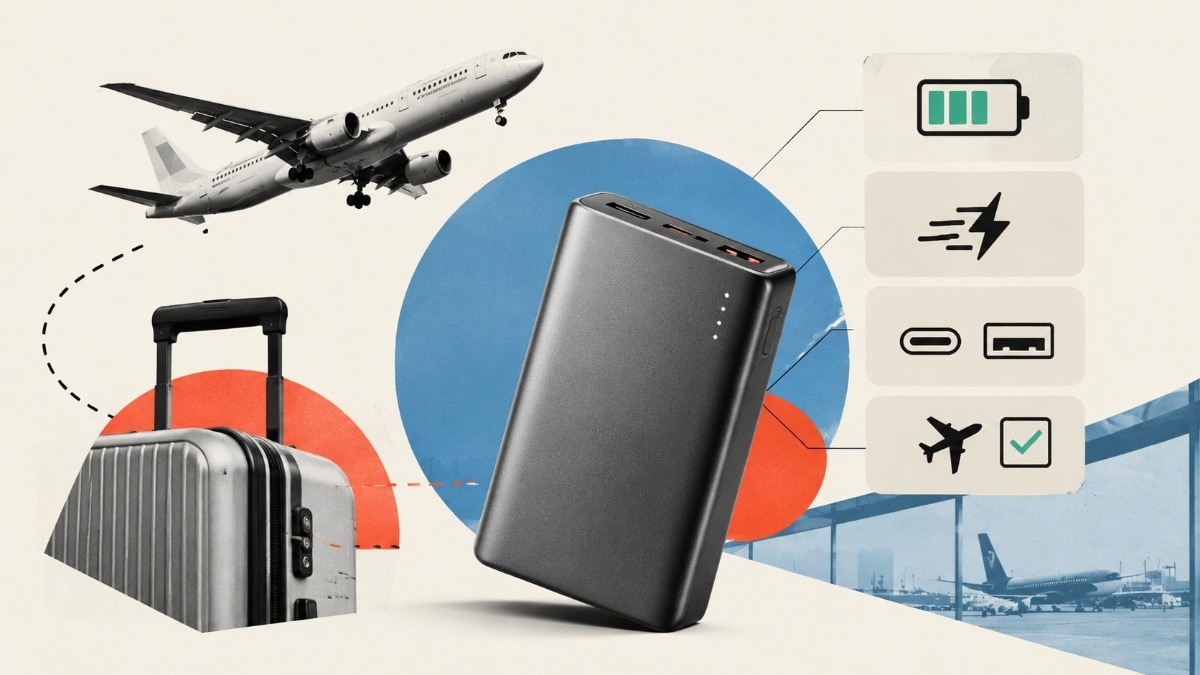
If there is one gadget that is non-negotiable in a tech survival kit, it is a power bank. It is your backup when your phone, earbuds or laptop are running low on battery and there isn't a charging socket in sight. And while it can be a lifesaver when you're out all day, it is also one of those gadgets we rarely think much about. You probably just toss it into your bag and forget about it until you need it.And things are different when you are flying altogether. You need to think about your power bank's capacity, where you pack it and whether you can use it onboard. Some of you might already know the rules, but the recent IndiGo incident is a reminder of why they matter. Because what seems like a harmless gadget could turn risky if not chosen right. So, how much do you really know about your power bank? And if you're planning to buy one, what should you look for? There’s more to it than just choosing between 10,000mAh and 20,000mAh. Let’s break it down.How to choose the right power bankSo, how do you choose the right power bank for yourself? For starters, there are plenty of options out there, and the one with the biggest number on the box is not always the best. Here are a few important things to check before you spend your money on a power bank.– Start with capacity. Power banks are sold by capacity, measured in milliampere-hours (mAh). If you only need to top up your phone or wearables now and then, a 5,000mAh or 10,000mAh model will usually do the job. But if you travel frequently, need multiple charges or want to power more demanding devices, a 20,000mAh unit may make more sense. Do keep in mind that more capacity usually means a bigger, heavier device in your bag. – Another thing you should note is that the number on the box is not the amount of charge your phone will actually receive. Some energy is lost during conversion and charging, so the usable capacity is lower than mentioned. A 20,000mAh power bank, for instance, will not charge a phone with a 5,000mAh battery exactly four full times. It is a bit like buying a 500GB storage drive and finding that the available space is lower than the mentioned capacity.– You should also check the watt-hour (Wh) rating. Two power banks with the same mAh rating can hold slightly different amounts of energy, so Wh helps you compare them better. For example, a 20,000mAh power bank usually works out to around 74Wh. This figure matters when you fly too, as airlines generally cap power banks in the cabin at 100Wh, and they must go in your hand baggage, not your checked luggage. Check your airline’s rules before you travel.– Next, check the charging speed. Look at the output wattage number and whether the power bank supports fast-charging standards such as USB Power Delivery (PD) or Quick Charge (QC). It is better to see if your phone supports it. If you have a recent Samsung or Google phone, look for PPS support too, as these phones use it for their fastest charging speeds.– If you also want to charge a laptop or tablet using the powerbank, pay close attention to the output. Many phone-focused power banks top out at 20W or 30W, which is not enough for most laptops. Look for a PD output of 45W or more, and check what your laptop actually needs.– Some power banks also come with wireless or magnetic charging, such as Qi2 or MagSafe-style models. They are convenient for iPhone users and some Android phones, but they charge more slowly than a cable and tend to get warmer.– Do not forget to check how quickly the power bank itself recharges. A 20,000mAh model that takes ten hours to refill can be a nuisance.– Also, do not overlook the ports and size. USB-C is useful for newer phones, while a USB-A port can come in handy if you still use older devices or cables. If you plan to charge several gadgets at once, check how many ports the power bank offers and whether the charging speed drops when you plug in multiple devices.– Pay attention to the cable. A bad quality cable can affect charging performance, so use a good-quality cable that supports the power bank’s output. If you also charge earbuds, a smartwatch or a fitness band, look for a low-power or trickle-charge mode, as some power banks switch off when the load is too small.– Also, if you have a power bank with a digital display that shows the exact battery percentage is comes handier than four vague LED dots.– Finally, check the brand, certification and warranty. This is where you should avoid cutting corners. Also– and this one is non-negotiable– look for the BIS (Bureau of Indian Standards) mark and registration number on the product, along with warranty coverage and protection against overheating, overcharging and short circuits. Counterfeits are common on online marketplaces and at roadside stalls, so buy from the brand’s official store or an authorised seller.– And if your power bank ever swells up, gets damaged or becomes unusually hot, stop using it immediately.Which power bank can you carry on a flight?Now, for the flight part. Which power bank can you carry onboard? While rules can differ between airlines and countries, there are a few basic things you should know.Under aviation rules (including DGCA guidelines in India and ICAO/FAA globally), your power bank must go in your cabin baggage, never in your checked-in luggage. That's because power banks use lithium-ion batteries, which can overheat and catch fire. Keeping them in the cabin makes it easier for the crew to respond if something goes wrong.DGCA and airline directives mandate to keep your power bank within reach, such as in a seat pocket or under the seat in front of you, rather than in the overhead compartment.Capacity matters too. Power banks rated up to 100Wh are generally allowed, subject to airline rules. Those above 100Wh and up to 160Wh usually need airline approval, while anything above 160Wh is generally not allowed. Some airlines also limit passengers to two power banks.Not sure what your power bank is rated at? Look for the Wh figure printed on its label. If only the mAh rating is mentioned, multiply it by 3.7 and divide by 1,000. A 10,000mAh model works out to about 37Wh, while a 20,000mAh one comes to around 74Wh. This means most everyday power banks fall within the 100Wh limit.Also, make sure the terminals are protected. Keep your power bank in a pouch or separate pocket, away from keys, coins and other metal objects that could cause a short circuit. And if it is damaged, swollen or recalled, don't carry it on a flight.Finally, remember that you cannot use a power bank to charge your phone or recharge the power bank itself during the flight under the updated restrictions.And of course It is always a good idea to check your airline's policy before you travel.- Ends
Power bank on flights, how to buy the right one and what to keep in mind before you board
Full Article
Original Source
Read the full article at Indiatoday →KhanList aggregates and links to publicly available news content. We do not host full articles from third-party sources. Always verify important information with original sources.