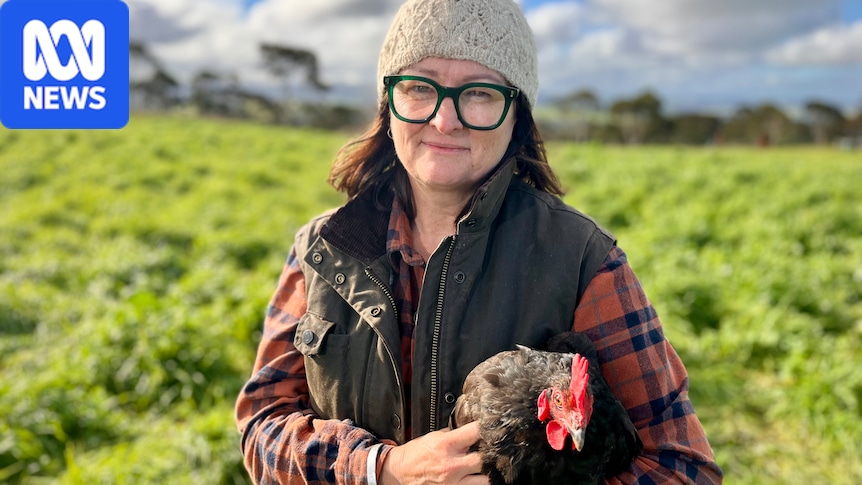
Claire Fuller's pasture-raised hens spend all day outside on her family farm on the Fleurieu Peninsula, 10 minutes from Victor Harbor.With a local spread of H5 bird flu confirmed in South Australia, Ms Fuller is worried about her birds getting sick."We are concerned about bird flu, being a poultry farm.""But we've really just thought 'what's within our control and what's outside our control'. What's within our control is biosecurity," she said.Ms Fuller is monitoring who comes onto the farm, limiting who can collect eggs, and protecting water sources."The wild birds don't come in and can't access water freely, or food, which means they have less need to come in and visit and mingle with the hens," she said.There are no confirmed reports of H5 bird flu infecting domestic or captive poultry in Australia. (ABC News: Stephen Opie)Federal Agriculture Minister Julie Collins confirmed yesterday that local transmission of H5 bird flu had occurred between a number of greater crested terns in South Australia.Eleven more suspected cases were detected in the state yesterday, and further spread is expected.While the strain has not been detected in poultry or agricultural industries, producers are on alert.Ms Fuller has 900 new hens arriving next week and said her business would be devastated if H5 bird flu spread to her farm."We would basically be out of business, and it would be at least 12 months," she said."I know for quarantine and sanitisation and testing for the virus it will take up to 12 months to be cleared of it."That would be a massive loss for us, and obviously for the birds themselves."Claire Fuller says an outbreak of H5 bird flu in her hens would end her egg business.'Business as usual' for Robe tourismOn the Limestone Coast in Robe, where one of the infected greater terns was located, locals are aware of bird flu, but they're not alarmed."For now things are just business as usual," Robe Town Brewery owner Maris Biezaitis said."[I'm] not really scared at all. I do recognise the huge risks that bird flu could bring."It's been shown in the past in other parts of the world that it can be devastating to wildlife and also industry."Maris Biezaitis is the owner and head brewer of Robe Town Brewery. (ABC News: Joshua Brine)Mr Biezaitis said it was ''early days for now" and he felt that authorities were "on top of it.""If it spread and jumped into mammals like the sea lions off the coast, or poultry inland, or even humans, that would probably be devastating to Robe."However, if that was the case, Robe probably wouldn't be alone; it would be a much bigger thing."Robe has been the site of multiple dead birds confirmed or suspected to have been infected with the deadly H5N1 subtype of avian influenza. (ABC South-East SA: Joshua Brine)Local spread 'expected'There has not been a detection of H5 bird flu in Victoria as yet, but it is getting closer.Victorian Farmers Federation egg group president Brian Ahmed said the local spread in SA came as no surprise."As farmers, we've been preparing for some time; we were never complacent, we expected that this day would come, and it was just a matter of when, not if," he said."A lot of farmers have increased their biosecurity, not letting on people unless they have to be there, and following procedures with foot baths and proper clothing and things like that."Mr Ahmed, himself a caged-egg producer, said he was reasonably confident caged and barn-laid egg producers could keep H5 out of their bird populations."No-one is 100 per cent, but I believe a caged system is probably 98 per cent, and a barn system probably 90 per cent secure," he said.But he said free-range systems would have far greater challenges."That's the unfortunate thing about letting them roam free — they've got that opportunity to mix with wild birds," he said.Brian Ahmed says he is not surprised bird flu is now spreading locally. (ABC Landline: Tim Lee)Free-range producers who choose to keep their hens housed may be protected by Australian Competition and Consumer Commission provisions that would allow them to continue to sell their eggs as free-range, but only for a limited time."Farmers then need to be prepared with alternative packaging," Mr Ahmed said."Also, when they're used to roaming free and then you lock them up, they can cannibalise each other, so you can have a welfare issue there."If we want food security and food affordability in this country, we need our cage and barn systems to balance the risks."
Poultry farmers concerned about local bird flu spread
Full Article
Original Source
Read the full article at Abc →KhanList aggregates and links to publicly available news content. We do not host full articles from third-party sources. Always verify important information with original sources.