
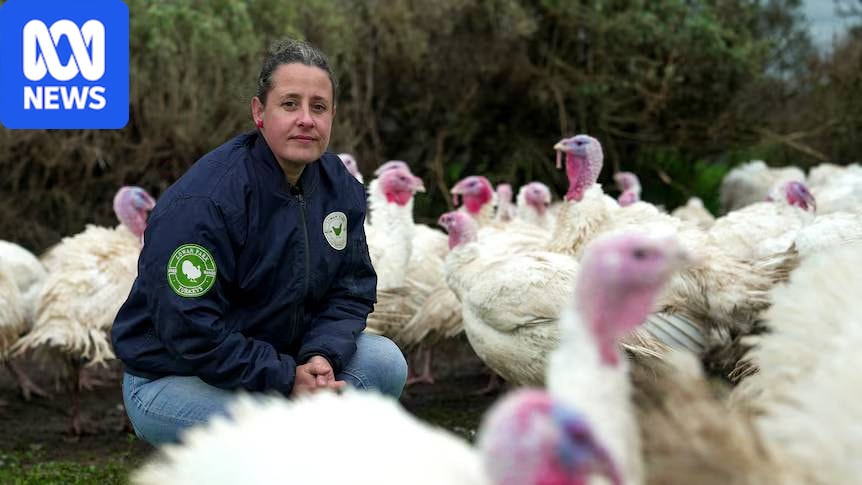
Christmas may still be months away, but near Bordertown in South Australia, the festive season is already in full flight at Lucy Dodd's turkey farm.It's peak time, with 6,000 free-range birds destined for the dinner table."These are all Christmas turkeys," she said."It's about half our annual income, so yeah, I'm feeling fairly nervous at the moment."The reason for her anxiety is H5N1 bird flu.The highly pathogenic strain is spreading through Australia's wild birds after reaching the mainland in June, carried by migratory seabirds from the sub-Antarctic.It's also been detected in several mammals, including a long-nosed fur seal, a fox and a dolphin.Port MacDonnell, a couple of hours' drive south of Ms Dodd's farm, is one of the worst hit areas.Local bird surveyor Bob Green said the scale of what he was seeing was devastating, with dozens of dead and dying crested terns a daily sight."I've been approached by people to say how real and how serious is this bird flu?" Mr Green said."It's real and it is extremely terrible."Bob Green is used to seeing dead and dying birds near his home. (ABC Landline: Kerry Staight)For poultry farmers, the fear is what happens when the virus makes the jump from wild birds to domestic flocks.And for free-range producers, keeping birds safe is particularly difficult.The risk of being outside"The free-range are the most vulnerable because they're out in the paddock and can have direct access with wild birds," Ms Dodd said.She also runs about 10,000 pasture-raised chickens, whose movable enclosures are shifted to fresh grass every day.Lucy Dodd also runs 10,000 pasture-raised chickens on her farm. (ABC Landline: Carl Saville)"The pasture-raised are a little bit more protected, but they're also in the paddock," she said."If a bird has been on the patch of grass that the chooks are going to go onto the next day, then that can be just as impactful."Adelaide University virologist Farhid Hemmatzadeh said the consequences of an outbreak in free-range poultry could extend beyond a single farm.Farhid Hemmatzadeh has spent years researching bird flu. (ABC Landline: Carl Saville)"We might put the other sectors of the poultry industry at risk," he said"When the virus load in nature is high, the controlling of that is very hard."Lessons from an outbreakVictorian egg producer Brad McAuliffe knows the damage an outbreak can do.In 2024, two strains of H7 bird flu infected his farms at Meredith and Terang.Brad McAuliffe has gone to extraordinary lengths to protect his egg business. (ABC Landline: Kyle Harley)More than half a million birds were culled and both properties were shut down for more than a year.Mr McAuliffe used that time to overhaul his operation and put biosecurity front and centre.At his farms, vehicles are washed and disinfected, and staff and visitors shower before entering sheds.New technology is also used to monitor the chickens around the clock for tiny changes that could signal disease.One of the biggest changes has been moving the company's grading facility off-farm to Geelong, creating another layer of separation.Eggs are washed and exposed to UV light.Brad McAuliffe has moved his egg facility off farm. (ABC Landline: Kyle Harley)Trays, fillers and dividers are washed and sanitised.Trucks are cleaned and sprayed with a thermal fogging machine."We've learnt a lot. We've adapted a lot. We've grown a lot. We've invested a lot," Mr McAuliffe said."I think we'll be able to overcome anything that's thrown at us."It is an extraordinary level of protection that cost more than $10 million.Biosecurity comes at a priceSmaller producers don't have such deep pockets.Ms Dodd's abattoir is in the middle of the farm, which makes processing easier but also brings more people onto the property.She said if she had the money to redesign the farm, she'd separate the abattoir.Another problem could arise if authorities require free-range birds to be housed.Lucy Dodd has an abattoir in the middle of her turkey farm. (ABC Landline: Kerry Staight)Victoria has already introduced mandatory housing for some poultry flocks of more than 50 birds.South Australia hasn't yet taken that step, instead encouraging farmers to voluntarily keep their birds indoors.But Ms Dodd only has enough shed space to house half of her turkeys.Turkeys are raised in paddocks at Lucy Dodd's free-range farm. (ABC Landline: Kerry Staight)"There's a lot of free-range farmers that won't be able to do that," she said."If we need to go down that path, then I've got to question whether I want to be a farmer or not."Half of Mr McAuliffe's egg production is also free-range.He said there were other welfare considerations that came with housing birds that were used to more freedom."It's hard on the bird," he said."To change everything, especially with an older flock … you can get feather pecking and stuff like that."For free-range farmers, it's a difficult trade-off.Accessing baby turkeys and chickens may be one of the biggest challenges for poultry farmers after an outbreak. (ABC Landline: Carl Saville)The birds need to be protected from the virus, but putting them inside can undermine the product customers are paying for.For producers, the problem doesn't necessarily end when an outbreak is over.If a flock is culled, getting back into production can take months."If we have a really wide outbreak, I may not be able to get chicks," Ms Dodd said.But despite fearing the worst, Ms Dodd is hopeful free-range farming can adapt."I think we can learn to live with the disease," she said."What I've seen overseas is that free-ranging still exists, the poultry industry still exists in other countries, so that gives me hope."Watch ABC TV's Landline at 12:30pm AEST on Sunday or stream anytime on ABC iview.
Poultry farmer nervous as Christmas turkeys face bird flu threat
Full Article
Original Source
Read the full article at Abc →KhanList aggregates and links to publicly available news content. We do not host full articles from third-party sources. Always verify important information with original sources.