
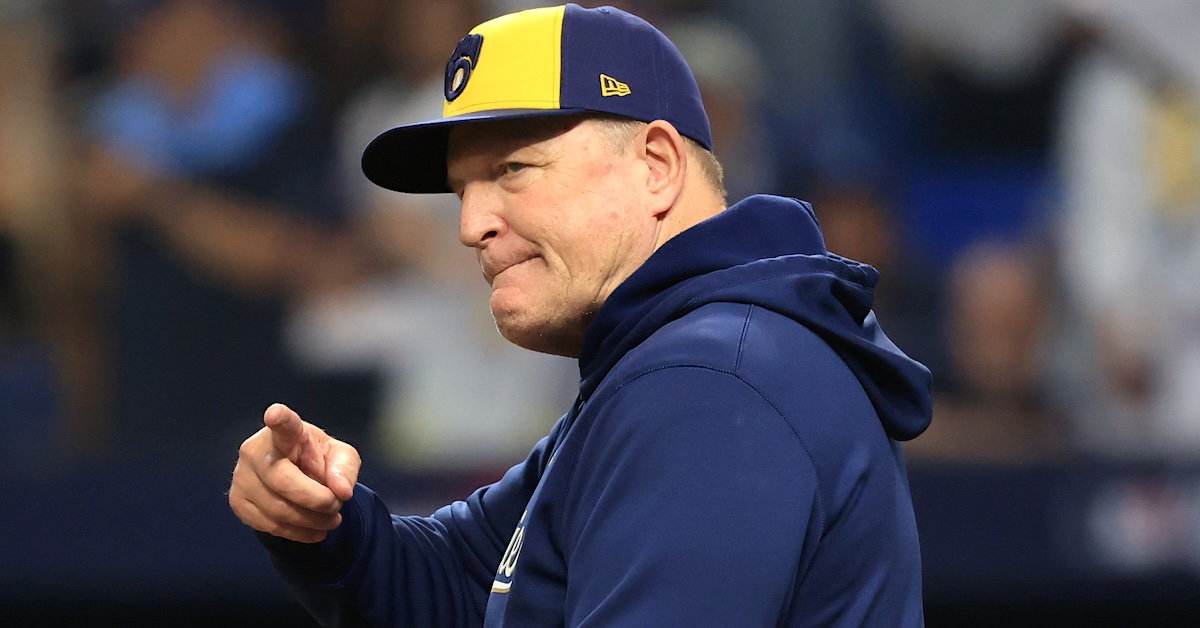
Kim Klement Neitzel-Imagn Images As I’m quite certain you’re aware if you’re reading this article on FanGraphs.com, the Milwaukee Brewers just won their first World Series championship in franchise history. They didn’t limp their way to the alcohol showers either, winning 103 games during the regular season before an 11-2 playoff run that never felt as if they were in serious jeopardy. When you’ve already snatched up the full scholarship to an elite school, it probably doesn’t matter whether you got an A or a B in your senior year electives. But as Mr. Barr reminded me when he gave me a D in English in my final quarter of high school, something which I managed to conceal from my mom for 20 years, there are still report cards to fill out. Grading the manager of a team that dominated in the playoffs is always a bit tricky to pull off. After all, whether moves were good ideas or poor ones, they mostly worked out, or the Brewers wouldn’t have dominated so consistently. But we evaluate the process here, not just the results, and hopefully I have just the right combination of objectivity and natural unlikability to grade Brewers manager Pat Murphy fairly. Batting: A As someone who likes picking apart things, I’m mildly disappointed that I don’t really have many gripes here. The truth is, a manager in baseball does not have the same level of tactical influence over the game as, say, an NFL head coach does. Baseball is largely a game of execution and chance, and while many decisions have an impact, there are limits, on both the good and bad sides, to just how much a manager can affect the outcome. A lot of a manager’s job is simply getting the right players on the field, and as Casey Stengel noted, “keep[ing] the five guys who hate you away from the four guys who haven’t made up their minds.” From an overall standpoint of getting his preferred players on the field, Murphy did a very good job. One thing I respect a lot is how Murphy trusted his players in their roles, while also not being afraid to bench a player. Even with Christian Yelich having a lousy season, a lot of managers likely would have had trouble leaving him, a veteran with a lot of cachet in Milwaukee who was named as the team’s first official captain in history, out of the lineup against unfavorable starting pitcher matchups. Even more would have had trouble doing it without it causing any kind of controversy. That’s a hard thing to do without significant buy-in from your players. While it didn’t pay any obviously huge dividends, I was also a fan of Murphy’s willingness to start Luis Lara against Tarik Skubal and Blake Snell in the NLCS, despite Lara being a rookie who didn’t have the greatest of debuts offensively. I’m not sure I’d have been as willing to start David Hamilton as Murphy was, but he saw the opportunity and took it. I also greatly appreciate the thoughtfulness with which the starting lineup was put together; in multiple press conferences, Murphy discussed how much he and the front office emphasized thinking about how specific late-inning relief choices would match up with Milwaukee’s available pinch-hitters. I’m not a fan of the hit-and-run generally, but I do like it used enough to have the threat of it out there. If you want your team to be aggressive, don’t half-ass it! William Contreras’ hit-and-run in World Series Game 2 was a really good one, and it was a big part in swamping the Rays with a massive inning. Murphy also didn’t get too rigid with his platoons if the situation didn’t call for it, something I complained about with Dave Roberts of the Dodgers. For example, Murphy left Sal Frelick in against Ian Seymour to lead off the sixth in Game 2 of the World Series. Yes, the Brewers were a run behind, but the bases were empty, and with Seymour’s excellent changeup being his best pitch (in my opinion), his nonexistent platoon splits so far in the majors are not unwarranted. Yes, Frelick ended up hitting a homer, but that’s not why I like it; Murphy’s powder was kept dry for a higher-leverage situation. I save the A+ grades for absolute perfection, and I do have some quibbles. I really thought that, in NLDS Game 3, Andrew Vaughn should have pinch-hit for Brice Turang with the bases loaded and two outs in a tie game with Yuki Matsui pitching and Turang having really struggled recently at the plate. I also did not like the Garrett Mitchell bunt in Game 1 of the World Series with two on and nobody out; Mitchell is not Hamilton (who had 15 bunt hits in 2026), and he did not have a single bunt hit during the regular season. If you’re playing aggressively, which the Brewers tried to do, go for the big inning. Still, this is a solid A. Pitching: A- As with the hitting, there are a lot more highs here than lows. I’m a fan of letting a reliever pitch multiple innings when they’re rolling along, with little sign of tiredness. One of my favorites was allowing Aaron Ashby to get out of his own jam in Game 2 of the World Series. I still thought Ashby was pitching well, and it kept the Brewers from turning to Trevor Megill for a second consecutive game after a dicey outing in Game 1. In fact, my broadly, I’m a fan of Murphy’s tendency to treat Ashby as a multi-inning reliever, so I naturally liked the choice to let Ashby finish NLCS Game 4, even though it left him all but officially unavailable in Game 5. There’s a clear pecking order in Milwaukee’s bullpen, and Murphy showed little fear of moving his high-leverage relievers into early innings if the situation called for it. Yes, you can bring in your closer to face Fernando Tatis Jr. in the eighth inning rather than worrying about saving him for the ninth. Yes, you can bring in Abner Uribe in the fifth or sixth even if he didn’t pitch before the seventh a single time during the regular season. The Brewers ended up losing Game 4 of the World Series, but I do think that not bringing in Jacob Misiorowski to pitch in relief was the right play, preserving his ability to start Game 5 on four days rest. In other Misiorowski moves, yanking him in Game 1 of the NLCS during the fifth was the right thing to do — he was still throwing hard, but the Dodgers were making a lot of contact. Murphy also took the Miz’s cramp in Game 5 of the World Series very seriously. In any case, Misiorowski was not likely to come back out for the seventh, so giving him the hook rather than trying to let him complete the sixth inning was the right thing to do. The negative side of the ledger is not large. The roster isn’t solely the manager’s call, but if Murphy had really wanted Chad Patrick on the roster, do you think anyone would have said no? I think Patrick was simply a more trustworthy option to have around than Kyle Harrison and, I’m sorry to say, Brandon Woodruff, and I’d be happier if Patrick had been forced into a start than either of those other two. I thought the slow hook with Uribe, whose command was very off in NLCS Game 3, was a mistake, especially with DL Hall ready to go. In that same game, I would have stuck with Robert Gasser, who had thrown only 72 pitches through five innings. I said a not-very-polite word to the television screen when Megill was pulled after recording the final out of the eighth inning with the score tied, 2-2, in World Series Game 4. Sure, it was Ashby who replaced him, but Megill had faced only one batter and needed only five pitches to retire him. All told, Murphy did an excellent job managing the Brewers in the playoffs, and Milwaukee was so dominant that a lousy job probably wouldn’t have changed things. I’m a tough grader, but given how much splitting hairs I’m doing to find fault, I don’t know how anything lower than an A- could be justified here. The Brewers may not have won the World Series because of Murphy, but their championship certainly wasn’t in spite of him.
Postseason Managerial Report Card: Pat Murphy
Full Article
Original Source
Read the full article at Blogs →KhanList aggregates and links to publicly available news content. We do not host full articles from third-party sources. Always verify important information with original sources.