
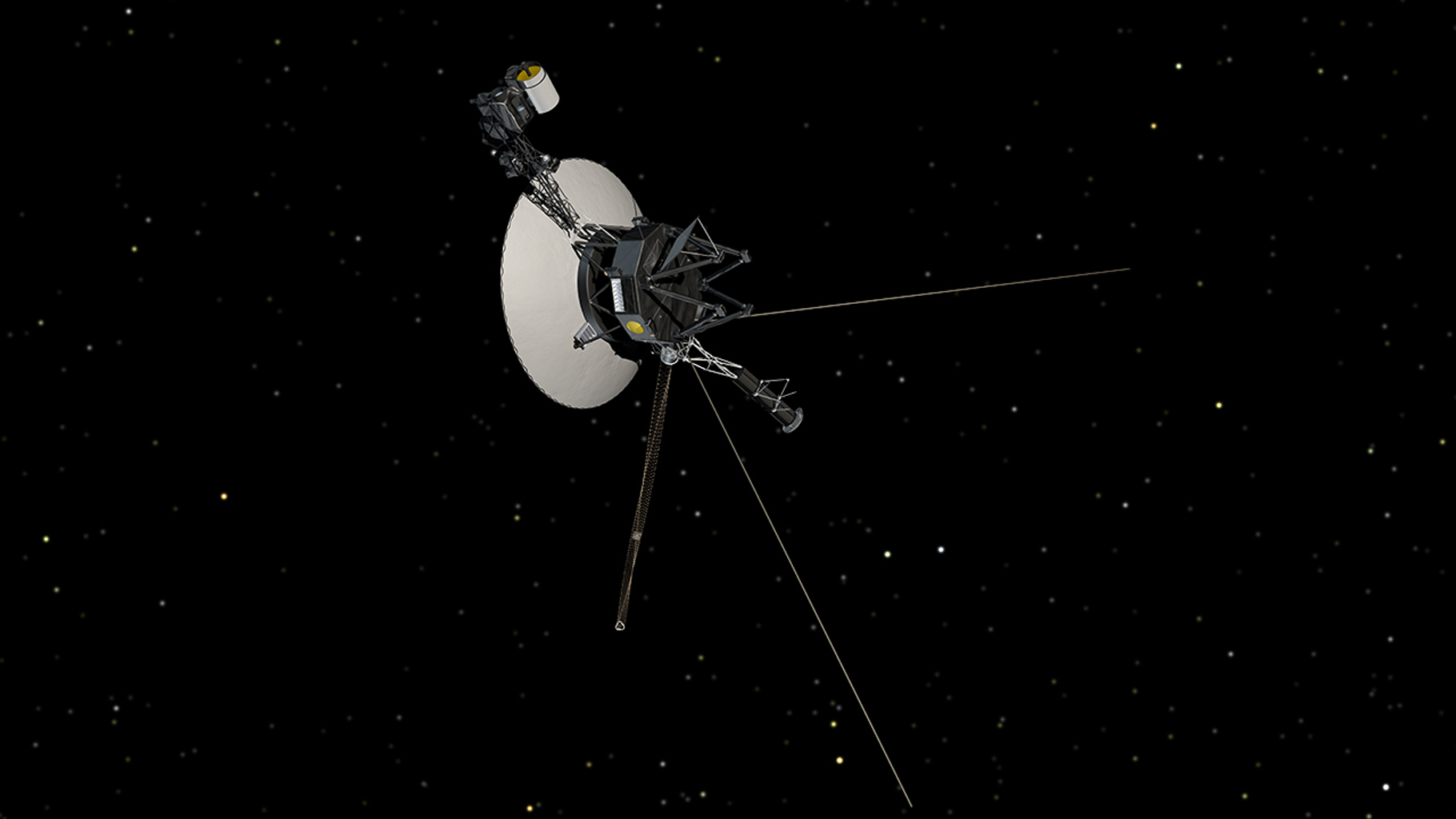
Image credits: NASA FROM EARTH Voyager I’s forty-nine-year journey into the void Published November 5 I. This November II. The Golden Record III. One Last Look Home IV. The Long Quiet V. The Final Frontier I. This November Somewhere above the plane in which the planets orbit, moving away from the sun at some 17 kilometres a second, a machine older than the internet is closing in on no ordinary milestone. On November 18, Voyager I will be one light-day away from earth. In 1965, a graduate student in the U.S. named Gary Flandro noticed that around the late 1970s, Jupiter, Saturn, Uranus, and Neptune would lie on a single line — something that happens only around every 175 years. So, a spacecraft launched at the right moment could use each planet's gravity to arc towards the next, compressing a 30-year crawl to Neptune into a single decade. NASA dreamed big at first, but as the budget priorities changed, the plan shrank to two probes aimed only at Jupiter and Saturn. These were the Voyagers. Scientists and engineers built two nearly identical spacecraft, and launched them 16 days apart: Voyager II first on August 20, 1977, then Voyager I. As it happened, Voyager I would take a faster path that let it overtake its sibling and reach Jupiter first. And from here the two machines lived very different lives. Voyager I is built like a decagon-shaped drum to pack the electronics and the propellant tank into a light frame. Sixteen thrusters keep a 3.7-metre dish antenna pointing at earth. Three nuclear generators sit at the end of a long boom to keep their radioactivity from corrupting the instruments. The Voyagers couldn't afford a gram of decoration. They're purely functional objects. II. The Golden Record Voyager Golden Record. Credits: NASA/JPL-Caltech Voyager I and Voyager II each carry a golden phonograph record bolted to their exteriors. The idea was that the mission ought to carry some kind of message explaining ourselves and our planet to any interstellar intelligence it may encounter that shared none of our biology, language, or history. Project manager John Casani handed the problem of designing a message to Carl Sagan, who invited the radio astronomer Frank Drake. Their official budget was $1,500 for six weeks — an absurd sum for a message meant to represent an entire species, and in practice it took most of the following year to compose. They assembled 116 photographs of human anatomy, cities, farms, a mother nursing a child, the structure of DNA, a 12-minute audio collage of surf, thunder, birdsong, humpback whales, and a baby's first cry; greetings in more than 50 languages; and 90 minutes of music from Bach to a Navajo night chant to Chuck Berry's 'Johnny B. Goode'. At Sagan's request, the documentary maker Ann Druyan spent an hour in a lab with electrodes on her scalp, thinking her way through the history of earth. Two days after she and Sagan had privately agreed to marry, she thought of what it felt like to fall in love. That hour of brain activity was encoded onto the record as sound as well. Whimsical though it sounds, the record's design posed a significant challenge: how do you write instructions for an alien entity with a different alphabet, units or even senses? So its designers picked something universal: physics. The playback speed was set by the oscillation of a hydrogen atom, location marked by a map of pulsars, the cover plated with uranium-238, whose decay lets a finder calculate exactly how long it has been travelling. Listen to Pale Blue Dot Connecting to SoundCloud controls… From this distant vantage point, the earth might not seem of any particular interest.But for us, it's different. Consider again that dot.That's here. That's home. That's us.On it everyone you love, everyone you know, everyone you ever heard of, every human being who ever was, lived out their lives.The aggregate of our joy and suffering, thousands of confident religions, ideologies, and economic doctrines,every hunter and forager, every hero and coward,every creator and destroyer of civilization, every king and peasant,every young couple in love, every mother and father, hopeful child, inventor and explorer,every teacher of morals, every corrupt politician,every "superstar", every "supreme leader",every saint and sinner in the history of our species lived there – on a mote of dust suspended in a sunbeam.The earth is a very small stage in a vast cosmic arena.Think of the rivers of blood spilled by all those generals and emperorsso that, in glory and triumph, they could become the momentary masters of a fraction of a dot.Think of the endless cruelties visited by the inhabitants of one corner of this pixelon the scarcely distinguishable inhabitants of some other corner,how frequent their misunderstandings, how eager they are to kill one another, how fervent their hatreds.Our posturings, our imagined self-importance,the delusion that we have some privileged position in the Universe, are challenged by this point of pale light.Our planet is a lonely speck in the great enveloping cosmic dark.In our obscurity, in all this vastness, there is no hint that help will come from elsewhere to save us from ourselves.The earth is the only world known so far to harbor life.There is nowhere else, at least in the near future, to which our species could migrate.Visit, yes. Settle, not yet.Like it or not, for the moment the earth is where we make our stand.It has been said that astronomy is a humbling and character-building experience.There is perhaps no better demonstration of the folly of human conceitsthan this distant image of our tiny world.To me, it underscores our responsibilityto deal more kindly with one another,and to preserve and cherishthe pale blue dot,the only home we've ever known. The earth is visible as a bright speck in the large void. The photograph was taken on February 14, 1990 by NASA’s Voyager I, 3.7 billion miles (6 billion kilometres) from the Sun. Source: NASA III. One Last Look Home By 1990, both Voyagers had passed Neptune and Sagan pushed for one more image before the Voyager I cameras went dark for good: of an earth reduced to an indistinct point of light, barely separable from the clutter of stars. On February 14, 1990, Voyager I turned its cameras back towards a part of space it had spent 13 years leaving and took 60 images. Scientists assembled them into a family portrait of the solar system — the only photograph of most of the system's planets ever taken from outside it. Here, earth appears smaller than a single pixel. It was also the last thing Voyager I ever looked at: its cameras were switched off immediately afterwards, to save power. Sagan's words about that pixel became one of the most quoted passages in modern science writing, especially when he called earth "a mote of dust suspended in a sunbeam". No war has ever been fought over more than a fraction of that pixel. No empire has ever ruled more than a smudge of colour a few thousand atoms wide. IV. The Long Quiet Voyager I was built for a four-year journey. It is now in its 49th year. As John Casani, the mission's original project manager, put it, "We didn't design them to last 30 years or 40 years, we designed them not to fail." Its three power generators have no moving parts: they turn the heat of decaying plutonium into electricity, so there's no wear. Its onboard computer processes around 8,000 instructions a second. In 2024, when the thrusters that keep Voyager I's dish aimed at earth were found to be clogging up, engineers revived a backup set declared unusable and left dormant since 2004, working by trial from 24 billion km away. The previous year, when Voyager I sent back nonsensical telemetry, engineers traced the fault to a single corrupted chip after months of remote diagnosis, and fixed it with a software patch. In 1994, Sagan guessed Voyager I would cross the heliopause, the edge of the Sun's influence, around 2010. He was close. Follow Voyager I Move through the mission from earth to beyond the heliopause. Drag to orbit, scroll to zoom, and use the timeline to see where Voyager and the planets were on any date. Loading JPL trajectory… Compressed distance scale 5 September 1977 Signal: — Skip ↓ 5 September 1977 Voyager I launches from Cape Canaveral on a faster, shorter trajectory than its twin, Voyager II. Skip experience ↓ Journey settings Mission milestones Choose a date Source and methodPositions and Voyager’s trajectory use NASA/JPL Horizons geometric vectors in the heliocentric ecliptic J2000 frame. The fine reference orbits use approximate J2000 osculating elements; planets remain on their Horizons positions. Jupiter and Saturn encounter windows use hourly vectors. Readable scale compresses distance; True preserves relative distance from the Sun. Body and spacecraft sizes are illustrative; the encounter camera reduces that enlargement without moving Voyager off its measured path. Distance From Sun— Light travel time from the Sun. From earth— Light travel time from earth. One-way signal— How long a radio message takes to reach earth. Speed Playback presets compress mission time. Date Mission date Voyager’s path and the planets’ positions come from NASA/JPL Horizons, using hourly data near Jupiter and Saturn. The orbit rings are approximate. Planets and the spacecraft are drawn larger than life so they are easy to see. “Readable” scale compresses distances; “True distance” keeps them in proportion. Playback is a time-lapse. The one light-day milestone and Voyager’s speed come from NASA’s Voyager mission update. V. The Final Frontier Sometime this November, Voyager I will likely be one light-day from earth, a distance that took 49 years of uninterrupted momentum to cover. Voyager I will not slow down to mark the occasion. It has no brakes and no fuel to spare for anything other than to keep its dish aimed at earth. What comes after makes even 49 years look brief. In roughly 40,000 years, Voyager I will drift within about 1.6 light-years of a faint star called Gliese 445, without pausing to look. It will take tens of thousands of years more just to clear the Oort Cloud, the outer edge of the Sun's gravitational reach. Its transmitter will fall silent long before any of that, likely within a decade or two, but the spacecraft itself should survive for a billion years or more, bearing the golden record as it orbits the centre of the galaxy. Nobody can say exactly how long NASA will keep hearing from it. But as Suzanne Dodd, Voyager's current project manager, put it earlier this year, the spacecraft can be trusted to "provide even more scientific surprises" the farther it travels. Humans are not a species that agrees easily on anything, least of all what we owe each other. Yet with total uncertainty over whether it would ever matter to anyone, a small group of people built something carefully and in good faith, then kept it going for nearly five decades, long after any committee on earth would have reasonably called the mission complete. Space is mostly empty and everyone who worked on the records knew that going in. Their message was less about its expected value and more about sincerity. This November, one light-day out, still transmitting, Voyager I will keep going. Credits Writing: Prathmesh Kher Editing: Vasudevan Mukunth Design and Frontend Development: Areena Arora Image credits: Voyager spacecraft illustration, NASA/JPL-Caltech. Postcard images from the Voyager Golden Record, courtesy NASA/JPL-Caltech; the original photographs and artwork were made by various photographers, publishers and institutions.
Postcards from Earth
Full Article
Original Source
Read the full article at Thehindu →KhanList aggregates and links to publicly available news content. We do not host full articles from third-party sources. Always verify important information with original sources.