
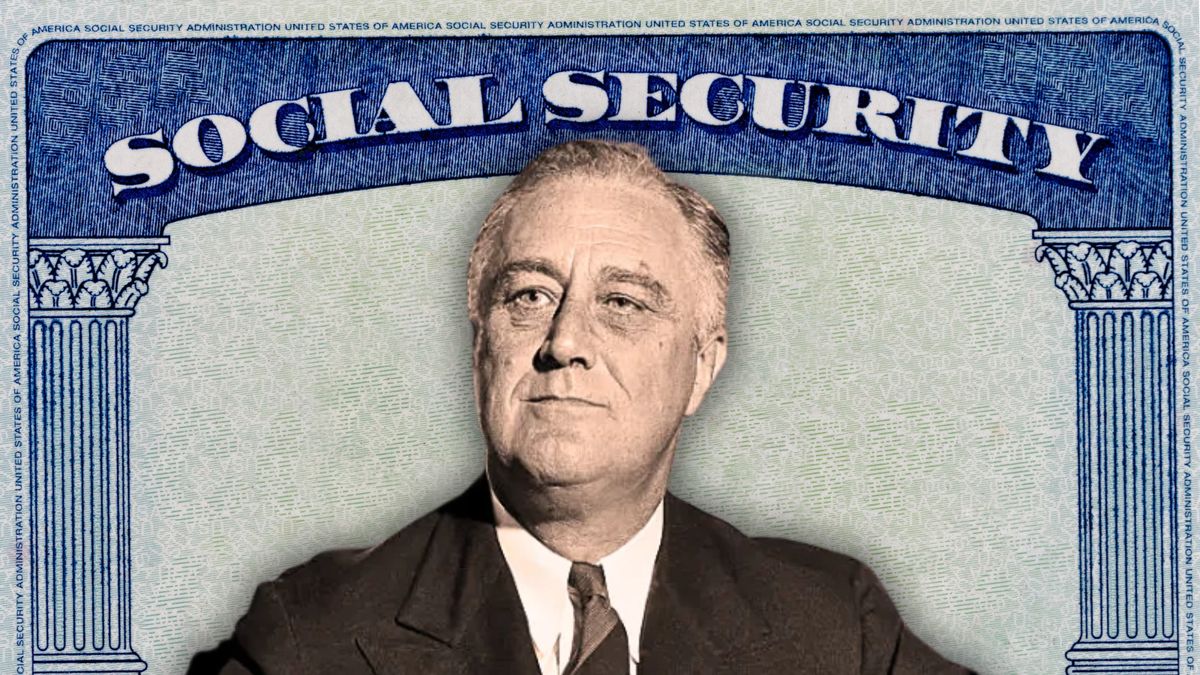
Claim: A copypasta circulating in 2026 accurately states a list of facts about the history of Social Security, including that former President Franklin D. Roosevelt promised voluntary participation in the program. Versions of a post claiming to state a list of "facts" about the history of Social Security have circulated online for over a decade. This supposed list of facts is so pervasive, the Social Security Administration debunked the claims within it on the administration's website. We have rated this list overall as mostly false because every claim is largely or entirely inaccurate, except for two. Former President Franklin D. Roosevelt — who signed the law creating Social Security — did, in fact, put the program's money in a trust fund separate from the government's general budget. However, claims that former President Lyndon B. Johnson reversed that decision are inaccurate. Social Security has always been in a separate, independent fund and still is as of this writing. Democrats did, in fact, increase taxes on Social Security annuities under former President Bill Clinton, but only for higher earners. In late 2026, readers asked us about posts claiming to share a long list of "facts" about the history of Social Security, including five supposedly broken "promises" about the program and a Q&A section about the Democratic Party's supposed impact on the public benefits program. Snopes readers referenced posts on LinkedIn and Facebook. These posts claimed that when former President Franklin D. Roosevelt introduced the public benefits program, he allegedly promised voluntary participation, far lower tax rates, tax deductible-eligibility and a Social Security fund separate from the general government budget. The Q&A section of the posts blamed the Democratic Party for supposedly breaking these promises and providing benefits to immigrants. Here's one example: HISTORY LESSON ON YOUR SOCIAL SECURITY CARD: Just in case some of you young whippersnappers (& some older ones) didn't know this. It's easy to check out, if you don't believe it. Be sure and show it to your family and friends. They need a little history lesson on what's what and it doesn't matter whether you are Democrat or Republican. Facts are FACTS. Up until the 1980's, Social Security cards expressly stated the number and card were not to be used for identification purposes. Since nearly everyone in the United States now has a number, it became convenient to use it anyway and the "NOT FOR IDENTIFICATION" message was removed. Franklin Roosevelt, a Democrat, introduced the Social Security (FICA) Program. His promises are in black, with updates in brackets. 1.) That participation in the Program would be completely voluntary [No longer voluntary], 2.) That the participants would only have to pay 1% of the first $1,400 of their annual Incomes into the Program [Now 7.65% on the first $90,000, and 15% on the first $90,000 if you're self-employed], 3.) That the money the participants elected to put into the Program would be deductible from their income for tax purposes each year [No longer tax deductible], 4.) That the money the participants put into the independent 'Trust Fund' rather than into the general operating fund, and therefore, would only be used to fund the Social Security Retirement Program, and no other Government program [Under Johnson the money was moved to the General Fund and spent], and 5.) That the annuity payments to the retirees would never be taxed as income [Under Clinton & Gore up to 85% of your Social Security can be taxed]. Since many of us have paid into FICA for years and are now receiving a Social Security check every month — and then finding that we are getting taxed on 85% of the money we paid to the Federal government to 'put away' — you may be interested in the following: Q: Which Political Party took Social Security from the independent 'Trust Fund' and put it into the general fund so that Congress could spend it?A: It was Lyndon Johnson and the democratically controlled House and Senate. Q: Which Political Party eliminated the income tax deduction for Social Security (FICA) withholding? A: The Democratic Party. Q: Which Political Party started taxing Social Security annuities? A: The Democratic Party, with Al Gore casting the 'tie-breaking' deciding vote as President of the Senate, while he was Vice President of the USQ: Which Political Party decided to start giving annuity payments to immigrants? A: That's right! Jimmy Carter and the Democratic Party. Immigrants moved into this country, and at age 65, began to receive Social Security payments! The Democratic Party gave these payments to them, even though they never paid a dime into it! Different versions of this copypasta — copied-and-pasted text shared online — have spread for years. The claims within have been debunked not only by independent fact-checkers, but by the Social Security Administration itself. In fact, these claims contain so many inaccurate details that our peers at FactCheck.org said in 2009 that they believed a near-identical version of the post circulating online "must be an intentional and malicious effort at disinformation." Given that almost every single supposed "fact" in the above post is largely inaccurate — but there are a few details based in varying levels of truth — we have rated the overall post as mostly false. Below, we broke down each claim made in the post and gave each its own rating, primarily relying on the Social Security Administration and the original Social Security Act of 1935 that Roosevelt signed into law. (For further reading, we also previously looked into a list of supposed Social Security "fun facts.") Roosevelt's supposed promises CLAIM: Roosevelt promised that participation in Social Security would be completely voluntary. RATING: Mostly False All employees who are covered by Social Security are subject to the Federal Insurance Contributions Act tax, or the FICA payroll tax, which funds Social Security and Medicare. "Like all taxes, this has never been voluntary," said the Social Security Administration. "From the first days of the program to the present, anyone working on a job covered by Social Security has been obligated to pay their payroll taxes." According to the Social Security Administration, however, when Roosevelt passed the law, "only about half the jobs in the economy were covered by Social Security." As such, people could technically choose to work a job that did not pay FICA taxes, which would make them ineligible for Social Security benefits. Nevertheless, there's no record of Roosevelt promising that participation in the program would be "completely voluntary," contrary to claims. As of 2026, an estimated 94% of workers are covered under Social Security. There are several exceptions to mandatory participation in Social Security, such as for some employees of state and local governments, who might be able to voluntarily choose Social Security coverage under certain conditions. CLAIM: Roosevelt promised participants would only have to pay 1% of the first $1,400 of their annual incomes into the program. RATING: Mostly False The tax rate on employees is listed in the Social Security Act of 1935 as 1% on the first $3,000 of earnings from 1937 to 1939. The rate then would increase on a regular schedule up until the end of 1948, when it was 3% on the first $3,000 of earnings. Section 801 clearly lays out the tax rates: INCOME TAX ON EMPLOYEES SECTION 801. In addition to other taxes, there shall be levied, collected, and paid upon the income of every individual a tax equal to the following percentages of the wages (as defined in section 811) received by him after December 31, 1936, with respect to employment (as defined in section 811) after such date:(1) With respect to employment during the calendar years 1937, 1938, and 1939, the rate shall be 1 per centum.(2) With respect to employment during the calendar years 1940, 1941, and 1942, the rate shall 1 1/2 per centum.(3) With respect to employment during the calendar years 1943, 1944, and 1945, the rate shall be 2 per centum.(4) With respect to employment during the calendar years 1946, 1947, and 1948, the rate shall be 2 1/2 per centum.(5) With respect to employment after December 31, 1948, the rate shall be 3 per centum. Meanwhile, Section 811 defines "wages" as everything paid to an individual up to $3,000. We have rated this claim as mostly false because the 1% tax rate figure in the claim was somewhat accurate for the program's early years — even though the maximum taxable amount claimed in the rumor is inaccurate. Furthermore, Roosevelt did not expressly promise a permanent 1% tax rate, per the law. CLAIM: Roosevelt promised the money the participants elected to put into the program would be deductible for income tax purposes. RATING: False In truth, Section 803, Title VIII of the original 1935 law that Roosevelt signed expressly forbids making employees' Social Security payments tax deductible (emphasis ours): SEC. 803. For the purposes of the income tax imposed by Title I of the Revenue Act of 1934 or by any Act of Congress in substitution therefor, the tax imposed by section 801 shall not be allowed as a deduction to the taxpayer in computing his net income for the year in which such tax is deducted from his wages. Since the claim made is the opposite of the truth in this instance, we have rated it as false. CLAIM: Roosevelt promised the money participants paid would be put in an account independent from the general government fund. RATING: Mostly True (but misleading) The Social Security Administration called this idea "basically correct." However, the list of "facts" in question claims that this was a broken promise and that under former President Lyndon B. Johnson, "the money was moved to the General Fund and spent." Below, we rate that claim, which shows up in the Q&A section of the post, as false. That's because the government's independent Social Security trust fund has never been "put into the general fund of the government," the Social Security Administration said. CLAIM: Roosevelt promised Social Security annuity payments to retirees would never be taxed as income. RATING: Mostly False According to the Social Security Administration, while Social Security benefits were not originally taxable income, that had nothing to do with the Social Security Act of 1935, "nor anything that President Roosevelt did or could have 'promised.'" In truth, Treasury Department issued a series of administrative rulings after the law already passed determining that Social Security benefits would initially not be taxable income. In 1983, under former President Ronald Reagan, a Republican, Congress changed the law to authorize the taxation of Social Security benefits (see the section titled "TAX TREATMENT" for a detailed explanation from the Social Security Administration about how the Social Security Amendments of 1983 changed U.S. tax code). Since Roosevelt was president when the Treasury Department's administrative rulings went into effect — but he made no such promise about taxable income, nor did he personally sign such a rule into law — we have rated this claim as mostly false. Evaluating more of the post's claims CLAIM: Former President Lyndon B. Johnson and the Democratic Party took Social Security payments from the program's independent trust fund and put the money into the general fund so Congress could spend it. RATING: False As we previously stated, the Social Security Trust Fund has always been a separate, independent account. This claim likely comes from confusion about how the Social Security Trust Fund is treated in federal budget accounting, the Social Security Administration said. In 1968, the Johnson administration changed the way the federal government presents its budget by creating a "unified budget." This was simply a framework for presenting all of the federal government's finances together in order to make the budget less confusing. Presenting everything as a unified budget did not actually change the operations of the Social Security trust fund. The way Social Security is presented in relation to the federal government's budget has undergone changes since Johnson's time, but it ultimately doesn't change how the federal government actually deposits or withdraws money from the fund. We have rated this claim as false because Johnson did not take money from Social Security's independent trust fund, nor did he put it in the general fund so Congress could spend it. CLAIM: The Democratic Party eliminated an income tax deduction for Social Security (FICA) withholding. RATING: False As stated above, Section 803, Title VIII of the original Social Security Act prohibited income tax deductions for Social Security (FICA) withholding. As such, there was no income tax deduction for the Democratic Party to eliminate. CLAIM: The Democratic Party enacted taxes on Social Security annuities. RATING: Mostly False Taxes on Social Security benefits began in 1984 under Reagan, who signed the Social Security Amendments of 1983. Those amendments, which were aimed at saving the Social Security program from insolvency, passed on a bipartisan vote and came from a bipartisan commission's recommendations. (Reagan even praised the "bipartisan spirit" in which the amendments were passed.) "The basic rule put in place was that up to 50% of Social Security benefits could be added to taxable income, if the taxpayer's total income exceeded certain thresholds," the Social Security Administration said. At the time, Reagan presented the amendments and the new taxes as a compromise to ensure the Social Security system continued: Time and again, benefits were increased far beyond the taxes and wages that were supposed to support them. In this compromise we have struck the best possible balance between the taxes we pay and the benefits paid back. Any more in taxes would be an unfair burden on working Americans and could seriously weaken our economy. Any less would threaten the commitment already made to this generation of retirees and to their children. Since Democrats were involved in the efforts to save Social Security in the 1980s by taxing annuities — but these taxes happened under Reagan and were overwhelmingly bipartisan — we have rated this claim as mostly false. CLAIM: The Democratic Party increased taxes on Social Security annuities, with former Vice President Al Gore casting a "tie-breaking" vote in the Senate. RATING: Mostly True In 1993, Congress increased taxes on Social Security benefits through a single provision in a massive budget bill called the Omnibus Budget Reconciliation Act, which former President Bill Clinton, a Democrat, signed into law. Section 13215 of the bill increased the taxes from the 1983 amendments from 50% to 85% for "higher income" beneficiaries (see Page 164 of the bill). After its passage, Clinton said the act "created real fairness" in the U.S. tax code by placing more tax burden on higher earners and implementing tax cuts on low-income working families. As vice president, Gore did, in fact, cast the tie-breaking vote, given that Republicans were universally against this legislation at the time (as were a few Democrats). CLAIM: The Democratic Party and former President Jimmy Carter passed a law giving Social Security annuity payments to immigrants, who don't pay into the program. RATING: False Noncitizens in the United States who have Social Security-covered jobs — in other words, almost every job in the country — must pay Social Security payroll taxes. That even includes people who are working in the U.S. without authorization or those working in the country temporarily. In fact, a 2013 report from the Social Security Administration found that immigrants in the country illegally paid a net $10 billion to the Social Security trust fund in 2010. More recently, an independent report from the Institute on Taxation and Economic Policy found "undocumented immigrants paid $25.7 billion in Social Security taxes" in 2022. (It is worth noting that some immigrants are also in the country legally but cannot legally work in the United States.) Immigrants who become citizens or legal residents can qualify for Social Security only to the extent that they have worked and paid into the system — the same as for citizens. When the Social Security program began, there were no restrictions on payments to noncitizens, according to a Congressional Research Service report. Restrictions for certain groups of noncitizens came later. It's unclear where the claim about Carter came from. The Social Security Administration said this claim likely confuses the Supplemental Security Income (SSI) program with Social Security. SSI is a federal welfare program that some immigrants can qualify for, but it was an initiative of former President Richard Nixon, a Republican, not Carter.
Post claiming to share Social Security 'history lesson' gets it mostly wrong. Here's how
Full Article
Original Source
Read the full article at Snopes →KhanList aggregates and links to publicly available news content. We do not host full articles from third-party sources. Always verify important information with original sources.