
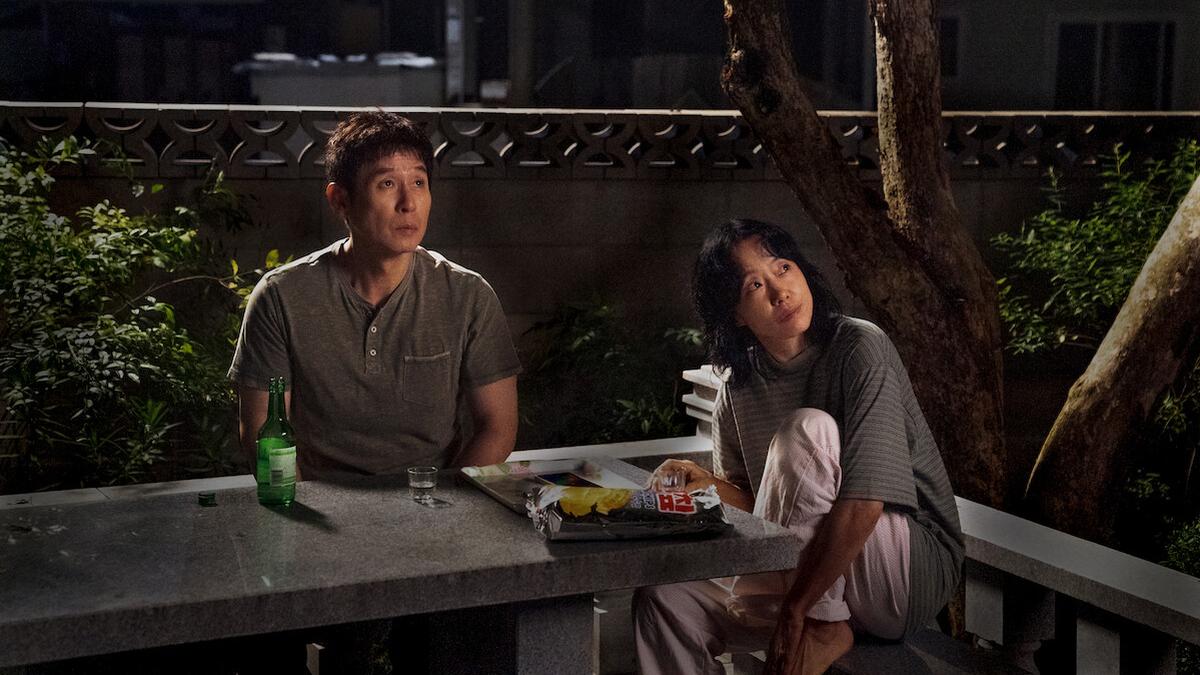
It is through the works of filmmakers like Lee Chang-dong that I have started to better understand and appreciate the etymology of the word ‘auteur’ — that rare writerly sensibility so singular that every frame seems to bear the imprint of an unmistakable literary temperament that makes cinema feel authored in the most intimate sense of the word.My second encounter with the Korean auteur after his masterful Burning (2018) was another reminder that few contemporary filmmakers understand the anatomy of modern human misery with quite this much formal intelligence. Led by one of the year’s most unforgettable ensembles, featuring Jeon Do-yeon, Sul Kyung-gu, Zo In-sung and Cho Yeo-jeong, Possible Love won the Silver Lion Grand Jury Prize and the FIPRESCI Prize at the 83rd Venice International Film Festival, and has been selected as South Korea’s submission for Best International Feature Film at the 99th Academy Awards.The film opens by invoking the Tenth Commandment, borrowing its dedication to the memory of Krzysztof Kieślowski’s Dekalog 10. Rather than attempting a remake, Lee takes the injunction against covetousness and subjects it to a more uncomfortable interrogation, bringing two married couples from opposite ends of South Korea’s economic spectrum into an increasingly fraught entanglement following the violent suppression of a factory workers’ strike.On one side are Ho-seok (Sul Kyung-gu), a taciturn factory worker whose life has unravelled following his dismissal and a brutal police assault during a workers’ strike, and Mi-ok (Jeon Do-yeon), his spirited wife, who has spent the intervening years watching the man she fell in love with recede into depression, resentment and alcoholism. On the other are Ye-ji (Cho Yeo-jeong), an aspiring documentarian who sees their misfortune as the subject of her next film, and Sang-woo (Zo In-sung), her fabulously wealthy, generationally privileged husband. Much as he did in Burning, Lee takes an almost novelistic interest in the strange intimacies that emerge when these disparate lives begin to overlap. But he is equally attentive to the social/class hierarchies of these encounters, letting seemingly innocuous exchanges, or displays of affluence and unspoken resentments, contaminate the possibility of genuine human connection. Possible Love (Korean)Director: Lee Chang-dongCast: Jeon Do-yeon, Sul Kyung-gu, Zo In-sung, Cho Yeo-jeong, Jung SeolRuntime: 164 minutesStoryline: Hidden desires emerge when a laid-off worker and his wife cross paths with a documentary filmmaker and her husbandIt is fascinating to watch Lee make the proximity of wealth such a destabilising experience for Mi-ok — Jeon Do-yeon is an absolute stunner throughout, bringing an irrepressible, almost mischievous vitality to her performance — whose growing attachment to Ye-ji is complicated by an acute awareness of everything her new friend takes for granted. The designer handbag she furtively photographs, the clothes she gently reprimands Ye-ji for wearing around impoverished workers, or the almost girlish fascination with her friend’s impossibly handsome husband; these are not incidental manifestations of covetousness so much as the small, humiliating negotiations of someone suddenly made conscious of the limits of their own existence. Lee is too astute to treat envy as a private moral deficiency when its objects are so conspicuously distributed along lines of economic privilege. Ye-ji and Mi-ok might have different ideas of what constitutes a desirable life, but as the iconic LCD (Lee Chang-dong) Soundsystem reminds us, sometimes you have to simply ‘Covet Yrslf Clean’. A still from ‘Possible Love’ | Photo Credit: Netflix Lee extends this suspicion of unequal power into the very act of storytelling, making Ye-ji’s documentary ambitions an uncomfortable exercise in the ethics of looking. Her interest in the casualties of corporate restructuring is ostensibly commendable, but the pampered documentarian’s attempts to insinuate herself into Mi-ok and Ho-seok’s working-class existence feels appropriately contrived. She wants proximity to their suffering without quite recognising the indignities involved in making that suffering available for her artistic consumption. The film’s recurring image of Ye-ji lurking behind her camera, even during moments of private intimacy, is a pointed joke at the expense of her professed empathy. Lee seems less interested in questioning her intentions than exposing her astonishing inability to recognise how thoroughly her privilege conditions the terms of her engagement. Even the name of Ye-ji’s dog, Blue, feels like a loaded choice, with Kieślowski’s Three Colours: Blue hidden just out of vision in her editing-room wall and the blue-collar world just beyond her field of vision.What is most delicious is the willingness to let the two couples trespass upon each other’s worlds, temporarily suspending the social arrangements. But there is no sense of levelling here, and certainly no redemptive fantasy in which a weekend at a seaside mansion dissolves the material antagonisms of class. The asymmetry survives every convivial dinner or drunken confession; even, the very hospitality often feels like another instrument of condescension. Lee knows that the cruellest indignity of late capitalism may not be that the poor cannot possess what the wealthy have, but that they are repeatedly invited to experience its pleasures without ever being allowed to partake freely.But what Lee is especially unwilling to do is afford Ho-seok the consolations of victimhood. His despondency has calcified into something uglier than sadness: an almost pathological withdrawal from the world, punctuated by flashes of aggression and an inability to recognise the person his wife is still trying desperately to reach. Having lost considerably more than a factory job, Ho-seok has been dispossessed of the social identity through which he understood his own dignity and masculine worth. His harrowing final-act interview lays bare the psychic wreckage of being stranded in the aftermath of a defeated political imagination, unable to mourn what was lost, yet equally incapable of recovering the emancipatory promise that once made struggle conceivable. He is neither an exemplary proletarian martyr nor an agreeable casualty of corporate brutality, but a damaged, resentful man whose suffering frequently spills over onto those closest to him. Nevertheless, Lee’s empathy remains boundless. He knows that economic violence does not produce photogenic victims, and that some injuries cannot be converted into inspirational narratives of recovery. He also seems entirely disillusioned in the reassuring directedness of progressive resistance, wherein suffering must eventually yield some historical dividend. A still from ‘Possible Love’ | Photo Credit: Netflix Perhaps most intoxicating is Lee’s incredible capacity to make seemingly negligible details accrue remarkable emotional and thematic consequence. The distinction between the workers who retained their jobs as “the living” and those made redundant as “the dead” is disconcerting enough, but Lee keeps finding stranger, more intimate ways of allowing that original violence to metastasise through the film — whether that is the drinking that continually circles back to Ho-seok’s trauma, the contrasting physicality of Cheol’s Taekwondo lessons, the police whistle that connects the brutality of the crackdown to the curious servitude of Sang-woo’s childhood companion, or the recollection of Mi-ok’s mother washing cars. Even the camera’s persistent encroachment upon private conversations feels like an extension of the film’s larger anxieties about surveillance and the ownership of experience. Lee has such an extraordinarily calibrated understanding of his characters’ interior lives that nothing feels incidental. The sheer density of observation is astonishing.What Lee seems to find so entertaining (yet even kind of heartbreaking), is the extent to which these four people mistake their mutual fascination for some kind of social or emotional reciprocity. The couples are genuinely taken with one another, but the terms of their attraction could hardly be more lopsided — Mi-ok and Ho-seok are briefly seduced by the prospect of a life beyond their economic humiliations, while Ye-ji and Sang-woo get to entertain the peculiarities of working-class existence without ever having to inherit its consequences. Lee delights in letting this improbable foursome play house and flirt with alternative arrangements, but the class antagonisms never quite disappear. A still from ‘Possible Love’ | Photo Credit: Netflix Possible Love finds its most affecting expression in the stubborn, thoroughly unidealised intimacy between Ho-seok and Mi-ok, and Lee’s deepest investment lies in the battered little covenant that survives between the two. Whatever remains of their marriage has long since outgrown the conventions of romantic fulfilment; now measured solely in the unglamorous, often thankless labour of staying beside someone who has become almost a stranger to themself. Lee deftly avoids offering any consolatory nonsense on how affection can somehow transcend material reality. If anything, Possible Love suggests that loving somebody under such conditions is a valiant act of insubordination, perhaps the last remaining luxury that the machinery of capital hasn’t quite figured out how to commodify.For the better part of a decade, Korean cinema and television have been gnawing away at the country’s class fissures, with some of its more palatable indictments making Oscar history and others proving a little too caustic for the Academy’s notoriously delicate constitution. The genre, if one can call it that, has only grown more incandescent in its indignation and more exacting in its dissection; Possible Love feels like the most assured and masterful distillation of everything that has come before it.Possible Love is currently streaming on Netflix
‘Possible Love’ movie review: Lee Chang-dong’s exquisitely layered study of covetousness
Full Article
Original Source
Read the full article at Thehindu →KhanList aggregates and links to publicly available news content. We do not host full articles from third-party sources. Always verify important information with original sources.