
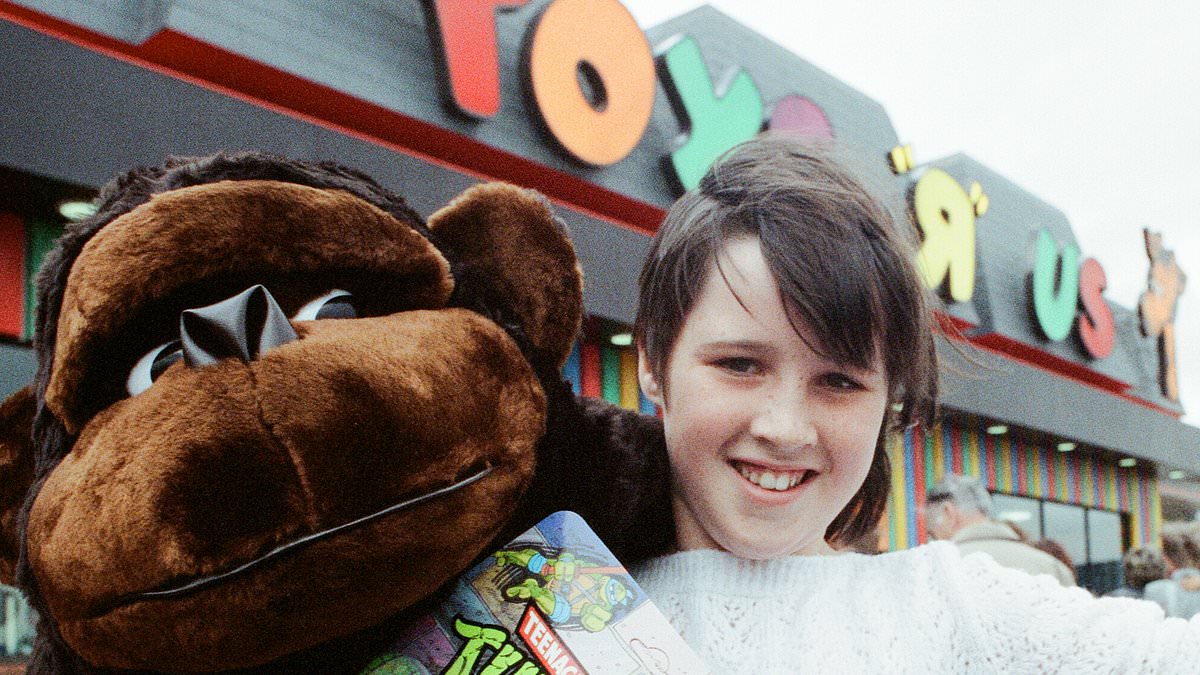
From luxury clothing to rented DVDs and imaginative children's toys, the bustling British high street was once the prime spot for premium shopping sprees.But the demand for next-day delivery coupled with online shopping has seen most of these historic stores almost vanish entirely - while the few that remain are struggling to stay in business.This week, Poundland became the latest high-street chain to be hit by the ensuing crisis, as the discount retailer collapsed into administration just weeks before Christmas.The signature chain - which has been trading since 1990 - could not secure a solvent rescue deal, with as many as 12,000 jobs across its 600 stores now at risk.Its failure marks one of the biggest High Street collapses since the shut of BHS in 2016, which resulted in 11,000 job losses and 164 store closures.But while the British high street has changed vastly through the decades - many nostalgic Britons still long for the days of wandering into physical stores that sold everything you could need.From Dixons to Gamages, Toys R Us and Blockbuster, read on to reminisce over Britain's lost high street stores that you desperately wish would make a comeback...Toys R Us The American toy store outlet Toys R Us was founded in its modern iteration in 1957. It was the go-to destination for parents hoping to treat their children to an assortment of branded games and electronics But the retail giant was forced to close all of its stores across both Britain and America in April 2018 having filed for bankruptcy protection just a few months before. Here, morning queues are seen at the Toys R Us in Teeside Shopping Park in 1990 More than 3,000 jobs were lost when the company went into administration. Some critics have blamed the brand's lack of innovation as well as the use of giant unnecessary warehouses that were not used to their full potentialThe American toy store outlet Toys R Us was founded in its modern iteration in 1957.It was the go-to destination for parents hoping to treat their children to an assortment of branded games and electronics.But the retail giant was forced to close all of its stores across both Britain and America in April 2018 having filed for bankruptcy protection just a few months before.More than 3,000 jobs were lost when the company went into administration.Some critics have blamed the brand's lack of innovation as well as the use of giant unnecessary warehouses that were not used to their full potential.Its Asian stores still remain operational after they were bought by lenders including Fung Retailing.Blockbuster Founded in 1985, Blockbuster was a vastly popular American rental chain that emerged on the British high street in March 1989 It boasted more than 9,000 stores and 84,300 employees across the globe at its peak in 2004. Customers could rent videos, DVDs, PlayStation games as well as a range of snacksFounded in 1985, Blockbuster was a vastly popular American rental chain that emerged on the British high street in March 1989.It boasted more than 9,000 stores and 84,300 employees across the globe at its peak in 2004.Customers could rent videos, DVDs, PlayStation games as well as a range of snacks.But its corporate owned company went bust in 2013 as many independent franchises attempted to struggle on.Its demise is often attributed to the modern accessibility of films through online streaming platforms such as Amazon and Netflix.Only one Blockbuster store in the entire world remains open today and can be found in Bend in Oregon, America.Gamages Founded in Holborn, London, in 1878 by Albert Walter Gamage, Gamages was a signature British department store that was particularly well-known for its bustling toy department and for its affordable products Fondly dubbed 'The People's Popular Emporium', youngsters flocked to the signature store at Christmas time, enjoying the likes of its Father Christmas grotto and large model railway displays that drew thousands of visitors But while it was seen as a signature store in the 1950s and 1960s, by 1972 Gamages was struggling to survive due to a shift in retail habits and a failed expansion attemptFounded in Holborn, London, in 1878 by Albert Walter Gamage, Gamages was a signature British department store that was particularly well-known for its bustling toy department and for its affordable products. Fondly dubbed 'The People's Popular Emporium', youngsters flocked to the signature store at Christmas time, enjoying the likes of its Father Christmas grotto and large model railway displays that drew thousands of visitors. Its 1,300-page mail-order catalogues shipped items all across Britain - bringing London shopping to households across the nation. Gamages later became the official supplier of Cub Scout uniform.But while it was seen as a signature store in the 1950s and 1960s, by 1972 Gamages was struggling to survive due to a shift in retail habits and a failed expansion attempt. In March of that year it closed its doors for the final time, much to the dismay of British shoppers who considered it to be a retail staple.Radio Rentals Founded in Brighton in 1930, Radio Rentals was Britain's major home-entertainment rental that quickly emerged as the nation's largest television rental group In 1997, 90 stores closed across the nation, and by 2000 it had merged with Granada Rentals to form Boxclever. In 2003, however, Boxclever collapsed into administration due to a decline in the demand for appliance rentalsFounded in Brighton in 1930, Radio Rentals was Britain's major home-entertainment rental that quickly emerged as the nation's largest television rental group. From the 1950s onwards, it expanded across much of the UK, with more than 500 shops and up to 200million customers at its peak. Acknowledging a gap in the market given the high price of televisions, Radio Rentals offered Britons the chance to watch the likes of Coronation Street and newly-unveiled colour TV in the late 60s. However, as electronics became cheaper to buy outright in the 1980s and 1990s, demand for renting slowly decreased - and sales quickly declined. In 1997, 90 stores closed across the nation, and by 2000 it had merged with Granada Rentals to form Boxclever. In 2003, however, Boxclever collapsed into administration due to a decline in the demand for appliance rentals. WoolworthsWoolworths was once a High Street staple, known for its pick 'n' mix sweets and its bargain prices, it sold everything from clothes, to records and household goodsThe much-loved high street variety retailer launched in Liverpool in 1909 and had more than 800 shops in the UK Scores of shoppers crowd a Woolworths during the Christmas rush of 1955. Affectionately referred to as 'Woolies', the once-ubiquitous department store chain collapsed amid the financial crisis of 2008 as cheaper shops ate into its market share Woolworths' lower prices, loyalty bonuses and its broad range of items meant customers could buy anything and everything all in one place. Its biggest competitors were penny bazaars such as Marks & Spencer, which has stood the test of timeWoolworths was once a staple of the High Street, known for its pick 'n' mix sweets and its bargain prices, it sold everything from clothes, to records and household goods.The much-loved high street variety retailer launched in Liverpool in 1909 and had more than 800 shops in the UK.By the 1930s, the British firm was experiencing an unrivalled period of prosperity, with record levels of sales and profits.This continued into the 1950s when Woolies celebrated its Golden Jubilee in 1959 with record profits and saw its 1,000th branch open in West Sussex.Affectionately referred to as 'Woolies', the once-ubiquitous department store chain collapsed amid the financial crisis of 2008 as cheaper shops ate into its market share.Some historians believe that Woolworths revolutionised the retail industry in the UK, with founders in America being surprised at how well it had been adopted by the British people.Woolworths' lower prices, loyalty bonuses and its broad range of items meant customers could buy anything and everything all in one place. Its biggest competitors were penny bazaars such as Marks & Spencer, which has stood the test of time.There had been talk of a Woolies revival back in 2017, when former brand director Tony Page teased plans to buy the name back from Shop Direct, but the comeback never materialised.The brand still exists abroad, including in Germany.Dixons First launched in October 1937 in Southend-On-Sea as a photographic studio, Dixons quickly emerged as a leader in camera sales, mail order and consumer electronics Its 190 stores formed part of the Currys chain, which had by then overtaken Dixons as Britain's leading electricals retailerFirst launched in October 1937 in Southend-On-Sea as a photographic studio, Dixons quickly emerged as a leader in camera sales, mail order and consumer electronics. By the 1950s and 60s, it was Britain's leading photography retailer before later offering the likes of televisions, calculators and VCRs as technology advanced. In 1984, following its takeover of Currys, Dixons became a staple on the British high street, with many regarding it as their go-to spot for gadgets and electricals.But in 2006, shoppers were left heartbroken when Dixons disappeared from the high street after almost 70 years. Its 190 stores formed part of the Currys chain, which had by then overtaken Dixons as Britain's leading electricals retailer. At the time, DSG chief executive John Clare acknowledged that 'some customers will feel nostalgic about the decision', but added: 'It's not a decision that we have taken lightly. 'The high street has become an increasingly challenging environment and the cost of maintaining a presence there has increased, largely through increases in rent and rates. We will be better able to offset those costs as we attract a wider range of customers.'Dewhurst It was once Britain's largest chain of high street butchers, with up to 1,400 shops at its peak. Founded in 1897 by the Vestey family, Dewhurst was famous for its signature counter service, nostalgic striped aprons and local community feel But by the early 2000s, Dewhurt's success was beginning to dwindle due to rising competition from supermarket and an increase in operation costsIt was once Britain's largest chain of high street butchers, with up to 1,400 shops at its peak. Founded in 1897 by the Vestey family, Dewhurst was famous for its signature counter service, nostalgic striped aprons and local community feel.Many also credited Dewhurst with the introduction of glass shopfront windows to butcher shops in a bid to protect the meat from outdoor air. At their peak, the Vestey family enjoyed almost unrivalled riches. Their immense fortune - created by two hard-knuckled brothers from Liverpool, William and Edmund, and currently estimated at about £750 million – enabled the Vesteys to acquire country seats in Gloucestershire and Suffolk, and sporting estates in Scotland, not to mention strings of polo ponies and a peerage.But by the early 2000s, Dewhurst's success was beginning to dwindle due to rising competition from supermarkets and an increase in operation costs. In 2006, Dewhurst collapsed into administration and was forced to close 60 of its 95 remaining shops. The rest were placed for sale, marking a devastating end to the historic high street staple. British Home Stores (BHS) British Home Stores opened its first store in Brixton, south London, in 1928 before slowly growing in prominence across the nation In June 2016, BHS shut its doors for good - having accumulated debts of more than £1.3billion, which included a pension deficit of £571million Financial deficit, poor management and an inability to adapt to the growth of online shopping saw the 88-year-old chain collapse into administration after being sold for just £1British Home Stores opened its first store in Brixton, south London, in 1928 before slowly growing in prominence across the nation.However, financial deficit, poor management and an inability to adapt to the growth of online shopping saw the 88-year-old chain collapse into administration after being sold for just £1.In June 2016, BHS shut its doors for good - having accumulated debts of more than £1.3billion, which included a pension deficit of £571million.BHS bosses had attempted to negotiate a rescue deal more than two months prior to the closure which eventually fell through.It had been the go-to department store for many hoping to buy clothing and household items but was criticised for catering to the elderly market and failing to innovate.Indicative of the nation's love for the store, there was even a guerrilla campaign in May 2016 that saw historic landmarks around London - such as Marble Arch, Wellington Arch and Blackfriars Bridge - lit up with the #SaveBHS slogan.It was hoped that this would help find a saviour to take ownership of the 163 BHS stores across the country but this ultimately proved unsuccessful.C&A A shopper takes in the expensive hats on sale at C&A in Marble Arch, London, in 1962. For many years, C&A retail clothing stores were a major presence on high streets throughout the UK C&A opened stores in a number of out-of-town locations, most notably its store at the Merry Hill Shopping Centre in the West Midlands, which opened in November 1989 However, the company's strategy of selling budget clothes from high-rent city-centre retail stores made it vulnerable to a new breed of competitors operating in cheaper, out-of-town locationsFor many years, C&A retail clothing stores were a major presence on high streets throughout the UK.C&A opened stores in a number of out-of-town locations, most notably its store at the Merry Hill Shopping Centre in the West Midlands, which opened in November 1989.However, the company's strategy of selling budget clothes from high-rent city-centre retail stores made it vulnerable to a new breed of competitors operating in cheaper, out-of-town locations, including Matalan and the rapidly expanding clothing operations of supermarket food chains such as Tesco and Asda.In 2000, C&A announced it was to close all its UK stores, with the loss of 4,800 jobs from its 113 stores.Neil McCausland, the company's managing director at the time, said: 'This is a sad and difficult decision for the company,' adding that it had racked up £250million of losses in the UK in the past five years.'C&A has been part of the British high street for over 75 years and was determined to remain so. Unfortunately, business conditions do not allow this to happen.'Primark bought 11 of the C&A stores.Peter Robinson First launched in 1833 as a linen shop in Oxford Street, Peter Robinson later emerged as one of the nation's most beloved high street stores - famous for women's fashion, clothing and accessories Its flagship Oxford Street store was a landmark of shopping in the capital, drawing in thousands of customers thanks to its festive window displays, bargain sales and exciting offerings Over time, the Peter Robinson brand was largely phased out and instead rebranded into either Topshop or Topman by the late 1970sFirst launched in 1833 as a linen shop in Oxford Street, Peter Robinson later emerged as one of the nation's most beloved high street stores - famous for women's fashion, clothing and accessories. In the 1850s, John Lewis even worked for Peter Robinson's Oxford Street store as an assistant, and turned down a partnership to open his own shop. Its flagship Oxford Street store was a landmark of shopping in the capital, drawing in thousands of customers thanks to its festive window displays, bargain sales and exciting offerings. During the Blitz in the Second World War, Peter Robinson suffered from extensive bomb damage, with three floors destroyed. The store's basement was even converted into studios for the BBC Eastern Service and used by George Orwell for broadcasting from 1941 to 1943. In 1964, Topshop was launched as a section within Peter Robinson stores designed to appeal to younger people. But by 1974, it had separated from Peter Robinson.Over time, the Peter Robinson brand was largely phased out and instead rebranded into either Topshop or Topman by the late 1970s. Tragically, however, the flagship Topshop store at the former Peter Robinson site closed in 2020 after Sir Philip Green's Arcadia Group went into administration. Borders For years, Borders was the go-to bookshop for Britons, first founded in 1998. It broke away from its American parent company in 2007 to become recognised in its own right But Borders eventually collapsed in the UK in June 2009 in the face of mounting debts and was followed a short time later by its American outlets which also filed for bankruptcyFor years, Borders was the go-to bookshop for Britons, first founded in 1998. It broke away from its American parent company in 2007 to become recognised in its own right.The chain offered a comfortable browsing experience of books, music and film complemented by its in-house coffee shops.It employed more than 2,000 employees and boasted 71 stores at its peak.But Borders eventually collapsed in the UK in June 2009 in the face of mounting debts and was followed a short time later by its American outlets which also filed for bankruptcy.The firm blamed its declining sales on a rapidly changing market that stemmed predominantly from the increasing availability of digital books.
Popular British High Street stores from your childhood that have vanished - including C&A, Woolworths, Toys R Us and Dewhurst... so, how many do YOU remember?
Full Article
Original Source
Read the full article at Dailymail →KhanList aggregates and links to publicly available news content. We do not host full articles from third-party sources. Always verify important information with original sources.