
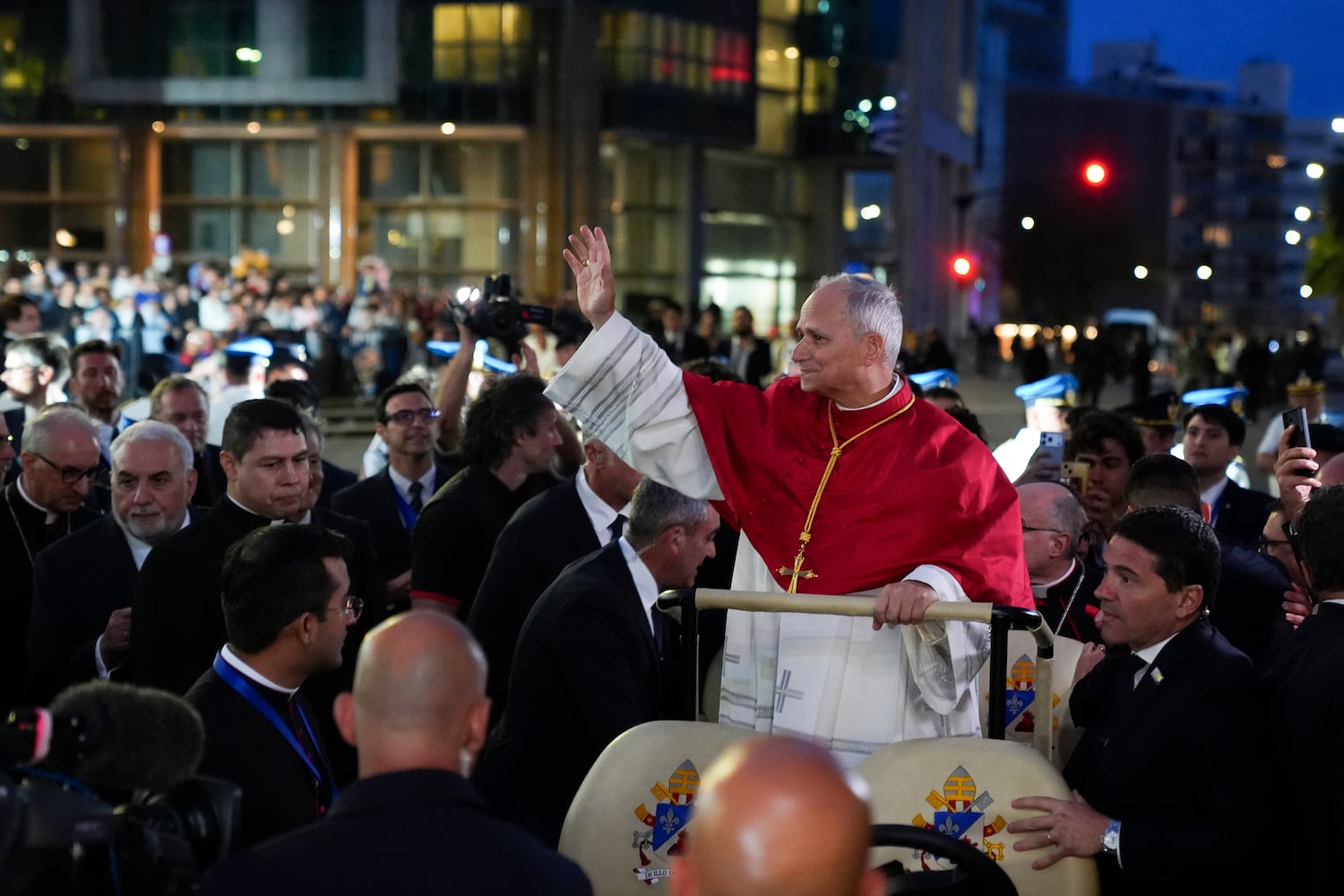
Welcome back to Foreign Policy’s Latin America Brief. The highlights this week: Pope Leo XIV visits South America, regional leaders gather at the Ibero-American Summit in Spain, and Chile’s Atacama Desert feels the effects of El Niño. Pope Leo XIV began a 12-day tour through South America last Friday. It is the longest trip yet of his papacy, taking him to Uruguay, Argentina, and Peru. He’s getting a rock star reception: The Chicago-born pope became a Peruvian citizen after working as a missionary in the country, making this trip a homecoming for him, Gene Kuleta wrote in Foreign Policy last month. In Argentina, Leo made headlines on Sunday when he called for the kind of strong social welfare state that runs counter to President Javier Milei’s austerity measures. Milei nevertheless praised Leo through tears when he bid him farewell. Argentina experienced a national “collective empathy” during Leo’s trip, Clarín’s Héctor Gambini wrote. Leo’s itinerary underscores a clear set of foreign-policy ideals, said Massimo Faggioli, a historian at Villanova University, the pope’s alma mater. Chief among them is the idea that the Catholic Church can be a guardian for multilateralism as it comes under attack from the United States. While the Vatican’s support for the United Nations system is not new, “what has changed is that U.S. foreign policy has become more muscular, more unilateral, and so you see more visibly now the difference between American foreign policy and that of the Vatican,” Faggioli said. Leo was outspoken after the United States captured Venezuelan President Nicolás Maduro in January and again after the United States and Israel launched a war against Iran in February, according to Faggioli. The pope publicly suggested that both actions could be unlawful; he has since visited multiple small countries and spoken about how they play crucial roles in the international system. “The gift of smallness,” Leo said on a trip to Monaco in March, means putting “your prosperity at the service of law and justice, especially at a historical moment when the display of power and logic of oppression are harming the world and jeopardizing peace.” This focus on small states helps explain why Leo chose to start his trip in Uruguay, which is one of Latin America’s least religious countries, Faggioli said. The pope was celebrating Uruguay’s strong civic and diplomatic traditions, not just its small Catholic population. A plurality of the country’s population has no religious affiliation. “Persevering in respect for law, for negotiation, and for the patient search for agreements is a service that Uruguay can continue to offer to its neighbors,” Leo said in Uruguay’s capital of Montevideo last Friday. The orchestra that welcomed him played Afro-Uruguayan candombe. Latin America’s Catholic population is shrinking—dropping from 80 percent of the total population in 1995 to only 55 percent today, losing ground to evangelicals and people with no religion, according to pollster Latinobarómetro. But the same survey suggests that the decline has slowed in the last half decade. “That might be part of the Pope Francis effect,” Faggioli said, referencing Leo’s popular Argentine predecessor. Leo has continued Francis’s focus on seeking out the poor and marginalized in his travels. Judging by the crowds welcoming the pope in Argentina, the country has fully embraced him as a continuation of Francis’s spirit. Leo arrived in Peru on Wednesday. On Friday, he will return to his adopted hometown of Chiclayo. Friday, Nov. 13: Cuban Foreign Minister Bruno Rodríguez Parrilla concludes visit to China. Friday, Nov. 13, to Tuesday, Nov. 17: Pope Leo XIV ends his tour with a visit to Peru. Wednesday, Nov. 18, to Thursday, Nov. 19: Chilean President José Antonio Kast, Mexican President Claudia Sheinbaum, and Peruvian President Keiko Fujimori attend the Asia-Pacific Economic Cooperation summit in China. Monday, Nov. 23, to Friday, Nov. 27: Polish President Karol Nawrocki visits Argentina and Chile. Paraguay’s bank scandal. As this newsletter covered last week, a dramatic bank collapse in Paraguay toppled President Santiago Peña, who was removed from office on Nov. 6 after announcing plans to resign the day before. It was the country’s largest political crisis since the 2012 removal of leftist President Fernando Lugo. Lugo was one of the few Paraguayan leaders of the last 70 years who did not hail from Peña’s right-wing Colorado Party. Peña was replaced by his vice president, Pedro Alliana, who is expected to hew closely to Colorado’s orthodoxy, the Paraguay Post reported. That includes trying to create a business-friendly environment and staying aligned with the United States, Israel, and Taiwan. Alliana signaled that he would focus mostly on domestic policy, saying in remarks to Congress that “too much time has been spent overseas.” Paraguay’s next presidential election is set for 2028. Slavery reparations? The United Kingdom’s King Charles III faced protesters demanding reparations for slavery during a trip to the Bahamas, Guyana, and Antigua and Barbuda that wrapped up last week. The island nations remain part of the Commonwealth of Nations, an association of 56 countries, mostly former British colonies. Unlike fellow Caribbean community member Jamaica, the three countries that Charles visited have not filed a formal legal petition on reparations to the United Kingdom. But the protesters’ demands still prompted a formal response from British Prime Minister Andy Burnham, who attended a Commonwealth Heads of Government summit last week. Burnham committed to beginning a “structured dialogue” with Caribbean countries affected by the slave trade, Antigua and Barbuda Prime Minister Gaston Browne said. Though Burnham recently wrote in the Guardian that he did not believe financial reparations were appropriate, last week he voiced openness to debt restructuring for some Commonwealth countries. An aerial view of blooming wildflowers in the Atacama Desert near Copiapo, Chile, on Sept. 18. An aerial view of blooming wildflowers in the Atacama Desert near Copiapo, Chile, on Sept. 18.Javier Torres/AFP via Getty Images Desert bloom. Chile’s Atacama Desert is covered in bright pink, purple, and yellow desert flowers this month. They spring to life every few years, when the area receives high amounts of rain. This year’s display is a result of the weather irregularities linked to the so-called Super El Niño climate phenomenon. El Niño has hit various parts of Latin America differently. Nearby Bolivia has seen severe droughts and has declared a state of emergency, FP’s Christina Lu reported. The toll on Chile has also been tragic: A storm that scientists say was exacerbated by the weather pattern killed 13 people in July, some of them in the same region as the Atacama Desert. While Chileans are celebrating the desert blooms, many are also calling for better preparedness for extreme climate events. In addition to the Atacama Desert, which of the following is also a desert in Chile? Though most of Patagonia is in Argentina, some of it extends into southern Chile. Hegseth’s Leadership Has Damaged the Pentagon by Kori Schake Why Kushner and Witkoff Keep Failing by Stephen M. Walt The Experts Are Taking Their Revenge Again by David Milne Argentina's President Javier Milei and other leaders attend the 30th Ibero-American Summit at the Royal Collections Gallery in Madrid on Nov. 5. Argentina’s President Javier Milei and other leaders attend the 30th Ibero-American Summit at the Royal Collections Gallery in Madrid on Nov. 5. Thomas Coex/AFP via Getty Images Last week, seven Latin American heads of state gathered in Madrid for the Ibero-American Summit, which has been held nearly every year since 1991 and unites Latin American countries with Spain, Portugal, Andorra, and Equatorial Guinea. Presidential attendance increased since the last summit in 2024, as did the number of countries that signed on to a joint declaration—albeit with some disagreements in the footnotes. The event is the latest evidence that Latin American leaders are trying to strengthen their network of relationships beyond just the United States and China, which are the top trade partners for many of them. Notably, most of the Latin American presidents at the summit were right-wing leaders who have signaled alignment with U.S. President Donald Trump. Brazil, Mexico, and Uruguay—all led by left-wing presidents—sent their foreign ministers instead. In his speech, Bolivian President Rodrigo Paz marked independence from the United States both by congratulating Brazil on its democratic election—which Trump has still not recognized—and by proposing the creation of an Ibero-American “center for strategic and security thinking” in Bolivia. The proposal was accepted, Paz said afterward. It is an indication that as his and other right-wing governments don’t want anti-crime cooperation to be restricted to the Trump-led Shield of the Americas initiative. It’s not the only recent sign that Latin American countries are turning to Europe for partnership. Since the Mercosur-European Union trade deal took provisional effect in May, exports to the bloc have risen by around 30 percent from Brazil alone, according to Brazil’s trade ministry.
Pope Leo’s South America Tour
Full Article
Original Source
Read the full article at Foreignpolicy →KhanList aggregates and links to publicly available news content. We do not host full articles from third-party sources. Always verify important information with original sources.